
Real Estate Project Finance: A Comprehensive Guide
Project finance is long-term financing of an independent capital investment, which are projects with cash flowsStatement of Cash FlowsThe Statement of Cash Flows (also referred to as the cash flow statement) is one of the three key financial statements that report the cash and assetsTangible AssetsTangible assets are assets with a physical form and that hold value. Examples include property, plant, and equipment. Tangible assets are that can be distinctly identified. Real estate project finance is a classic example. Other examples of project finance include mining, oil and gas, and buildings and constructions.

Real estate project finance cash flows should be sufficient to cover operating expenses and to fund the financing repayment requirements. Typically, the financing is made up of debtSenior and Subordinated DebtIn order to understand senior and subordinated debt, we must first review the capital stack. Capital stack ranks the priority of different sources of financing. Senior and subordinated debt refer to their rank in a company's capital stack. In the event of a liquidation, senior debt is paid out first and equity matched to the lifespan of the asset.
Real Estate Project Finance vs Corporate Finance
When a corporationCorporationA corporation is a legal entity created by individuals, stockholders, or shareholders, with the purpose of operating for profit. Corporations are allowed to enter into contracts, sue and be sued, own assets, remit federal and state taxes, and borrow money from financial institutions. takes on a new investment, it can use cash flows from other operating activities to fund the new project. It can also use its general creditworthiness to borrow money and fund the project. The corporation might also issue equity with an indefinite time horizon. In real estate project finance, equity used to fund the project is usually repaid at the end of a specific time horizon.
Capital Stack in Real Estate Project Finance
When it comes to funding real estate project finance, the capital stack includes several considerations, as follows:
- Draws on construction loans for financing
- Security and priority for various lenders in the capital stack
- Term that matches the length of time it takes to develop and sell the project
- Trade-offs between fixed and floating interest rate
- Pricing around the equity
The capital stack, which consists of all of the different types of financing that may be used, typically comprises the following:
- Senior debt
- Subordinated debt
- Equity
Senior debt is the most secured capital, while equity is the riskiest out of the three.
Real Estate Project Finance Industry Terms and Definitions
To build a financial model, we need to understand the important terms and definitions frequently used in real estate project finance:
- Loan to value (LTV): The amount of debt financing a lender will provide as a percentage of the market value of the real estate.
- Loan to cost (LTC): The amount of debt financing a lender will provide as a percentage of the cost of a development.
- Net operating income (NOI): Gross rental revenue less operating expenses (property taxes, insurance, maintenance, etc.).
- Cap rate: NOI divided by the value of the property, expressed as a percentage.
- Amortization period: The number of periods (months or years) the principal repayments of a loan take to be completed.
- Term: The length of time that the interest rate on a mortgage loan is agreed for.
- General partner (GP): An owner of a partnership with unlimited liability – usually a manager who actively participates in the operations.
- Limited partner (LP): A passive investor who has limited ability, based on the amount they have invested in the project.
- Land loan: Financing used to acquire a piece of land with no NOI. The long-term value will be much lower than that of an income-producing property.
- Floor space ratio (FSR): Used to determine the size of a building and control the density of development on a parcel of land.
- Gross building area (GBA): The sum of all building spaces from wall to wall.
- Gross leasable area (GLA): The sum of all enclosed livable space.
- Gross site area: The two-dimensional measures of a site, based on its property lines.
- Deductions: A portion of the gross site area that cannot be built on, such as public access areas, roads, lanes, etc.
- Net site area: The gross site area, less any deductions.
- Max GBA: The gross building area, calculated based on the FSR.
- Construction GBA: The gross building area, based on construction plans.
- Saleable area: The gross building area based on construction, less all common spaces or other non-salable areas.
Real Estate Project Finance – Development Timeline
Understanding the development process and timeline helps us get a clear map when building a real estate project finance model. There are several stages in a real estate development project:
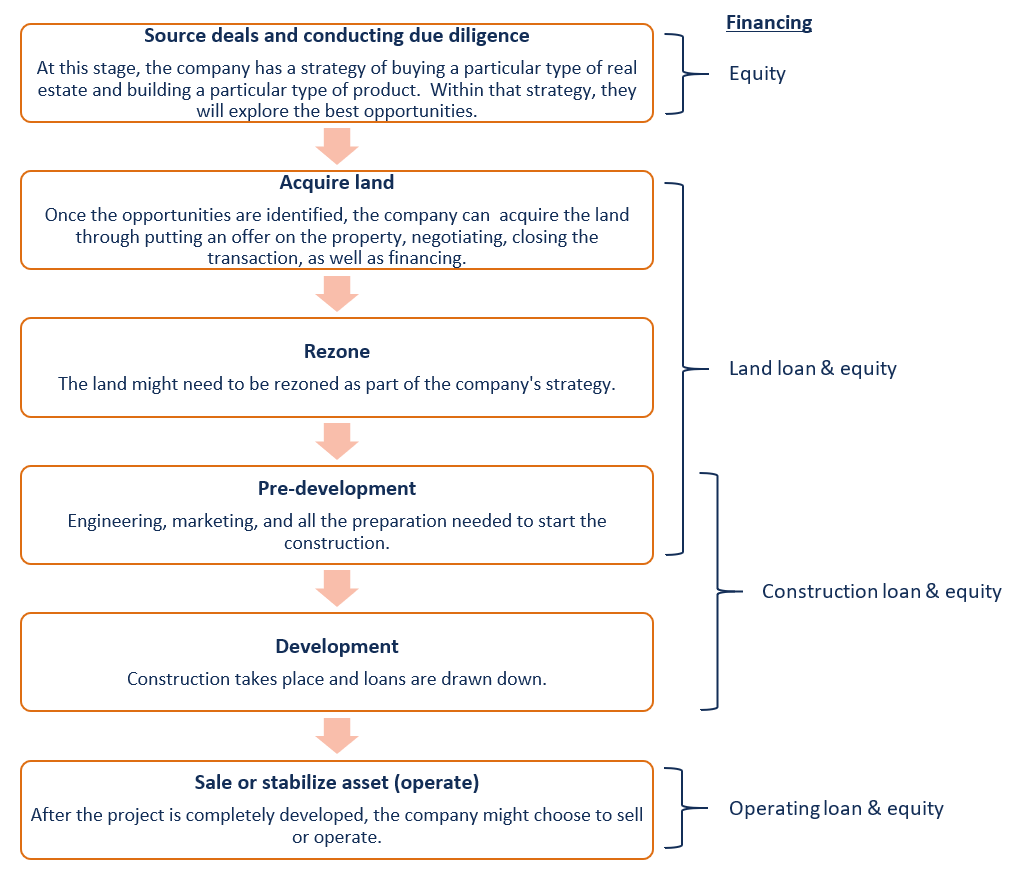
Different types of funding are used at each stage of the life cycle of real estate project finance. For example, a company may use equity to finance the sourcing of deals. This is because there is high risk in the early stages of a project and, therefore, it may be hard to obtain bank loans. In the later stages, such as rezoning and pre-development, the projects are usually financed with both loans and equity.
Real Estate Project Finance – Financial Model & Valuation
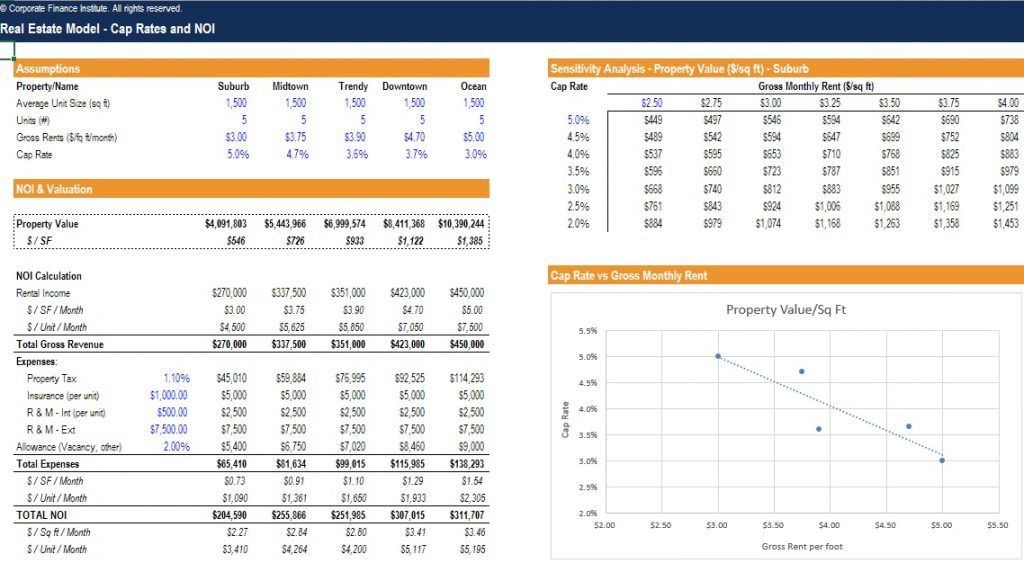
Below is a screenshot from CFI’s Real Estate Financial Modeling Course, where you can learn how to build a development model from scratch in Excel. Step-by-step instructions.
More Resources
We hope you’ve enjoyed reading CFI’s guide to real estate project finance. CFI offers the Financial Modeling & Valuation Analyst (FMVA)™Become a Certified Financial Modeling & Valuation Analyst (FMVA)®CFI's Financial Modeling and Valuation Analyst (FMVA)® certification will help you gain the confidence you need in your finance career. Enroll today! certification program for those looking to take their careers to the next level. To help you advance your career, check out the additional CFI resources below:
- Due Diligence in Project FinanceDue Diligence in Project FinanceDue diligence in project finance involves managing and reviewing the aspects related to a deal. Proper due diligence ensures no surprises arise in regard to a financial transaction. The process involves a comprehensive examination of the transaction and preparation of a credit appraisal note.
- Financial Modeling Best PracticesFinancial Modeling Best PracticesThis article is to provide readers information on financial modeling best practices and an easy to follow, step-by-step guide to building a financial model.
- Project Budget TemplateProject Budget TemplateThis project budget template provides you with a tool to summarize the cost budget for a project. The Project Budget is a tool used by project managers to estimate the total cost of a project. A Project Budget template includes a detailed estimate of all costs that are likely to be incurred before the project is comple
- Real Estate Joint VentureReal Estate Joint VentureA Real Estate Joint Venture (JV) plays a crucial role in the development and financing of most large real estate projects.
-

Haircut (Finance): Definition, Calculation & Importance
In finance, a haircut refers to the reduction applied to the value of an asset for the purpose of calculating the capital requirementNet Working CapitalNet Working Capital (NWC) is the difference betw
-

Leveraged Finance Explained: Strategies & Applications
Leveraged finance is the use of an above-normal amount of debt, as opposed to equity or cash, to finance the purchase of investment assets. Leveraged finance is done with the goal of increasing a
finance
- TLC in Real Estate: Understanding 'Tender Loving Care' Properties
- Understanding Baselines: Performance Measurement & Project Management
- Understanding Current Income Real Estate Investments
- Functional Obsolescence in Real Estate: Understanding & Impact
- Understanding Real Estate: Definition, Types & Key Concepts
- REITs Explained: Investing in Real Estate Through Trusts
- Real Estate Operating Companies (REOCs): Definition & How They Differ from REITs
- Proof of Funds in Real Estate: A Comprehensive Guide
- Project Finance: A Comprehensive Overview
-
 Understanding 10% Contingency Fees in Real Estate: A Comprehensive Guide
Working with a real estate agent to sell or buy property can free up your time. The agent is responsible for most aspects of the sale and basically all you have to do is show up at the closing and sig...
-
 Gift Deed for Real Estate: A Comprehensive Guide
When you want to convey a piece of property to someone else, choosing the right way to go about it is essential. One tool that you could use to convey a piece of real estate is a gift deed. This is a ...