
Incremental Analysis: A Comprehensive Guide for Business Decisions
Incremental analysis (also referred to as the relevant cost approach, marginal analysis, or differential analysis) is a decision-making tool used to assess financial information and derive a decision between two or more alternatives.

Incremental analysis is used by businesses to analyze any existing cost differences between different alternatives. The method incorporates accounting and financial information in the decision-making process and allows for the projection of outcomes for various alternatives and outcomes. Through incremental analysis, the revenues, costs, and possible outcomes of the alternatives can be identified.
Summary
- Incremental analysis (also referred to as the relevant cost approach, marginal analysis, or differential analysis) is a decision-making tool used to assess financial information.
- The three main concepts relevant to incremental analysis are relevant cost, sunk cost, and opportunity cost.
- Incremental analysis incorporates accounting and financial information in decision making and allows for the projection of outcomes for various respective alternatives and outcomes.
Examples of Incremental Analysis
The example below briefly illustrates the concept of incremental analysis; however, the analysis process can be more complex depending on the scenario at hand.
Company ABC is considering and evaluating two new business segments to add to their existing revenue streamsRevenue StreamsRevenue Streams are the various sources from which a business earns money from the sale of goods or provision of services. The types of. For educational purposes, these two segments will be called Alternative A and Alternative B, with the following information:
The revenues for each segment are $1.5 million and $1.45 million, respectively. The expenses for each segment amount to $750,000 and $595,000, respectively. To determine which segment is more attractive in the long run, the net income must be calculated, as seen in the diagram below:
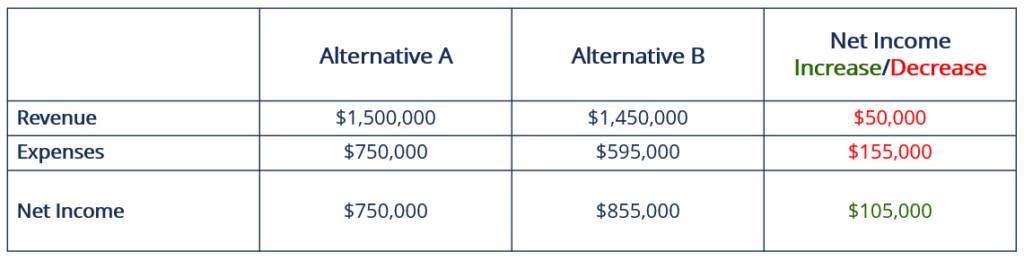
Alternative A reports a net income amounting to $750,000, while Alternative B’s net income totals $855,000. Based purely on the available financial information, the management team should decide to take on Alternative B as a new and/or additional segment.
Another example can be seen below:
A company receives an order from a customer for 1,000 units of a green widget for $12 each. The company controller looks up the standard cost for a green widget and finds that it costs the company $14. Of the $14, $11 is variable costVariable CostsVariable costs are expenses that vary in proportion to the volume of goods or services that a business produces. In other words, they are costs that vary and $3 is fixed cost.
Since the fixed cost is being incurred regardless of the proposed sale, it is classified as a sunk cost and ignored. It means that the incremental cost of the widget is $11. The company should accept the order since it will earn $1 ($12-$11) per unit sold, or $1,000 in total.
Concepts Incorporated Into Incremental Analysis
To fully comprehend the concept of incremental analysis, one has to understand its underlying concepts. The three main concepts are relevant cost, sunk costSunk CostA sunk cost is a cost that has already occurred and cannot be recovered by any means. Sunk costs are independent of any event and should not, and opportunity cost.
The concept of relevant cost describes the costs and revenues that vary among respective alternatives and do not include revenues and costs that are common between alternatives. The revenues that are generated between different alternatives are referred to as relevant benefits in some studies or texts.
Relevant costs are also referred to as avoidable costs or differential costs. For a cost to be considered a “relevant cost,” it must be incremental, result in a change in cash flow, and be likely to change in the future. Hence, a relevant cost arises due to a particular management decision. The concept does not apply to financial accounting but can be applied to management accounting.
The concept of sunk costs describes a cost that’s already been incurred and does not impact any decision made by management or between alternatives. The cost is unlikely to increase in the future or disappear completely. Other terms that refer to sunk costs are sunk capital, embedded cost, or prior year cost.
The concept of opportunity costOpportunity CostOpportunity cost is one of the key concepts in the study of economics and is prevalent throughout various decision-making processes. The describes the reward or loss resulting from a decision made between respective alternatives.
The opportunity cost refers to the value of what is lost when a decision between two or more alternatives is made. Hence, opportunity cost is “the loss taken to make a gain, or the loss of one gain for another gain.”
Applications of Incremental Analysis
Since incremental analysis makes use of financial information to derive decisions, the following are examples of scenarios to which incremental analysis can be applied:
- Taking on or accepting a new line of business
- Making or buying parts of a product and/or manufacturing the product
- Selling unfinished or raw products and/or processing them further
- Eliminating an unprofitable arm or segment of the business (e.g., discontinuing the sale and/or production of a product)
- Resource allocation: Determining a sales mix
Additional Resources
CFI is the official provider of the Commercial Banking & Credit Analyst (CBCA)™Program Page - CBCAGet CFI's CBCA™ certification and become a Commercial Banking & Credit Analyst. Enroll and advance your career with our certification programs and courses. certification program, designed to transform anyone into a world-class financial analyst.
In order to help you become a world-class financial analyst and advance your career to your fullest potential, these additional resources will be very helpful:
- Cost Approach (Real Estate)Cost Approach (Real Estate)The cost approach of evaluating real estate properties is based on the assumption that the cost of a property should be equal to the cost of building a
- Differential CostDifferential CostDifferential cost refers to the difference between the cost of two alternative decisions. The cost occurs when a business faces several
- Fixed and Variable CostsFixed and Variable CostsCost is something that can be classified in several ways depending on its nature. One of the most popular methods is classification according
- Segment MarginSegment MarginSegment margin is a profitability measure that assesses the profit or loss generated by a particular product line of a business, or a particular geographic location. The segment margin is mainly used to compare the profitability of the different components of a company.
-

Cost of Equity: Definition, Calculation & Importance
Cost of Equity is the rate of return a company pays out to equity investors. A firm uses cost of equity to assess the relative attractiveness of investments, including both internal projects and exter
-

Understanding Cost of Production: A Comprehensive Guide
Cost of production refers to the total cost incurred by a business to produce a specific quantity of a product or offer a service. Production costs may include things such as labor, raw materials, or
finance
- Incremental Analysis: A Business Decision-Making Technique
- Contribution Analysis: Understanding Profitability & Cost Management
- Cost of Capital: Definition, Calculation & Importance
- Credit Analysis: A Comprehensive Guide to Assessing Credit Risk
- Incremental Budgeting: Definition, Pros & Cons | [Your Company Name]
- Understanding Incremental Cost: A Definition & Key Considerations
- Life Cycle Cost Analysis (LCCA): A Comprehensive Guide
- Quantitative Analysis: Definition, Methods & Applications
- Cost Behavior Analysis: Understanding Cost Relationships & Management
-
 Understanding Acquisition Cost: Definitions & Applications
Acquisition cost is the cost of purchasing an asset. It is generally used in three different contexts in business, which include the following:Mergers and acquisitionsFixed assetsCustomer acquisition&...
-
 Activity-Based Budgeting (ABB): A Comprehensive Guide
Activity-based budgeting (ABB) is a budgeting method where activities are thoroughly analyzed to predict costs. ABB does not take historical costs into account when creating a budget. Summa...