
Activity-Based Budgeting (ABB): A Comprehensive Guide
Activity-based budgeting (ABB) is a budgeting method where activities are thoroughly analyzed to predict costs. ABB does not take historical costs into account when creating a budget.

Summary
- Activity-based budgeting (ABB) is a budgeting method where activities are thoroughly analyzed to predict costs.
- There are three main steps in ABB: identifying cost drivers, projecting total units, and estimating the cost per unit.
- While ABB can help a company more thoroughly analyze cost drivers, it can be expensive to implement.
Understanding Activity-Based Budgeting
While a traditional budgeting method adjusts previous costs based on inflationInflationInflation is an economic concept that refers to increases in the price level of goods over a set period of time. The rise in the price level signifies that the currency in a given economy loses purchasing power (i.e., less can be bought with the same amount of money). or changes in business activity, activity-based budgeting is a much more thorough way of looking at costs.
Every cost incurred by a business will be looked at closely to determine if efficiencies can be created and costs reduced. It can be in the form of a reduction in activity levels or complete removal of unnecessary activities. Ultimately, ABB aims to analyze business cost driversCost DriverA cost driver is the direct cause of a cost, and its effect is on the total cost incurred. For example, if you are to determine the amount of electricity consumed in a particular period, the number of units consumed determines the total bill for electricity. In such a scenario, the units of electricity consumed and enable the business to become more profitable.
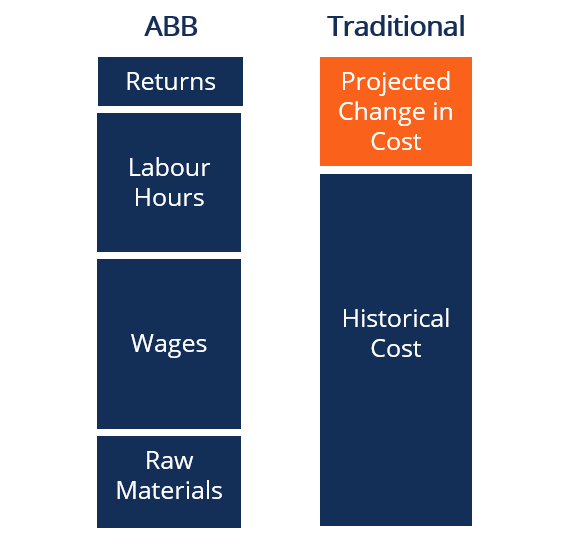
The diagram above demonstrates how ABB budgeting differs from a traditional budgeting method. While a traditional method simply increases or decreases projected costs based on historical values, ABB breaks down costs more gradually.
Activity-Based Budgeting – Steps
ABB follows three main steps:
1. Identify the cost drivers of various activities.
For example, the cost drivers for a manufacturing facility can be the total labor hours and wages paid to employees.
2. Project the number of units required within each cost driver.
For example, the manufacturing facility may always need three people on the production line, translating to 240 labor hours per week.
3. Calculate the cost per unit of activity relating to that cost driver.
For example, wages for warehouse labor can be $12 per hour.
When is Activity-Based Budgeting Used?
Businesses must analyze their goals and requirements to determine whether an ABB system will make sense to implement. ABB is better suited to new businesses that lack historical costing data that more established businesses have.
For example, a more established retail business, such as Walmart, has made changes to optimize its strategy for profitability over many years. Their profits are going to remain at a relatively even growth rate, and they know exactly what their cost drivers are.
On the other hand, a new start-up doesn’t have years of historical financial information at its disposal. It may be worthwhile for the newer start-up to inspect each cost driver and their corresponding activity levels to make more accurate financial projections.
Activity-Based Budgeting – Advantages
Relative to other budgeting methods, ABB allows you to see exactly what the associated costs are for each operational activity. It also helps to further break down these costs to determine what can be hurting the profitability of a company.
While other methods of budgeting look at the costs of inputs to perform activities, ABB looks at the outputs that drive costs. In doing so, management can better evaluate different business units relative to each other and allocate capitalCost of CapitalCost of capital is the minimum rate of return that a business must earn before generating value. Before a business can turn a profit, it must at least generate sufficient income to cover the cost of funding its operation. where they deem to be most profitable.
Activity-Based Budgeting – Disadvantages
The biggest disadvantage of implementing ABB is that it is more costly and time-consuming to implement than other budgeting methods. As all costs associated with a business activity are tracked, all technical details must be recorded as they occur.
Furthermore, accountants handling ABB need to have a deep understanding of the business processes. This can be difficult, especially in businesses with complex production cycles. Businesses need to decide if increased forecasting accuracy is worth the extra investment needed to implement an ABB system.
Activity-Based Budgeting – Example
To demonstrate how ABB can be implemented, it is useful to compare it to a traditional budgeting method. Suppose Company ABC expects to sell 1,000 units of its product over the next month, and the product costs $5 to produce. Under activity-based budgeting, the company will estimate the cost of goods sold to be $5,000.
Also, assume Company ABC reported a cost of goods sold at $4,000 last month, with the rate of increase averaging 10% each month in the past. Under the traditional budgeting method, the company will estimate the cost of goods sold in the upcoming month to be $4,400 [$4,000 + ($4,000 x 10%)].
Related Readings
CFI offers the Commercial Banking & Credit Analyst (CBCA)™Program Page - CBCAGet CFI's CBCA™ certification and become a Commercial Banking & Credit Analyst. Enroll and advance your career with our certification programs and courses. certification program for those looking to take their careers to the next level. To keep learning and advancing your career, the following resources will be helpful:
- Balanced BudgetBalanced BudgetA balanced budget is a budget (i.e., a financial plan) in which revenues are equal to expenditures, such that there is no budget deficit or surplus.
- Cost of Goods Sold (COGS)Cost of Goods Sold (COGS)Cost of Goods Sold (COGS) measures the “direct cost” incurred in the production of any goods or services. It includes material cost, direct
- ForecastingForecastingForecasting refers to the practice of predicting what will happen in the future by taking into consideration events in the past and present. Basically, it is a decision-making tool that helps businesses cope with the impact of the future’s uncertainty by examining historical data and trends.
- Zero-based BudgetingZero-Based BudgetingZero-based budgeting (ZBB) is a budgeting technique that allocates funding based on efficiency and necessity rather than on budget history
-

Understanding the Cost of Preferred Stock: A Key Capital Metric
The cost of preferred stock to a company is effectively the price it pays in return for the income it gets from issuing and selling the stock. In other words, it’s the amount of money the compan
-

Understanding Flotation Costs: A Comprehensive Guide
Flotation costs are the costs that are incurred by a company when issuing new securities. The costs can be various expenses including, but not limited to, underwriting, legal, registration, and audit
finance
- Understanding Acquisition Cost: Definitions & Applications
- Beyond Budgeting: A Modern Approach to Organizational Control
- Business Budgeting: A Comprehensive Guide to Planning & KPIs
- Cost of Capital: Definition, Calculation & Importance
- Incremental Budgeting: Definition, Pros & Cons | [Your Company Name]
- Budgeting Software: Types, Features & Comparison - [Year]
- Marginal Cost: Definition, Calculation & Examples
- Activity-Based Management (ABM): Definition & Benefits
- Activity-Based Budgeting (ABB): A Comprehensive Guide
-
 Bottom-Up Budgeting: A Comprehensive Guide
Bottom-up budgeting is a budgeting method that starts at the department level, moving up to the top level. Each department within the organization is required to compile a list of the things it needs,...
-
 Capital Budgeting: A Comprehensive Guide for Business Leaders
Capital budgeting refers to the decision-making process that companies follow with regard to which capital-intensive projects they should pursue. Such capital-intensive projects could be anything from...