
Understanding Baselines: Performance Measurement & Project Management
Baseline is a reference point that is used to analyze the current performance of a project, company, or budgetProject BudgetThe Project Budget is a tool used by project managers to estimate the total cost of a project. A project budget template includes a detailed estimate of all costs that are likely to be incurred before the project is completed. relative to historical records and measure progress over time.

Baseline – Applications
1. Project management
In project management, a baseline is used as a reference point for each new project that a company undertakes. Typically, baselines are used for a project’s schedule, cost, and scope.
The schedule refers to the timeline of the project and the expected completion dates for given project milestones. The cost of the project is the total amount of expenditure required and may be divided into certain parts depending on the type of project undertaken. The scope of the project refers to its reach and scalability – so for a new product that’s being developed, the scope may refer to the projected number of units sold.
By creating a basis for all three of the important components mentioned above, companies and managers can keep track of how the project is performing relative to a set benchmark – which can be modified according to the needs and goals of the company.
However, it is also important to keep the baseline flexible, as the scope and economic environment surrounding the project and the company are subject to change with changes in the market.
For example, a risk advisory company may have a benchmark for the number of clients it expects to acquire each month, based on how many clients were acquired historically. The benchmark can be referred to as the baseline for monthly client acquisition.
2. Sales projection
The graph below illustrates another example: Baseline for the sales timeline of a new product. The green line shows the sales of a product that was developed two years ago by the company, whereas the orange line plots the sales of a product that was commercialized six months ago and projects the volume of sales over time (the dotted line).
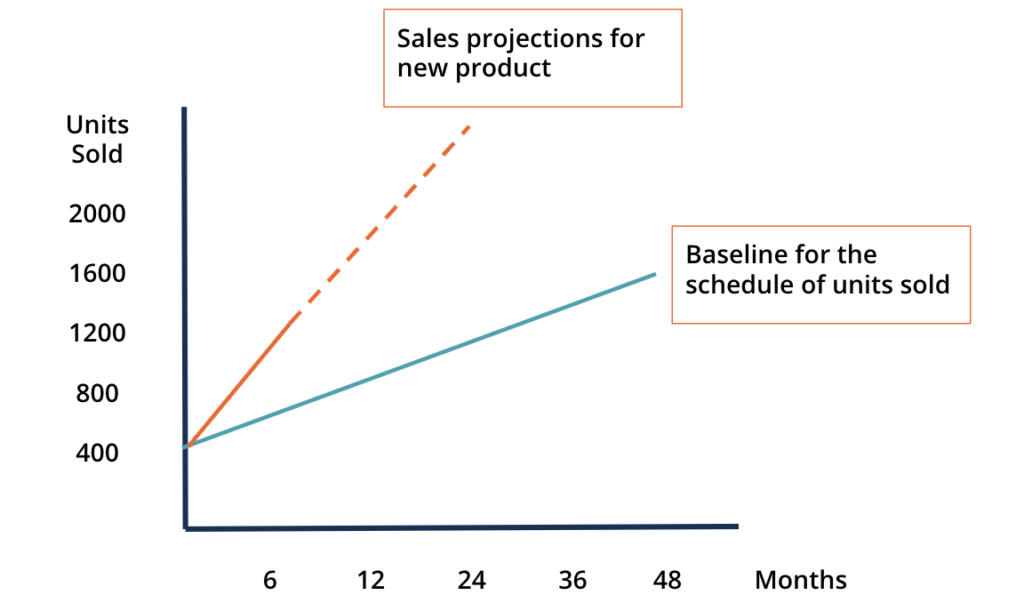
Here, the baseline is used as a point of comparison and allows the company to measure the performance of a newly launched product against a historical record of sales.
2. Baseline budgeting
Baseline budgeting is an accounting method that is used by governments to develop a budget for future years. The current fiscal year’s budget is used as the baseline for future years, and projections are calculated using the inflation rateInflationInflation is an economic concept that refers to increases in the price level of goods over a set period of time. The rise in the price level signifies that the currency in a given economy loses purchasing power (i.e., less can be bought with the same amount of money). and the population growth rate.
Future Budget = Current Budget x Inflation Rate x Population Growth Rate
The formula assumes that the budget grows at the same rate as the inflation rate and the population growth rate. Although this may be inaccurate, it provides a rough estimate of the increase in financial requirements as a country’s population grows, prices of domestic goods and services increase, and it experiences economic growth.
3. Horizontal financial analysis
Horizontal financial analysis is the process of comparing a company’s financial condition to a benchmark that is set according to its performance in previous accounting periods. It allows companies to examine their financial progress on the balance sheetBalance SheetThe balance sheet is one of the three fundamental financial statements. The financial statements are key to both financial modeling and accounting. and the income statement.
In horizontal analysis, the period that is used for comparison to the current period is the baseline. For instance, if a business is in Year 3 and is comparing the current financial condition to that of Year 2, Year 2 is the baseline year.
Baseline – Advantages
- Projects a clear picture of the expected timeline for a project, which allows the team to stay on track.
- Provides a plan for which resources are needed and when they are needed in the project’s life cycle.
- Allows progress to be reflected and reported accurately.
- Allows companies to compare current performance to a particular benchmark based on their own historical performance (horizontal financial analysis) and benchmark created relative to comparable firms in the industry
- Project financial injections and leakages so that funds can be managed accordingly.
Related Readings
CFI offers the Commercial Banking & Credit Analyst (CBCA)™Program Page - CBCAGet CFI's CBCA™ certification and become a Commercial Banking & Credit Analyst. Enroll and advance your career with our certification programs and courses. certification program for those looking to take their careers to the next level. To keep learning and developing your knowledge base, please explore the additional relevant resources below:
- Projecting Income Statement Line ItemsProjecting Income Statement Line ItemsWe discuss the different methods of projecting income statement line items. Projecting income statement line items begins with sales revenue, then cost
- BudgetingBudgetingBudgeting is the tactical implementation of a business plan. To achieve the goals in a business’s strategic plan, we need some type of budget that finances the business plan and sets measures and indicators of performance.
- Project ManagementProject ManagementProject management is designed to produce an end product that will make an impact on an organization. It is where knowledge, skills, experience, and
- Budget VarianceBudget VarianceBudget variance deals with a company’s accounting discrepancies. The term is most often used in conjunction with a negative scenario. An example is when a company fails to accurately budget for their expenses – either for a given project or for total quarterly or annual expenses.
-

IRA CDs: Secure Retirement Savings with FDIC Insurance
An Individual Retirement Account, referred to as an IRA, offers tax advantages to help you save for retirement. An IRA acts like a basket to hold different types of investments and assets. One of the
-

Understanding the DU: Your Mortgage Approval Explained
DU in relation to a mortgage stands for Desktop Underwriter, which is a mortgage program used to analyze a borrower's application to see if it meets criteria set up by the governing agency of that
finance
- Discounted Payback Period: Definition & Calculation
- Project Budget: Definition, Template & Cost Estimation
- Project Sequencing: Strategic Investment & Capital Budgeting
- Real Estate Project Finance: A Comprehensive Guide
- Social Impact Bonds: Investing in Social Good & Outcomes
- Expansion Projects: Definition, Types & Strategic Growth
- Completed Operations Insurance: Protect Your Business After Project Completion
- Facebook Libra Project: A Deep Dive into the Cryptocurrency Initiative
- CrypToadz NFTs: Understanding the Viral Collection & How to Buy
-
PC Banking: A Comprehensive Guide to Online Banking Security & Features
PC banking refers to a person being able to access their banking information from a "personal computer." It has become a popular method for people to manage money and pay bills using online ...
-
Social Impact Bonds: Investing for Social Good | [Your Company Name]
More and more of us are concerned about investing in companies that practice ethical and environmentally-conscious business by engaging in socially responsible investing (SRI) and ESG investing. But t...