
Revolving Credit Facility: Definition & Business Benefits
A revolving credit facility is a line of credit that is arranged between a bank and a business. It comes with an established maximum amount, and the business can access the funds at any time when needed. The other names for a revolving credit facility are operating line, bank line, or, simply, a revolver.

A revolving type of credit is mostly useful for operating purposes, especially for any business experiencing sharp fluctuations in its cash flows and some unexpected large expenses. In other words, it is needed for companies that may sometimes have low cash balances to support their net working capitalNet Working CapitalNet Working Capital (NWC) is the difference between a company's current assets (net of cash) and current liabilities (net of debt) on its balance sheet. needs. Because of this, it is often considered a form of short-term financing that is usually paid off quickly.
When a company applies for a revolver, a bank considers several important factors to determine the creditworthiness of the company. They include the income statement, cash flow statement,Cash Flow StatementA cash flow Statement contains information on how much cash a company generated and used during a given period. and balance sheet statement.
Features of a Revolving Credit Facility
1. Cash Sweep
The revolver is often structured with a cash sweep (or debt sweep) provision. It means that any excess free cash flow generated by a company will be used by the bank to pay down the outstanding debt of the revolver ahead of schedule.
Doing so forces the company to make repayment at a faster rate instead of distributing the cash to its shareholders or investors. In addition, it minimizes the credit risk and liability that comes from a company burning through its cash reserves for other purposes, such as making large, excessive purchases.
2. Interest Expense
The borrower is charged interest based only on the withdrawal amount and not on the entire credit line. The remaining portion of the revolver is always ready for use. This feature of built-in flexibility and convenience is what gives the revolver its main advantage. As for its outstanding balance, a business can have the option to pay the entire amount at once or simply make minimum monthly payments.
The interest rate is usually close to the rate found on the company’s senior term debt. However, it may be variable and is based on the bank’s prime rate plus a premium, with an additional premium determined based on the company’s creditworthinessCreditworthinessCreditworthiness, simply put, is how "worthy" or deserving one is of credit. If a lender is confident that the borrower will honor her debt obligation in a timely fashion, the borrower is deemed creditworthy..
3. Maximum Amount
When a company experiences a shortfall in cash flows to meet financial obligations, it can be corrected promptly by borrowing from a revolver. There is a maximum borrowing amount set by the bank. However, the bank may review the revolver annually. If revenues of a business drastically fall, the bank may lower the maximum amount of the revolver to protect it from default risk.
Conversely, if a company has a good credit score, strong cash reserves, a steady and rising bottom line, and is making regular, consistent payments on a revolver, the bank may agree to increase the maximum limit.
4. Commitment Fee
To commence the revolving credit facility, a bank may charge a commitment fee. It compensates the lender for keeping open access to a potential loan, where interest payments are only activated when the revolver is drawn on. The actual fee can either be a flat fee or a fixed percentage.
5. Reusability
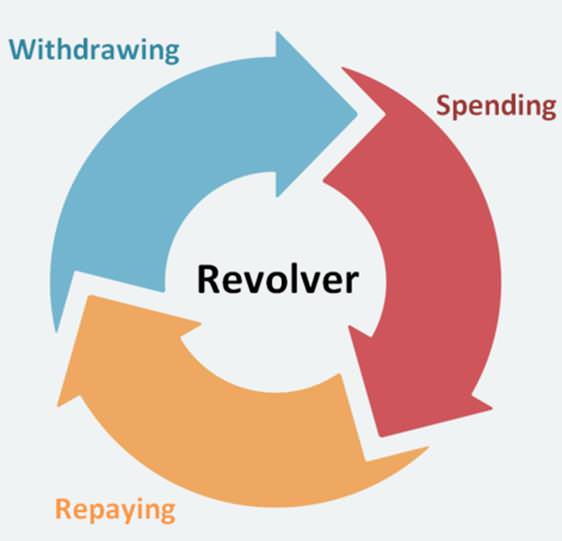
This type of loan is named a revolver because once the outstanding amount is paid off, the borrower can use it over and over again. It’s a revolving cycle of withdrawing, spending, and repaying any number of times until the arrangement expires – the term of the revolver ends.
A revolving credit facility is different from an installment loan, where there are monthly fixed payments over a set period. Once an installment loan is fully paid, you can’t use it again like the revolver. The borrower must apply for a new installment loan.
Revolver in a Financial Model
A revolving credit facility is an important part of financial modelingWhat is Financial ModelingFinancial modeling is performed in Excel to forecast a company's financial performance. Overview of what is financial modeling, how & why to build a model. because it underscores changes in a company’s debt based on operating assumptions. For example, if it’s projected that revenues will drastically fall in the coming years, a company will look for additional sources of financing to fund R&D or capital expenditures as ways to grow the business. It may issue more debt to make such necessary expenses.
As mentioned before, the company can perform a revolver drawdown if it has insufficient cash on hand to service debt. Thus, a change in the revolver is triggered by a change in a company’s debt level. Furthermore, a revolver helps with keeping a financial model balanced because it calculates any excess cash generated or cash shortfall for a given year.
An Example of a Revolving Credit Facility
Seasonal Industry
In the hospitality industry, which is considered seasonal, a ski resort may experience a shortage in operating income during the summer months; therefore, it may not be able to cover its payroll. Additionally, if it’s making most of its sales on credit, then the company will be waiting to cash its receivablesAccountingOur Accounting guides and resources are self-study guides to learn accounting and finance at your own pace. Browse hundreds of guides and resources. before making inventory expenses.
Having a revolver will allow the company to be able to access funds at any time when it requires money for its day-to-day operations.
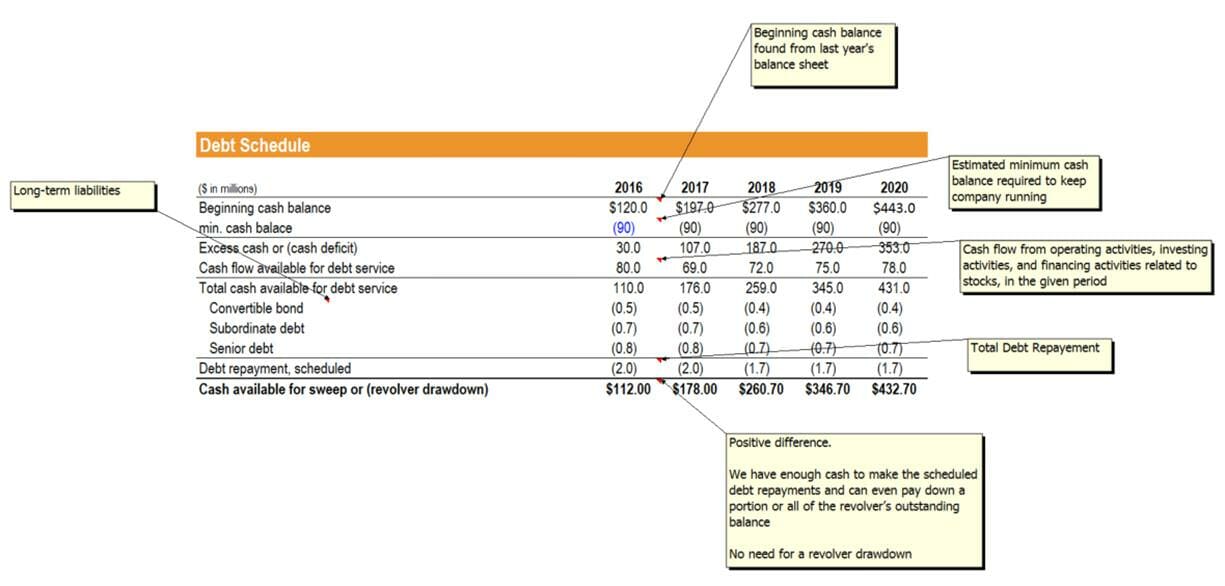
Calculation of Sweep (see figure below)
To calculate the cash available for sweeping, we take the beginning cash balanceCash EquivalentsCash and cash equivalents are the most liquid of all assets on the balance sheet. Cash equivalents include money market securities, banker's acceptances that is found on last year’s balance sheet under assets and subtract from it the estimated minimum cash balance required to keep a company running. Further diligence is performed if we need an accurate minimum cash balance.
The difference is then added to the cash flow from operating activities, investing activities, and financing activities in the period. We now have cash that is available for debt service. After that, we take the sum of all the scheduled debt repayments and subtract it from the cash available for debt service.
If the difference turns out to be positive, then we have enough cash to make the scheduled debt repayments and can even pay down a portion or all of the revolver’s outstanding balance. The company can even make early full repayments of other debt balances.
However, if the difference is negative, then there wouldn’t be enough cash to make debt repayments; therefore, the company will have to draw from the revolver to cover the shortage of cash.
To learn more, launch our financial modeling courses.
Additional Resources
CFI offers the Commercial Banking & Credit Analyst (CBCA)™Program Page - CBCAGet CFI's CBCA™ certification and become a Commercial Banking & Credit Analyst. Enroll and advance your career with our certification programs and courses. certification program for those looking to take their careers to the next level. To keep learning and developing your knowledge base, please explore the additional relevant resources below:
- How to Link the 3 Financial StatementsHow the 3 Financial Statements are LinkedHow are the 3 financial statements linked together? We explain how to link the 3 financial statements together for financial modeling and
- 3 Statement Model in Excel3 Statement ModelA 3 statement model links the income statement, balance sheet, and cash flow statement into one dynamically connected financial model. Examples, guide
- DCF Modeling GuideDCF Model Training Free GuideA DCF model is a specific type of financial model used to value a business. The model is simply a forecast of a company’s unlevered free cash flow
- Valuation MethodsValuation MethodsWhen valuing a company as a going concern there are three main valuation methods used: DCF analysis, comparable companies, and precedent transactions
-
Understanding Liquidity in Financial Markets: A Comprehensive Guide
In financial marketsFinancial MarketsFinancial markets, from the name itself, are a type of marketplace that provides an avenue for the sale and purchase of assets such as bonds, stocks, foreign excha
-
Profit vs. Cash Flow: Understanding the Key Difference
Understanding the difference between profit vs cash is very important in the finance industry. Profit is defined as revenue less all the expenses of a company in a certain period, while cash flow is c
finance
- Understanding Cash Finance Charges: What You Need to Know
- Understanding Cash Consideration in Mergers & Acquisitions
- Cash Credit (CC): A Comprehensive Guide for Businesses
- Revolver Debt: Understanding Revolving Credit for Businesses & Individuals
- Understanding Revolving Debt: Lines of Credit Explained
- Cash Advances: Understanding Costs, Uses & Alternatives
- Understanding Cash Advances: Costs, Benefits & Alternatives
- Credit Card Cash Advances: Definition, Costs & Limitations
- Understanding Revolving Credit: A Comprehensive Guide
-
 Understanding Credit Scores: What They Are & Why They Matter
A credit score is a number representative of an individual’s financial and credit standing and ability to obtain financial assistance from lenders. LendersFinancial IntermediaryA financial inter...
-
 Disbursement Explained: Definition, Impact & Accounting Implications
A disbursement is an act of paying out money – especially from a public or dedicated fund. It often refers to the payment made for a client to a third party, as reimbursement will be sought from...