
Tax Deductions: Understanding and Claiming Benefits
A tax deduction refers to an item that is subtracted from taxable income, where an individual or an organization can get expenses deducted from their income. Tax deductions are considered a form of tax relief for the individual or organization.

It is important to note that you need to file your taxes in order to be eligible for deductions. Furthermore, there may also be a certain limit on how much you can deduct each year. For example, the U.S. Internal Revenue Service (IRS) in the United States limits the maximum amount of deductions that an individual can claim in a tax year.
In order to claim deductions, you will also need to keep proof of the expenses you incurred. For example, you will need to retain receipts and other supporting documents of any medical expenses that you paid.
Tax Deductions for Individuals
Individuals are allowed to claim certain expenses that can lower their tax liability. The deductions available to individuals will depend on which tax jurisdiction you are located in. Below is a list of possible tax deductions that an individual can utilize:
- Childcare expenses: Expenses such as day care services, boarding schools, and summer camps can reduce taxable income.
- Medical expenses: You may also be eligible to use medical expenses to reduce tax liability. They can include dental, orthopedic, and other expenses.
- Support services for individuals with a disability: If you suffer from a mental or physical disability, you are also eligible to deduct expenses that are paid towards support services.
- Support services for seniors: If you are a senior and you are receiving support services, you are also allowed to reduce your tax liability.
- Union and professional dues: If you are an employee who is part of a union or a professional association, the fees that you pay can be used to claim a deduction on your taxable income.
Tax Deductions for Business Expenses
Organizations can claim tax deductions for certain expenses that are incurred to operate and maintain the organization. Once again, depending on where you are located, there may be different tax deductions. Below is a list of business expenses that can be deducted from the organization’s taxes:
- Supplies: Businesses can claim deductions for supplies used indirectly in order to provide goods and services for customers. For instance, supplies can be tools and machinery used by a construction worker.
- Office expenses: Businesses can also reduce their tax liability for the cost of items used in an office. For example, they will include paper, pencils, staples, and other stationery. Note that office expenses do not consist of computers, desks, and other furniture because they are considered capital expensesCapital ExpendituresCapital expenditures refer to funds that are used by a company for the purchase, improvement, or maintenance of long-term assets to improve.
- Wages, salaries, and other benefits: Companies can deduct gross wages, salaries, and benefits that a company pays to their employees.
- Rent: If a company rents space to operate the business, the amount of rent paid can be deducted from the company’s taxes.
- Telephone and other utility fees: Expenses such as water, gas, and electricity can be used for tax deductions. The utility expenses should only be incurred by the organization to operate the business.
- Banking and administration fees: Companies may deduct administration expensesSG&ASG&A includes all non-production expenses incurred by a company in any given period. It includes expenses such as rent, advertising, marketing incurred to run the business. They can include banking fees and interest incurred on loans from the bank.
Tax Deductions vs. Tax Credits
It is also important to consider the difference between tax deductions and tax credits. Although both tax incentives are quite similar, they are different in how they are carried out.
A tax deduction is an amount that is subtracted from your taxable incomeTaxable IncomeTaxable income refers to any individual's or business’ compensation that is used to determine tax liability. The total income amount or gross income is used as the basis to calculate how much the individual or organization owes the government for the specific tax period.. As such, tax deductions can be used to reduce your tax liability.
On the other hand, tax credits are deductions that reduce taxes payable. Tax credits are either refundable or non-refundable. Refundable tax credits are paid back to the taxpayer by a reduction in taxes payable or via a refund. Non-refundable tax credits are only available under certain conditions and can only reduce taxes payable.
More Resources
CFI is the official provider of the global Certified Banking & Credit Analyst (CBCA)®Program Page - CBCAGet CFI's CBCA™ certification and become a Commercial Banking & Credit Analyst. Enroll and advance your career with our certification programs and courses. certification program, designed to help anyone become a world-class financial analyst. To keep advancing your career, the additional CFI resources below will be useful:
- How to Use the IRS.gov WebsiteHow to Use the IRS.gov WebsiteIRS.gov is the official website of the Internal Revenue Service (IRS), the United States’ tax collection agency. The website is used by businesses and
- Indirect TaxesIndirect TaxesIndirect taxes are basically taxes that can be passed on to another entity or individual. They are usually imposed on a manufacturer or supplier who then
- Source DocumentsSource DocumentsThe paper trail of a company's financial transactions are referred to in accounting as source documents. Whether checks are written to be
- Tax ShieldTax ShieldA Tax Shield is an allowable deduction from taxable income that results in a reduction of taxes owed. The value of these shields depends on the effective tax rate for the corporation or individual. Common expenses that are deductible include depreciation, amortization, mortgage payments and interest expense
-

Understanding Net of Tax: Definition & Calculation
Net of tax is the amount obtained after the applicable tax is deducted from the gross incomeGross IncomeGross income refers to the total income earned by an individual on a paycheck before taxes and o
-
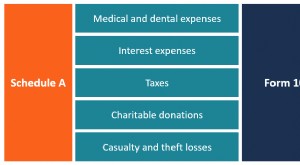
Understanding Schedule A: Itemized Deductions Explained
Schedule A is an income tax form that is used in the United States to declare itemized deductions.It is attached to Form 1040 for taxpayers that pay annual income taxesAccounting For Income TaxesIncom
finance
- Understanding Business Erosion: Causes, Risks & Prevention
- Franchise Tax Explained: What It Is & Who Pays
- Understanding Income Tax: A Comprehensive Guide for Individuals & Businesses
- Understanding Tax Deductions: What Businesses Need to Know
- Understanding Taxation: A Comprehensive Guide to Government Revenue
- Progressive Tax Explained: How It Works & Examples
- Regressive Taxes: Definition, Examples & Impact on Income Inequality
- Tax Depreciation Explained: A Comprehensive Guide for Taxpayers
- Roth IRA Tax Implications: Understanding Contributions & Benefits
-
 Understanding Horizontal Equity in Taxation
Horizontal equity is an economic theory that is used to assess the fairness of tax burden across a population. The theoretical underpinning of horizontal equity is that the amount of taxes paid should...
-
 Understanding Income Tax Payable: A Guide for Businesses
Income tax payable is a term given to a business organization’s tax liability to the government where it operates. The amount of liability will be based on its profitability during a given perio...