
Tether (USDT): Understanding the Stablecoin & Its Role in Crypto
Tether in its simplest form, is a cryptocurrency (USDT) with a fixed price measured by a fiat currency, in this case, the U.S. Dollar (USD). It has become the world’s most popular stablecoin simply because it’s backed by the USD, ensuring that for every Tether issued, there is enough USD in reserve to back it up.
The concern surrounding market volatility and cryptocurrency stability is a major factor behind industry hesitation for mass adoption, specifically looking to Bitcoin, Ethereum, and Litecoin. While the three currencies have been used for several online transactions, they are not considered to be reliable for making day-to-day transfers because of their high volatility in price.
Without stability, a seller’s hesitance of trading goods and services in exchange for a cryptocurrency only increases.
Origins of Tether
Tether’s origins can be traced back to 2014, where two groups that believed the Bitcoin blockchain could also serve as a platform for issuing fiat currencies--Realcoin and the cryptocurrency exchange Bitfinex. Eventually, Realcoin and Bitfinex merged their efforts, forming the Hong Kong-based company, Tether Limited, which includes the same Chief Executive, Chief Financial Officer, Chief Strategy Officer, and General Counsel.
Tether originally launched and was issued on the Bitcoin blockchain via the Omni Layer protocol, a platform that was used to create and trade other digital assets on top of Bitcoin. The purpose of Omni Layer’s protocol, was to help enable the minting and burning of Tether tokens based on the amount under custody.
Tether’s ledger is stored on the Bitcoin blockchain and Omni Explorer allows users to view their verified transactions. As of 2020, Tethers are also available as assets on other major blockchains, including Crypto Exchange, Ethereum (ETH), Tron (TRX), and EOSIO (EOS), which allow for the creation of new native assets.
How Does Tether Stay ‘Fixed’ to Our US Dollar?
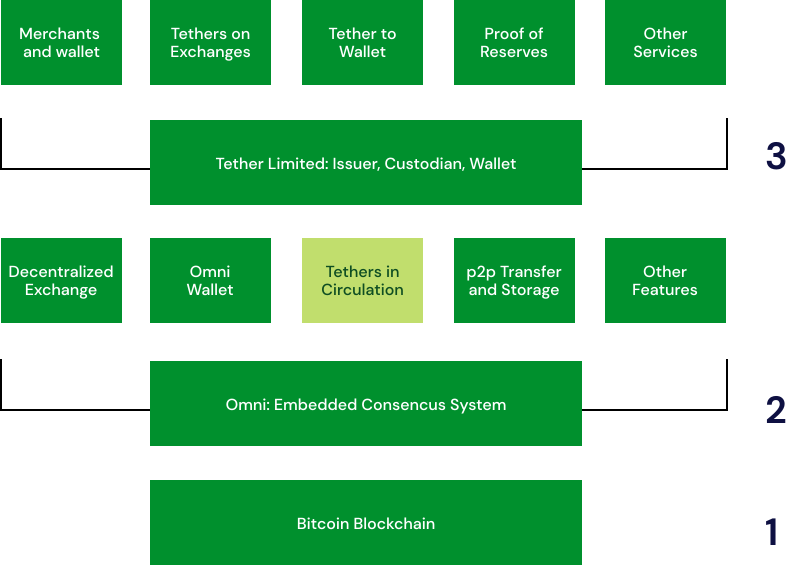
Source: Blockgeeks
First, we need to debunk the years worth of public claims that Tether is in fact fully backed by the US Dollar. Tether’s website has publicly stated that “every tether is always backed 1-to-1, by traditional currency held in our reserves. So 1 USDT is always equivalent to 1 USD”.
However, in 2019, that text has been replaced with the following, drawing major concern from industry experts:
“Every Tether is always 100% backed by our reserves, which include traditional currency and cash equivalents and, from time to time, may include other assets and receivables from loans made by Tether to third parties, which may include affiliated entities (collectively, “reserves”). Every tether is also 1-to-1 pegged to the dollar, so 1 USDT is always valued by Tether at 1 USD”.
In one interview with Breaker Mag, representatives of Tether further clarified the change to its Terms with respect to Tether’s fixed pricing:
“Tethers remain completely stable and 100% backed, so Tether’s reserves always equal or exceed the number of issued Tethers. The only change is that the composition of the assets that provide that backing includes a combination of cash, cash equivalents, and may also include other assets or receivables from loans issued by Tether”.
Following the announcement, Forbes described Tether as “an unregulated fractional reserve bank”, highlighting that “cash equivalents” are presumed to be other cryptocurrencies, while “reserves” are held in the form of loans that it has made to other parties.
Despite the clarification of Tether’s terms of service, the market is still receptive to Tether and its guarantee.
As of 2020, USDT remains the largest and most widely-used stablecoin. Since USDT has been in the market, Tether Limited’s vision has been embraced by many global companies, including Facebook’s struggling ‘Libra’ project.
-

Bitcoin Cash CFDs: A Comprehensive Guide for Traders
The Bitcoin Cash (BCH) cryptocurrency is a peer-to-peer electronic currency for the internet. Just as it is with other cryptocurrencies, it is a decentralized platform with no central bank or govern
-

Understanding Cryptocurrency: A Beginner's Guide to Bitcoin & Blockchain
The world of crypto is a funny one. On the one hand, billionaires are made overnight, and companies raise billions without even launching a product. On the other, most projects fail, and you can lose
Fund information
- Bitcoin Dominance Explained: Understanding BTC Market Share & Trends
- Bitcoin Cash (BCH): A Comprehensive Overview - Features, History & Future
- Blockchain Explained: A Beginner's Guide to Distributed Ledgers
- Bitcoin Explained: A Simple Guide to Digital Currency
- Bitcoin Gold (BTG): Understanding the 2017 Hard Fork & Implications
- Bitcoin Explained: A Comprehensive Guide to Cryptocurrency
- Bitcoin Explained: The History & Future of Cryptocurrency
- Bitcoin Cash (BCH): A Comprehensive Overview - What You Need to Know
- Litecoin (LTC): A Comprehensive Overview - History, Features & Purpose
-
Ethereum (ETH): A Beginner's Guide to Decentralized Applications
Think of Ethereum as Android OS or Linux, open-source platforms where you can write code, create, and build, without a set of rules, so to speak. Think of Ethereum as Android OS or Linux, ...
-
 PrimeXBT: Your Leading Bitcoin Margin Trading Platform | Crypto, Forex & More
Serving clients in more than 150 countries, PrimeXBT is a Bitcoin-based margin trading platform that offers instant access to over 30+ assets, including Crypto, Forex, Commodities, and Indices with re...