
Black Tuesday: Causes, Impact, and Historical Significance
Black Tuesday is the stock market crash that occurred on October 29, 1929. It is considered the most disastrous market crash in the history of the United States. The Black Tuesday event was preceded by the crash of the London Stock Exchange and Black Monday, and was characterized by panic sell-offs on the New York Stock ExchangeStock MarketThe stock market refers to public markets that exist for issuing, buying and selling stocks that trade on a stock exchange or over-the-counter. Stocks, also known as equities, represent fractional ownership in a company and dramatic declines in major market indicesDow Jones Industrial Average (DJIA)The Dow Jones Industrial Average (DJIA), also referred to as "Dow Jones” or "the Dow", is one of the most widely-recognized stock market indices..
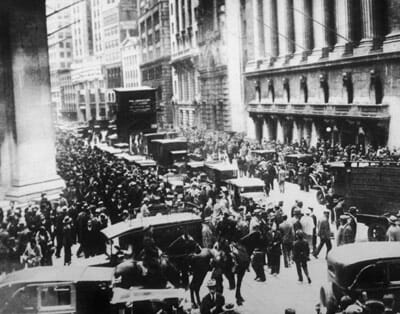
Black Tuesday was the starting point of the Great DepressionThe Great DepressionThe Great Depression was a worldwide economic depression that took place from the late 1920s through the 1930s. For decades, debates went on about what caused the economic catastrophe, and economists remain split over a number of different schools of thought. that hit the economies of the United States and other countries across Europe.
Preceding the Black Tuesday Market Crash
The 1920s (also known as “The Roaring Twenties”) were characterized by dynamic economic and socio-cultural growth around the world. The world was recovering from the devastating consequences of World War I, and the population was spending more on consumer goodsGross Domestic Product (GDP)Gross domestic product (GDP) is a standard measure of a country’s economic health and an indicator of its standard of living. Also, GDP can be used to compare the productivity levels between different countries. and boosting economic growth.
The United States, which suffered significantly less than major European countries during World War I, became the largest economy in the world. The US successfully transferred its economy to peacetime conditions. Relatively new industries, such as automobile production, film and radio industries, and the introduction of mass production, fueled consumer spending and the subsequent economic expansion.
The 1920s were also distinguished by constant growth in the stock market. There was a strong public sentiment of an almost perpetual economy and stock market expansion. Amid the economic surge, the stock market’s growth was partially encouraged by speculation. Speculative activities, exacerbated by enormous borrowing carried out to fund the trading of stocks, resulted in the big bubble.
By the end of the 1920s, economic growth slowed down. As there was no support for the further expansion of the stock market, it was only a matter of time before the crash would occur.
Events of Black Tuesday
In September 1929, British financier Clarence Hatry was arrested for allegations of fraud. The event caused a crash on the London Stock Exchange that also changed the optimistic sentiment of American investors. The US stock market became volatile and experienced the Black Monday event on October 28, 1929.
On October 28, the Dow Jones Industrial Average (DJIA)Dow Jones Industrial Average (DJIA)The Dow Jones Industrial Average (DJIA), also referred to as "Dow Jones” or "the Dow", is one of the most widely-recognized stock market indices. lost 13% of its value. The next day, the decline continued when DJIA fell by another 12%. A panic sell-off of securities that could not be stopped ensued.
Consequences of Black Tuesday
Black Tuesday resulted in devastating consequences not only for the US economy but for other economies around the world. The market crash ended the period of economic growth and prosperity and led to the Great Depression. Black Tuesday triggered a chain of catastrophic macroeconomic events in the US and Europe, which included mass bankruptcies and unemployment, and dramatic declines in production and money supply.
The US stock market fully recovered from the consequences of Black Tuesday only in the 1950s.
Related Readings
Thank you for reading CFI’s explanation of Black Tuesday. CFI offers the Financial Modeling & Valuation Analyst (FMVA)™Become a Certified Financial Modeling & Valuation Analyst (FMVA)®CFI's Financial Modeling and Valuation Analyst (FMVA)® certification will help you gain the confidence you need in your finance career. Enroll today! certification program for those looking to take their careers to the next level. To learn more about related topics, check out the following resources:
- Black Swan EventBlack Swan EventA black swan event, a phrase commonly used in the world of finance, is an extremely negative event or occurrence that is impossibly difficult to predict. In other words, black swan events are events that are unexpected and unknowable. The term was popularized by former Wall Street trader Nassim Nicholas Taleb
- Capital ControlsCapital ControlsCapital controls are measures taken by either the government or the central bank of an economy to regulate the outflow and inflow of foreign capital in the country. The measures taken may be in the form of taxes, tariffs, volume restrictions, or outright legislation.
- Insider TradingInsider TradingInsider trading refers to the practice of purchasing or selling a publicly-traded company’s securities while in possession of material information that is
- Stock HaltStock HaltA stock halt, often referred to as a trading halt, is a temporary halt in the trading of a security. Usually, a stock halt is imposed for regulatory reasons, the anticipation of significant news, or to correct a situation in which there are excess of buy or sell orders for a specific security.
-

Allotment Explained: Resource & Equity Distribution in Business
The term allotment, in business, refers to the structured and systematic distribution of the business’ resources. Commonly, the term allotment is used in the context of equity distribution in fi
-

Defensive Stocks: A Guide to Stable Investments
A defensive stock is a stock that demonstrates relatively stable performance regardless of the current state of the economy. Defensive stocks are also called non-cyclical stocks, as they are less pron
invest
- Black Monday 1987: Causes, Impact & Historical Significance
- Understanding Downtrends: Definition, Identification & Reversal
- Understanding Non-Assessable Stock: Limited Liability Explained
- Understanding Overweight Stocks: A Comprehensive Guide
- Stock Indexes Explained: A Beginner's Guide to Market Benchmarks
- Stock Valuation: A Comprehensive Guide for Investors
- Stock Float Explained: Understanding Publicly Available Shares
- Stock Splits Explained: What They Are & What They Mean for Investors
- Phantom Stock: Definition, Benefits & How It Works
-
 Stock Replenishment: A Comprehensive Guide for Inventory Management
Stock replenishment is one of the most important considerations when it comes to inventory management, as it helps ensure the right stock is on the shelves at the right time, while keeping inventory h...
-
TaaS Stocks: Understanding the Transportation as a Service Market & Investment Potential
Once people start making ludicrous amounts of money on something, it’s probably too late to start investing. So your profit-making potential depends on your ability to rec...