
Stock Indexes Explained: A Beginner's Guide to Market Benchmarks
A stock index, also called a share index or stock market index, consists of constituent stocks used to provide an indication of an economy, market, or sector. A stock index is commonly used by investors as a benchmark to gauge the performance of their portfolio. Examples of stock indexes include the Dow Jones Industrial Average (DJIA)Dow Jones Industrial Average (DJIA)The Dow Jones Industrial Average (DJIA), also referred to as "Dow Jones” or "the Dow", is one of the most widely-recognized stock market indices., the Nikkei Stock Average, the S&P 500, the Nasdaq CompositeNASDAQ CompositeThe NASDAQ Composite is an index of more than 3,000 common equities listed on the NASDAQ stock market. The index is one of the most followed indices in the, and the Wilshire 5000.
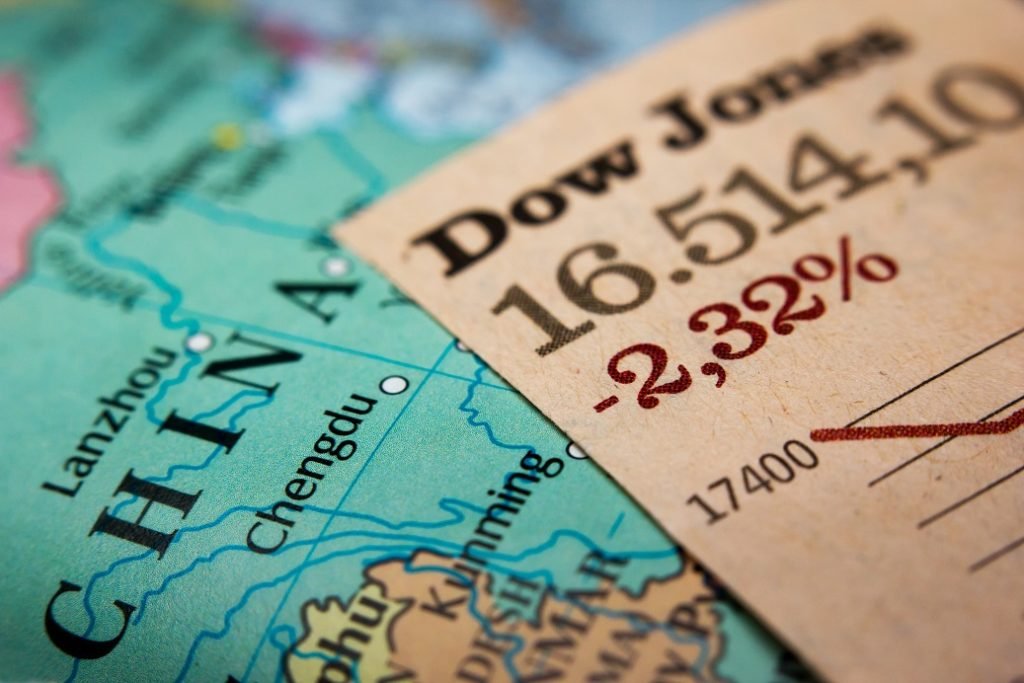
Stock Index Composition
A stock index is comprised of constituent stocks that, when pooled together, provides an indication of something. For example:
- The Dow Jones Industrial Average comprises 30 of the largest and most influential companies; and
- The S&P 500 consists of the top 500 U.S. stocks by capitalization.
The Dow Jones Industrial Average and S&P 500 are used in mass media to provide a broad indication of economic performance in the United States.
Stock Index Weighting
Stock indexes can follow different weighting methods, such as a:
- Price-weighted indexPrice-Weighted IndexA price-weighted index is a type of stock market index in which each component of the index is weighted according to its current share price. In price-weighted indices, companies with a high share price have a greater weight than those with a low share price.;
- Modified price-weighted index;
- Market capitalization-weighted indexCapitalization-Weighted IndexThe Capitalization-Weighted Index (cap-weighted index, CWI) is a type of stock market index in which each component of the index is weighted relative to its total market capitalization. In a capitalization-weighted index, companies with larger market capitalization exert a greater impact on the index value.;
- Market capitalization-weighted index adjusted for float; and
- Equally-weighted index.
For example:
- The Dow Jones Industrial Average is a price-weighted index; and
- The S&P 500 is a market capitalization-weighted index.
The weighting method used carries implications on the performance of an index.
The S&P 500
The S&P 500 chart is taken from Google and provided below:
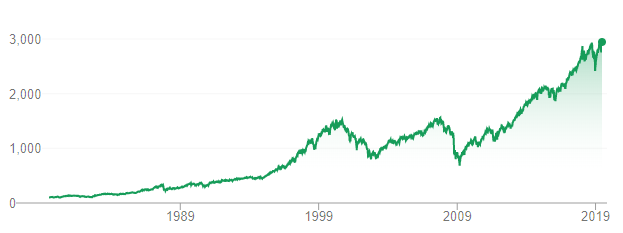
Recall that the S&P 500 is used in mass media to provide a broad indication of economic performance in the United States. From the S&P 500, we can discern economic events in each major downtrend of the index, including:
- The Tech Boom in 2000; and
- The Global Financial Crisis in 2008.
As one can see, the S&P 500, consisting of the top 500 U.S. stocks by capitalization, provides a pretty good representation of major economic events.
Example – An Industry Indicator
Colin recently decided to create two stock indexes.
Index 1 – Automobile:
The first stock index, provided below, consists of five automobile stocks that he believes provides a good representation of the automobile industry in the United States:
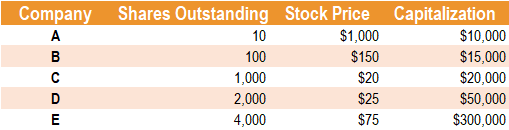
Using a capitalization-weighted index, the value of the stock index above is $10,000 + $15,000 + $20,000 + $50,000 + $300,000 = $395,000.
Index 2 – Telecommunications
The second one, provided below, consists of five telecom stocks that he believes provides a good representation of the telecommunications industry in the United States:
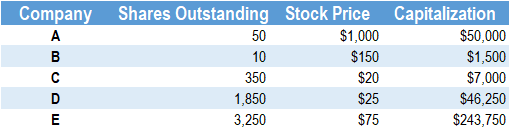
Using a capitalization-weighted index, the value of the stock index above is $50,000 + $1,500 + $7,000 + $46,250 + $243,750 = $348,500.
Impact of Steel Tariffs
The next day, the US president imposes a 50% steel import tariff. The market index constructed by Colin is now as follows:
Index 1 – Automobile
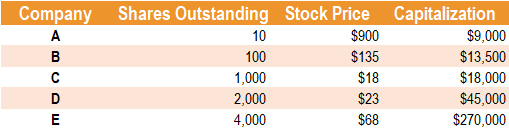
Using a capitalization-weighted index, the index’s value is $9,000 + $13,500 + $18,000 + $45,000 + $270,000 = $355,500 – which is a decrease from $395,000 before the implementation of the steel tariffs. Colin is able to see that the steel import tariff imposed by the US leader negatively affected the automobile industry.
Index 2 – Telecommunications
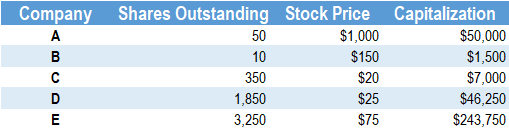
Using a capitalization-weighted index, the index’s value is $50,000 + $1,500 + $7,000 + $46,250 + $243,750 = $348,500 – which is identical to $348,500 before the implementation of the steel tariffs. Colin is able to see that the steel import tariff imposed by the US leader did not affect the telecommunication industry.
More Resources
CFI offers the Financial Modeling & Valuation Analyst (FMVA)™Become a Certified Financial Modeling & Valuation Analyst (FMVA)®CFI's Financial Modeling and Valuation Analyst (FMVA)® certification will help you gain the confidence you need in your finance career. Enroll today! certification program for those looking to take their careers to the next level. To keep learning and advancing your career, the following resources will be helpful:
- Dow DivisorDow DivisorThe Dow divisor, in simple terms, is a number used to help calculate the Dow Jones Industrial Average (DJIA). The divisor began as the equivalent of the
- FTSE IndicesFTSE IndicesFTSE indices refer to several major UK stock market indexes. Indices provide market analysts and investors with a gauge for monitoring the overall equity market. Specifically, the FTSE (Financial Times Stock Exchange) indices represent stocks traded on the London Stock Exchange (LSE). They reflect the performance of UK stock shares
- Nikkei IndexNikkei IndexThe Nikkei Index, or Nikkei 225, is the most recognized Japanese stock market index. It comprises Japan's top 225 companies listed on the Tokyo Exchange.
- Index FundsIndex FundsIndex funds are mutual funds or exchange-traded funds (ETFs) that are designed to track the performance of a market index. Currently available index funds track different market indices, including the S&P 500, Russell 2000, and FTSE 100.
-

Founders Stock: Definition, Vesting, and Key Differences
Founders stock refers to the equity that is given to the early founders of an organization. This type of stock differs in a few important ways from common stock sold in the secondary marketSecondary M
-

Restricted Stock: Definition, Types & How It Works
Restricted stock refers to an award of stock to a person that is subject to conditions that must be met before the stockholderStockholders EquityStockholders Equity (also known as Shareholders Equity)
invest
- DAX Index: Your Guide to Germany's Top 30 Companies
- Understanding Downtrends: Definition, Identification & Reversal
- Understanding High Beta Indexes: Risk & Investment Opportunities
- High-Low Index: Understanding 52-Week Highs & Lows | [Your Brand]
- Index Investing: A Beginner's Guide to Passive Investing
- Understanding Market Indexes: A Comprehensive Guide
- Understanding Quadruple Witching: A Guide for Investors
- Understanding Stock Index Futures: A Comprehensive Guide
- Stock Market Indexes: A Comprehensive Guide to Understanding
-
 Understanding Stock Performance: A Guide for Investors
Brokers, investors and day traders are particularly sensitive to the performance of stocks on markets such as the New York Stock Exchange. The performance of stocks vary depending on the industry, pri...
-
All-Ordinaries Index (XAO): Your Guide to Australian Equities
What Is the All-Ordinaries Stock Index? The All-Ordinaries ( or Kangaroos for slang) is a stock index comprised of common shares from the Australian Stock Exchange (ASX). The All-Ordinaries Ind...