
Declaration of Trust: Definition, Purpose & Key Terms
A declaration of trust is a legal document used to create a new trust or to confirm the terms of an existing trust.

The declaration of trust acts as the legal contract between the trustee and the beneficiaryNamed BeneficiaryA named beneficiary is an individual – named in a legal document – who is permitted to collect assets from IRAs, insurance policies, pension plans, and regarding the administration of the trustee’s assets. As a legal document, the declaration of trust outlines the beneficiaries, trustees, and terms of the trust agreement. It can also be used to confirm the terms of an existing trust.
Summary
- A declaration of trust is a legal document used to create a new trust or to confirm the terms of an existing trust.
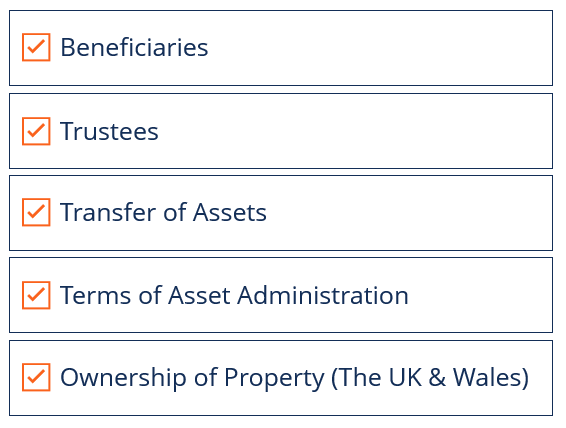
- The declaration of trust outlines the beneficiaries, trustees, and terms of the trust agreement.
- In England and Wales, the declaration of trust refers to a legal agreement that confirms the true owner of a property.
Beneficiaries and Trustees
Before delving into the declaration of trust, it’s important to understand the legal relationship between beneficiaries and trustees. In a declaration of trust, the trustee administers assetsTotal AssetsTotal assets refers to the sum of the book values of all assets owned by an individual, company, or organization. on behalf of the beneficiary. Although trustees are responsible for the administration of assets, the underlying assets still belong to the beneficiary.
A trustee is an individual or company that can hold and administer assets on behalf of a beneficiary following the terms of the trust agreement. Common trustees include banks, trust companies, or individuals. In contrast, the beneficiary is the owner of the assets and benefits from increases to the value of the underlying assets.
Under a trust agreement, many forms of assets can be administered, such as cash, securities, or real estateReal EstateReal estate is real property that consists of land and improvements, which include buildings, fixtures, roads, structures, and utility systems. Property rights give a title of ownership to the land, improvements, and natural resources such as minerals, plants, animals, water, etc..
Analyzing the Declaration of Trust
As a legal document, a declaration of trust is used to establish a new trust or to confirm the terms of an existing trust. When creating a new trust, the declaration of trust establishes the trustees and the beneficiaries of the trust, and clearly states the terms and conditions of the agreement.
It includes aspects such as the purpose of the trust, restrictions governing how the assets will be administered, and agreements between the beneficiary and the trustee regarding the transfer of assets.
After the declaration of trust is executed, the trust is established, and assets will be administered accordingly. The declaration of trust can also be used to confirm the terms of an existing trust.
Once a declaration of trust has been executed, subsequent declarations can be issued to confirm current terms or amend the existing agreement. Depending on the jurisdiction, the declaration of trust can also be referred to as a trust agreement or a trust document.
Benefits of Holding Assets in Trust
Many benefits will compel a beneficiary to administer their assets through a trust. Due to the flexibility of trust agreements, trusts can be used in all aspects of financial planning – from retirement to taxes.
One of the benefits of a trust is that assets can be professionally administered and used following the beneficiary’s original intent. For example, a declaration of trust can ensure that funds are only used for certain purposes – such as education or charitable donations.
Trusts can serve a multiple of other purposes – such as reducing income taxes, protecting assets from creditors, or ensuring that assets are distributed to multiple generations of beneficiaries. Due to the flexibility of trust agreements, the declaration of trust can be used to establish trusts for a multitude of financial obligations.
Declaration of Trust (England & Wales)
In England and Wales, the declaration of trust refers to a legal agreement that confirms the true owner of a property.
Similar to a deed of trust, the declaration of trust is used by the beneficiary to transfer property to a trustee without having the trustee’s name appear on the deed. Therefore, the declaration of trust can be used to confirm the true owner of a property, as the entry in the land registry may only include the name of the trustee.
For example, Kayla is buying an apartment in London with financial help from her parents. Let’s say that her parents are willing to provide her with 40% of the purchase price in exchange for 40% of any profits received from the property.
By signing a declaration of trust, only Kayla’s name will appear on the deed, but her parents are still legal beneficiaries of the property. If Kayla decides to sell her apartment at a profit, she will need to return 40% of the profits to her parents.
More Resources
CFI offers the Commercial Banking & Credit Analyst (CBCA)™Program Page - CBCAGet CFI's CBCA™ certification and become a Commercial Banking & Credit Analyst. Enroll and advance your career with our certification programs and courses. certification program for those looking to take their careers to the next level. To keep learning and developing your knowledge base, please explore the additional relevant resources below:
- Account in TrustAccount in TrustAn account in trust, also known as a trust or ITF – “in trust for” – account, is a bank account that is registered by an individual but that is managed and
- Contingent BeneficiaryContingent BeneficiaryA contingent beneficiary is the alternative beneficiary, designated by the account holder, who is set to receive the proceeds or benefits of a financial
- Power of AttorneyPower of AttorneyPower of Attorney, or POA, is legal documentation giving an attorney-in-charge or legal agent the authority to act on behalf of the principal. The attorney
- Asset ProtectionAsset ProtectionAsset protection refers to a set of techniques, strategies, and laws that aims to protect assets belonging to individuals and businesses against the claims
-

Influencer Marketing: When Do Consumers Trust Recommendations?
The best way to choose what to buy is probably still from a personal recommendation. If you don't know anyone who fits the bill (and those handy review sites aren't cutting it), a social media
-
Understanding Distributable Net Income (DNI): A Comprehensive Guide
Distributable Net Income (DNI) is a term that describes the portion of a trust’s income allotted to the beneficiaries. The calculation of DNI is performed to distribute the income of the trust b
invest
- Trust Officer: Responsibilities, Career Path & Requirements
- Understanding Residual Trusts: What Happens to Your Remaining Assets?
- Trust Checking Accounts: A Comprehensive Guide for Trustees & Beneficiaries
- Trust Banks: Understanding How They Facilitate Transactions
- Voting Trust Certificate: Definition & Corporate Control
- Understanding Trusts: A Comprehensive Guide to Asset Management & Estate Planning
- Investment Trusts Explained: A Comprehensive Guide
- Living Trusts: A Comprehensive Guide to Estate Planning
- Understanding Trustees: Roles, Responsibilities & Duties
-
 Depository Trust Company (DTC): Central Securities Depository Explained
The Depository Trust Company (DTC), a US-based corporation, is a central securities depository accepting deposits from over 65 countries. It provides book-entry and depository services, transfer and p...
-
Understanding Cryptocurrency: A Beginner's Guide to Digital Currency
Cryptocurrency is a kind of digital currency that is intended to act as a medium of exchange. Cryptocurrency has become popular in the last decade, in particular, with Bitcoin becoming the most widel...