
Voting Trust Certificate: Definition & Corporate Control
A voting trust certificate is a document used to give temporary voting control over a corporation to one or several individuals. It is issued to a shareholder and represents the normal rights of any other stockholder, such as receiving quarterly dividends in exchange for their common sharesCommon StockCommon stock is a type of security that represents ownership of equity in a company. There are other terms – such as common share, ordinary share, or voting share – that are equivalent to common stock.. The only exception, however, is that their right to vote is terminated.
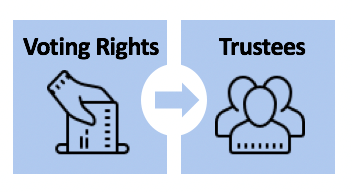
A voting trust certificate expires within two to five years, which at maturity, voting rights are transferred back to the original shareholderShareholderA shareholder can be a person, company, or organization that holds stock(s) in a given company. A shareholder must own a minimum of one share in a company’s stock or mutual fund to make them a partial owner..
Summary
- Through a voting trust agreement, majority shareholders with voting rights will transfer their right to vote to a trustee in the form of a voting trust certificate. The certificate gives the trustee temporary control of the company.
- Voting trust certificates are used to allow trustees to restructure a company’s finances, counter hostile takeovers, and mitigate any other activity that may damage and result in a detrimental position for the company and its current shareholders.
- The difference between voting trusts and a proxy vote is the amount of power distributed to the trustee and the extended reasons for doing so.
Understanding Voting Trust Certificates
A voting trust certificate provides a small number of individuals with the opportunity to gain control and make strategic decisions for a business with little to no resistance from other parties. In order for a voting trust certificate to be effective, a majority of shareholders must accept the terms for the voting power to be momentarily transferred over.
Generally, a voting trust certificate’s purpose is to allow a group of individuals to restructure the corporation during challenging times, such as overcoming short-term financing plans, strategic hurdles, and more.
Thus, by allowing for the existence of a voting trust certificate, the majority shareholders are implicitly expressing their confidence in the group of trustees to execute and make the necessary changes to reduce any financial struggles that may threaten the goodwill of the company and its shareholders. In other cases, voting trust certificates may be used to countermeasure any possibility of hostile takeoversHostile TakeoverA hostile takeover, in mergers and acquisitions (M&A), is the acquisition of a target company by another company (referred to as the acquirer) by going directly to the target company’s shareholders, either by making a tender offer or through a proxy vote. The difference between a hostile and a friendly.
Normally, voting trust certificates are used in smaller firms that struggle with their finances, relative to larger companies that tend to encounter dissimilar problems, considering the latter’s abundance of deployable capital along with a larger float of shares and diversified shareholders.
Recognizing the Terms of a Voting Trust Agreement
Once voting trust agreements are enacted, they must be filed and recorded by the U.S. Securities and Exchange Commission (SEC)Securities and Exchange Commission (SEC)The US Securities and Exchange Commission, or SEC, is an independent agency of the US federal government that is responsible for implementing federal securities laws and proposing securities rules. It is also in charge of maintaining the securities industry and stock and options exchanges. Voting trust agreements tend to include:
- The date of the agreement
- Duration of maturity
- The rights of shareholders
- Following procedures in the scenario that a merger occurs
- Consolidation or dissolution of the company
- Stated duties and given powers of the trustees
In addition, compensation is included within the contract for the trustee, which is often stated and agreed upon by the majority shareholders.
Voting Trusts vs. Proxy Voting
Though voting trusts and proxy voting are similar, there are some slight differences in terms of how they operate. For a proxy vote, it is a temporary arrangement for a one-time issue; whereas, for a voting trust, it gives the trustees increased power to make decisions on behalf of all shareholders to control the company, which differs from proxy voting in terms of how much power is allocated.
Related Readings
CFI is the official provider of the Commercial Banking & Credit Analyst (CBCA)™Program Page - CBCAGet CFI's CBCA™ certification and become a Commercial Banking & Credit Analyst. Enroll and advance your career with our certification programs and courses. certification program, designed to transform anyone into a world-class financial analyst.
In order to help you become a world-class financial analyst and advance your career to your fullest potential, these additional resources will be very helpful:
- Common vs Preferred SharesCommon vs Preferred SharesPotential investors who are looking to acquire a stake or ownership in a company can choose to purchase between common vs preferred shares. Companies
- Proxy VoteProxy VoteA Proxy Vote is a delegation of voting authority to a representative on behalf of the original vote-holder. The party who receives the authority to vote is known as the Proxy and the original vote-holder is known as the Principal. The concept is important in financial markets and particularly with public companies
- Voting SharesVoting SharesVoting shares are shares of a company that entitle the shareholder to vote on key issues of the company. It is generally one vote per share. The shares
- Stakeholder vs. ShareholderStakeholder vs. ShareholderThe terms “stakeholder” and “shareholder” are often used interchangeably in the business environment. Looking closely at the meanings of stakeholder vs shareholder, there are key differences in usage. Generally, a shareholder is a stakeholder of the company while a stakeholder is not necessarily a shareholder.
-

Certificate-Secured Loans: A Comprehensive Guide
A certificate-secured loan is a type of loan that is offered at most credit unions. Here are the basics of a certificate-secured loan and how it could benefit you. Certificate Secured Loans A ce
-
Testamentary Trusts: How They Work & Key Considerations
A testamentary trust is a type of trust arrangement that is initiated from the specific requests of an individuals will. When the person dies, the trust is then set up and is funded with the app
finance
- Understanding Certificates of Judgment: A Comprehensive Guide
- Understanding Short Certificates: Estate Administration Explained
- Understanding Certificates of Deposit (CDs): A Comprehensive Guide
- Trust Banks: Understanding How They Facilitate Transactions
- Declaration of Trust: Definition, Purpose & Key Terms
- Understanding Trusts: A Comprehensive Guide to Asset Management & Estate Planning
- Investment Trusts Explained: A Comprehensive Guide
- Living Trusts: A Comprehensive Guide to Estate Planning
- Understanding Trustees: Roles, Responsibilities & Duties
-
 Share Certificates: Understanding the Basics & Key Differences
A share certificate is an investment instrument that is very much like a certificate of deposit (CD). There are two primary differences between share certificates and certificates of deposi...
-
 Understanding Cumulative Voting: A Guide for Shareholders
Cumulative voting, also called accumulation voting or weighted voting, is a multi-voting system used by companies to promote a more proportional representation for shareholders. In cumulative voting, ...