
Trust Banks: Understanding How They Facilitate Transactions
A trust bank is an organization that allows its customers to transact with each other through contracts known as trusts. The bank acts as a trustee in such transactions and transfers assets from one customer/client (known as the settlor) to another (known as the beneficiary) according to the terms of the trust agreement.

Summary
- A trust bank allows its customers to transact with each other through contracts known as trusts.
- Japan’s trust banks offer banking/financing services along with investment-related services such as asset management.
- Mitsubishi UFJ Trust and Banking (MUTB), one of Japan’s largest trust banks, currently manages $370bn in assets.
Trust Banks in Japan
Many countries have trust banks or offer trust banking services, but Japan has one of the largest and most well-established trust banking industries in the world. Japan’s trust banks are financial institutions that combine banking/financing services with investment-related services such as asset management and miscellaneous services, including pension plan design and management, real estate brokerage, and appraisal services for both corporate and individual banking clients.
Trust banks in Japan were separated from bank trust departments during the early 1960s to bridge the gap between banks and securities firms. Currently, Mitsubishi UFJ Trust and Banking (MUTB) is one of the country’s largest trust banks with $370bn in assets under management.
History of Trust Banks in Japan
Japan set up its first secured bonds trust system in 1905 when it enacted the Secured Bonds Trust Act. The legislation allowed large banks and financial institutions to trade bonds with each other. The government-backed project was a key factor behind the large capital inflow into Japan in the early part of the 20th century. The capital inflows enabled the country to become a military and economic superpower in the Asia-Pacific region.
In 1906, the Tokyo Trust Company was established to help households and small businesses mobilize funds and invest in the financial markets. In 1921, the number of trust banks totaled more than 400. Until then, the government allowed the banks to largely govern themselves. In 1922, Japan passed the Trust Act as the governing law for trusts and the Trust Business Act to protect the settlors and beneficiaries of the trusts.
Functions of Trust Banks in Japan
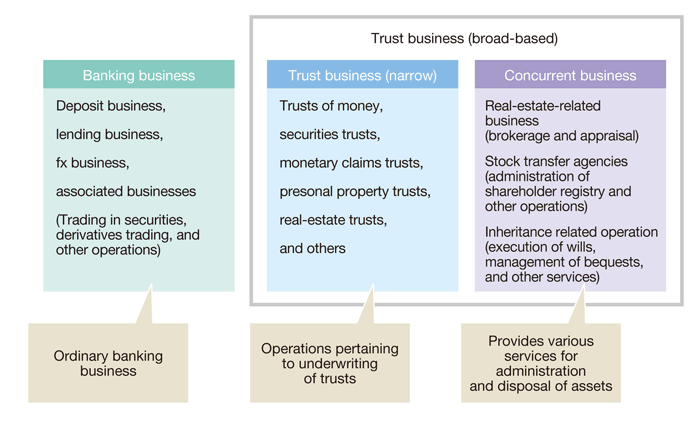
Trust banks in Japan combine banking/financial services with investment-related services for both corporate and individual clients. In addition, the banks also provide miscellaneous services such as pension plan design and management, real estate brokerage, and other services. They are able to access not only the expanding market of direct financing but also the traditional market of indirect financing.
The diversity of operations and services offered by Japan’s trust banks can be outlined by the following graphical description:
Additional Resources
CFI is the official provider of the global Financial Modeling & Valuation Analyst (FMVA)™Become a Certified Financial Modeling & Valuation Analyst (FMVA)®CFI's Financial Modeling and Valuation Analyst (FMVA)® certification will help you gain the confidence you need in your finance career. Enroll today! certification program, designed to help anyone become a world-class financial analyst. To keep advancing your career, the additional CFI resources below will be useful:
- Financial IntermediaryFinancial IntermediaryA financial intermediary refers to an institution that acts as a middleman between two parties in order to facilitate a financial transaction. The institutions that are commonly referred to as financial intermediaries include commercial banks, investment banks, mutual funds, and pension funds.
- Mortgage BankMortgage BankA mortgage bank is a bank specializing in mortgage loans. It can be involved in originating or servicing mortgage loans, or both. The banks loan their own capital to borrowers and either collect payments in installments along with a certain rate of interest or sell their loans in the secondary market.
- Retail Bank TypesRetail Bank TypesBroadly speaking, there are three main retail bank types. They are commercial banks, credit unions, and certain investment funds that offer retail banking services. All three work toward providing similar banking services. These include checking accounts, savings accounts, mortgages, debit cards, credit cards, and personal loans.
- Top Banks in JapanTop Banks in JapanThere are over 400 banks in Japan. The Bank of Japan, the country’s central bank, was established in 1882 to control the domestic money supply
-

Understanding Bank Overdrafts: Causes, Costs & Solutions
A bank account overdraft happens when an individual’s bank account balance goes down to below zero, resulting in a negative balance. It usually happens when there are no more funds in the accoun
-

Bank Line of Credit (LOC): Definition & How It Works
A “bank line” or a “line of credit” (LOC) is a kind of financing that is extended to an individual, corporationCorporate InformationLegal corporate information about Corporate
finance
- Community Banks: What They Are & How They Differ from Big Banks
- Understanding Banks: Types, Functions, and Regulations
- Bank Drafts: Definition, How They Work & Usage
- Understanding Bank Ratings: A Guide to Financial Stability
- Understanding Bank Reserves: A Comprehensive Guide
- Commercial Banks: Definition, Services & Bridge Loans
- Money Center Banks: Definition, Services & Key Players
- Living Trusts: A Comprehensive Guide to Estate Planning
- Central Banks: Functions, Role & Impact on the Economy
-
 Understanding Bank Statements: A Comprehensive Guide
A bank statement is a document that summarizes all the transactions that have taken place in your bank account over a period of a month. The purpose of a bank statement is to record and track all your...
-
 Understanding Trustees: Roles, Responsibilities & Duties
You may have heard the term “trustee” before but might be questioning what it means and what a trustee does. Trustees may take care of things such as a person’s estate plan, investments, or charitable...