
Direct Stock Purchase Plans (DSPPs): A Comprehensive Guide
A Direct Stock Purchase Plan (DSPP) is a way for individuals to buy stocks directly from a company rather than through a brokerage.
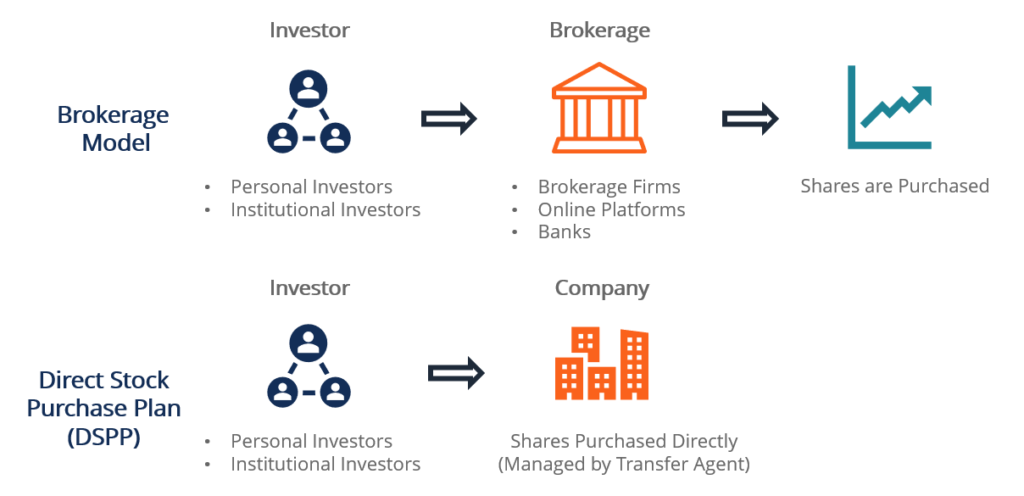
Typically, investors purchase stocks through brokerages, such as banks or online investment platforms. In this case, the brokerage acts as a middlemanMiddlemanA middleman plays the role of an intermediary in a distribution or transaction chain who facilitates interaction between the involved parties. Middlemen between the investor and the company, providing investors with access to a range of stock offerings on one platform.
However, brokerages typically charge commissions or currency exchange fees per transaction. Through a direct stock purchase plan, an investor can skip the middleman and purchase shares directly from a company. Although DSPPs minimize commissions, there are other drawbacks, such as purchase requirements and transfer fees.
Summary
- A Direct Stock Purchase Plan (DSPP) is a way for individuals to buy stocks directly from a company rather than through a brokerage.
- Through a DSPP, an investor can eliminate any brokerage fees associated with the purchase.
- In a DSPP, the price of each share isn’t equivalent to the market price, but rather an average price over a period of time.
How Direct Stock Purchase Plans Work
Direct stock purchase plans offer an alternative to the brokerage model most commonly used in the buying and selling of stocks. By skipping the middleman, investors can invest directly in a company while avoiding any commissions that would be paid to the brokerageBrokerageA brokerage provides intermediary services in various areas, e.g., investing, obtaining a loan, or purchasing real estate. A broker is an intermediary who.
However, direct stock purchase plans are agreements between an investor and a single company. Therefore, each company may have different requirements regarding the purchase of shares. Examples of companies that offer direct stock purchase plans are Walmart, Starbucks, and Coca-Cola.
Similar to the brokerage model, investors initiate the direct stock purchase by transferring money from their checking or savings accounts, and the money is used to purchase shares. Unlike a brokerage, direct stock purchase plans typically enforce minimum investment requirements, which limit the minimum number of shares that can be bought in each transaction.
Also, the price of each share isn’t equivalent to the market price, but rather the average price over a period of time. Funds from investors are pooled and are used to purchase shares periodically. Once the shares are purchased, the plan administrator will issue the investor a certificate that states the number of shares purchased, dividends, and other relevant information.
Direct stock purchases are managed by transfer agents, which are third-party institutions that record transactions, issue certificates, and perform administrative duties. Some of the world’s largest transfer agents include Computershare Trust Company and American Stock Transfer & Trust Company (AST).
For institutional investors that purchase large quantities of shares, direct stock purchases may be beneficial because companies can offer discounts that are unavailable through traditional brokerage models.
Direct stock purchases can provide increased communication between the investor and the company. Some corporations may also offer employee stock ownership plans (ESOP)Employee Stock Ownership Plan (ESOP)An Employee Stock Ownership Plan (ESOP) refers to an employee benefit plan that gives the employees an ownership stake in the company. The employer allocates a percentage of the company’s shares to each eligible employee at no upfront cost. The distribution of shares may be based on the employee’s pay scale, terms of, which allow employees to purchase shares at a discounted price.
Advantages of Direct Stock Purchases
1. Offers cost savings
For investors, one of the biggest advantages of direct stock purchases are the cost savings achieved from eliminating brokerage fees. Companies may also provide price discounts and dividend reinvestments.
2. Provides a simplified purchasing experience
Avoiding the brokerage model can also provide greater simplicity in the purchasing experience.
3. Promotes stronger investor relations
For the company itself, direct stock purchases can be beneficial because it promotes stronger investor relations. Since shares are purchased directly, the company can reach out to investors directly to promote and share information.
4. Prevents short-selling
Also, shares purchased through direct stock purchases cannot be shorted, which prevents short-selling and reduces price volatility.
Disadvantages of Direct Stock Purchases
1. Charges other fees
Although direct stock purchases eliminate brokerage fees, there are still other fees that can arise, such as account setup fees, transaction feesTransaction CostsTransaction costs are costs incurred that don’t accrue to any participant of the transaction. They are sunk costs resulting from economic trade in a market. In economics, the theory of transaction costs is based on the assumption that people are influenced by competitive self-interest., or fees to sell.
2. Reduces portfolio diversity and limits trading options
Direct stock purchases are between an investor and a single company. While a brokerage can offer thousands of stock options, a direct stock purchase limits the investor to one stock. It reduces portfolio diversity and limits an investor’s trading options.
With direct stock purchases, it’s difficult to know the price of each share before purchasing as the prices are an average. This makes it difficult to time the market and more complicated for investors to sell.
Additional Resources
CFI offers the Commercial Banking & Credit Analyst (CBCA)™Program Page - CBCAGet CFI's CBCA™ certification and become a Commercial Banking & Credit Analyst. Enroll and advance your career with our certification programs and courses. certification program for those looking to take their careers to the next level. To keep learning and advancing your career, the following resources will be helpful:
- Financial IntermediaryFinancial IntermediaryA financial intermediary refers to an institution that acts as a middleman between two parties in order to facilitate a financial transaction. The institutions that are commonly referred to as financial intermediaries include commercial banks, investment banks, mutual funds, and pension funds.
- Managed AccountManaged AccountA managed account is a portfolio of stocks or bonds – or a combination of the two – that is owned by a single manager. The investor hires a professional
- Secondary MarketSecondary MarketThe secondary market is where investors buy and sell securities from other investors. Examples: New York Stock Exchange (NYSE), London Stock Exchange (LSE).
- Checking Accounts vs. Savings AccountsChecking Accounts vs Savings AccountsA bank client can choose to open checking accounts vs savings accounts depending on several factors, such as purpose, ease of access, or other attributes. A checking account is a type of bank account that is used for everyday transactions. It is the most basic account that banks, credit unions, and small lenders offer.
-

Unlock Retirement Savings: 4 Benefits of an Employee Stock Purchase Plan
Investing in an employee stock purchase plan can provide you with a number of benefits when you are saving for retirement. If your company offers this type of plan, there are a few reasons that
-
Direct Stock Purchase Plans (DSPPs): Advantages & Disadvantages
How do you purchase stocks? Mostly through brokers, right? What if I say there is another way to purchase stocks that it does not involve brokers and thereby saves on the cost to invest in a particula
invest
- Omnibus Stock Plans: A Comprehensive Guide for Employees & Executives
- Direct Stock Purchase Plans: A Comprehensive Guide (2024)
- Invest in P&G: Understanding the Procter & Gamble Shareholder Investment Program (SIP)
- Direct Stock Purchase Plans (DSPPs): A Comprehensive Guide
- Direct Stock Purchase Plans (DSPPs): A Comprehensive Guide
- Understanding Downtrends: Definition, Identification & Reversal
- ESOP: Understanding Employee Stock Ownership Plans - Benefits & How They Work
- Employee Stock Purchase Plans (ESPP): A Comprehensive Guide
- Employee Stock Purchase Plans (ESPPs): A Comprehensive Guide
-
DB(k) Plans: A Hybrid Retirement Solution for Employers & Employees
The DB(k) plan is a type of retirement plan that is available for employers. This type of retirement plan combines features from the 401(k) plan with features from a defined benefit pension plan...
-
Phantom Stock: Definition, Benefits & How It Works
Many companies today are looking for creative ways to reward their senior managers and key executives for outstanding performance. One strategy is to provide these employees with what’s commonly refer...