
Direct Offerings: A Guide to Selling Securities Directly to Investors
A direct offering is sometimes referred to as direct placement. It is a type of offering that allows the issuing company to sell its securities directly to investors without using a middleman, such as an investment bank. When a company decides to use direct offering rather than an initial public offering (IPO)Initial Public Offering (IPO)An Initial Public Offering (IPO) is the first sale of stocks issued by a company to the public. Prior to an IPO, a company is considered a private company, usually with a small number of investors (founders, friends, family, and business investors such as venture capitalists or angel investors). Learn what an IPO is, it eliminates most of the costs associated with going public.
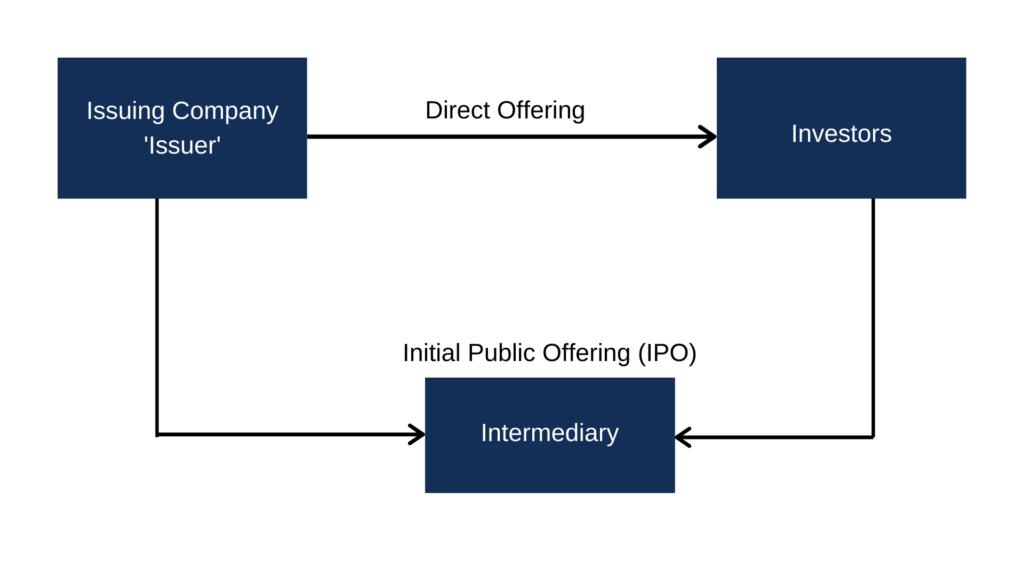
Usually, companies going public through an IPO are required to use intermediaries such as investment banks, which handle the offering process on behalf of the issuer. Eliminating the intermediaries lowers the cost of capital of the offering.
Most direct offerings are exempted from a majority of the requirements set out by the Securities Exchange Commission (SEC)Securities and Exchange Commission (SEC)The US Securities and Exchange Commission, or SEC, is an independent agency of the US federal government that is responsible for implementing federal securities laws and proposing securities rules. It is also in charge of maintaining the securities industry and stock and options exchanges. Some of these exemptions came into place in 1992 when SEC established the Small Business Initiatives Program. The program offered a reprieve to small businesses that were unable to raise funds by offering securities to investors.
When raising capital, small- to medium-sized companies prefer direct offering over IPOs, since it allows them to raise capital directly from the community where they operate from, instead of borrowing from financial institutions such as banks. Such an arrangement allows the issuing company to determine the terms of the offerings, rather than struggle to meet the stringent requirements set by banks and venture capital firms.
Quick Summary
- A direct offering is a type of offering that allows companies to raise capital by selling securities directly to the public.
- It eliminates the intermediaries that are often involved in the offering process, thereby cutting down the costs of raising capital.
- The issuer is required to meet regulatory requirements of the state where it plans to sell the securities.
How Direct Offering Works
A company may opt to use the direct public offering method rather than an IPO when it lacks financial resources to pay underwritersUnderwritingIn investment banking, underwriting is the process where a bank raises capital for a client (corporation, institution, or government) from investors in the form of equity or debt securities. This article aims to provide readers with a better understanding of the capital raising or underwriting process, or it does not want to dilute existing shares by issuing new shares to the public. The company sells stocks directly to the public without using any middlemen or brokers.
The issuing company is responsible for determining the terms of the offering based on the company’s goals and interests. It sets the offering price, the limit on the number of stocks per investor, settlement date, and the offering period when investors can purchase the stocks.
Direct Offering Process
A direct offering can take a few days, weeks, or even months, depending on the company and the amount of capital that the issuer plans to raise. The following are the key stages in a direct offering:
1. Preparation stage
At the preparation stage of the issue, the issuer prepares an offering memorandumOffering MemorandumAn Offering Memorandum is also known as a private placement memorandum. It is used as a tool to attract external investors. that details information about the company and the security being issued. Usually, the type of security can either be common stock, preferred stocks, REITs, debt securities, etc.
The issuer should also decide on the appropriate marketing medium, such as newspapers, social media, telemarketing campaigns, etc. that it will use to market the offering.
2. Regulatory approval
The issuing company is also required to meet all the regulatory requirements in the state where it intends to conduct the direct offering. The regulatory requirements are guided by the Blue Sky Laws of each state, and it requires issuers to register their offerings and disclose financial details of the offering, as well as all the entities involved.
Some of the compliance documents that issuers are required to file include the offering memorandum, articles of incorporationArticles of IncorporationArticles of Incorporation are a set of formal documents that establish the existence of a company in the United States and Canada. For a business to be, latest financial statements, and other material information that may affect the transaction.
The documents provide investors with a wealth of information on which to base their investment decisions. The state then conducts a merit review to determine whether the offering is balanced and fair for investments. If satisfied with the information provided, approval is granted within a period of two weeks to two months.
3. SEC exemptions
Most direct offerings are not required to be registered with the SEC since they qualify for certain exemptions. For example, Rule 147 (Intrastate filing exemption) allows companies to raise funds by selling securities to the public, as long as the securities are sold in the primary state where the company does business. The exemption is only valid when both the company and the investors are residents of the same state.
Another exemption is Rule 504 or Regulation D, which exempts companies that raise no more than $1 million in a 12-month period through the sale of securities. It does not place any restrictions on the number or type of investors.
Direct Offering vs. Initial Public Offering
A direct offering and an initial public offering are the two main methods in which a company can raise funds by selling securities in a public exchange market. In an IPO, the issuer creates new shares that are underwritten by an intermediary, such as an investment bank or financial advisors. The underwriter works with the issuing company during the offering process, by ensuring that the company meets regulatory requirements.
The intermediary determines the IPO price of shares and is in charge of the offering process on behalf of the issuer. On some occasions, the intermediary may be required to guarantee the sale of a specific number of shares out of the shares offered to the public.
In contrast, a direct offering is less complicated compared to an IPO. It involves selling securities directly to the public without going through an intermediary. No new shares are offered to the public, and there is no guarantee for the sale of securities. The issuing company sets the terms of issue, such as the offer price, minimum amount of investment per investor, and the maximum number of securities that each investor can buy.
Additional Resources
CFI offers the Commercial Banking & Credit Analyst (CBCA)™Program Page - CBCAGet CFI's CBCA™ certification and become a Commercial Banking & Credit Analyst. Enroll and advance your career with our certification programs and courses. certification program for those looking to take their careers to the next level. To keep learning and advancing your career, the following resources will be helpful:
- Capital Raising ProcessCapital Raising ProcessThis article is intended to provide readers with a deeper understanding of how the capital raising process works and happens in the industry today. For more information on capital raising and different types of commitments made by the underwriter, please see our underwriting overview.
- Flotation CostsFlotation CostsFlotation costs are the costs that are incurred by a company when issuing new securities. The costs can be various expenses including, but not limited to, underwriting, legal, registration, and audit fees. Flotation expenses are expressed as a percentage of the issue price.
- Rights IssueRights IssueA rights issue is an offering of rights to the existing shareholders of a company that gives them an opportunity to buy additional shares directly from the company at a discounted price
- Top Investment BanksList of Top Investment BanksList of the top 100 investment banks in the world sorted alphabetically. Top investment banks on the list are Goldman Sachs, Morgan Stanley, BAML, JP Morgan, Blackstone, Rothschild, Scotiabank, RBC, UBS, Wells Fargo, Deutsche Bank, Citi, Macquarie, HSBC, ICBC, Credit Suisse, Bank of America Merril Lynch
-

Outsourcing: A Comprehensive Guide to Benefits & Strategy
Outsourcing is a strategic decisionCorporate StrategyCorporate Strategy focuses on how to manage resources, risk and return across a firm, as opposed to looking at competitive advantages in business s
-

Ramp-Up: Definition, Benefits & How to Achieve It
In business, ramp-up is a term that describes a significant increase in the output of a company’s products or services. Essentially, ramp-up implies bringing the company’s capacity utiliza
invest
- Acquirer Definition: Understanding Corporate Acquisitions
- Understanding Clawbacks: Protecting Stakeholders from Failed Performance
- Direct Deposit: Definition, Benefits & How It Works
- Direct Listing Explained: Going Public Without an IPO
- Understanding Financial Gearing: Debt & Leverage Explained
- Leverage in Finance: Strategies, Types & Risks
- Parent Company Explained: Definition, Control & Examples
- Understanding Initial Coin Offerings (ICOs): A Comprehensive Guide
- Understanding Net-Net: A Financial Health Indicator
-
 Holding Companies: Definition, Purpose & How They Work
A holding company is a company that doesn’t conduct any operations, ventures, or other active tasks for itself. Instead, it exists for the purpose of owning assets. In other words, the company d...
-
 Kaizen: Understanding Continuous Improvement for Business
Kaizen is a Japanese word (改善) that means “improvement” or “to improve.” When applied to the world of business, kaizen refers to every action, operation, or rule ...