
Double Bottom Pattern: Technical Analysis Explained
A double bottom is a type of price movement identified in technical analysis where there is a fall in price led by gain and then another drop (similar to the previous drop), and finally, a rise in price from a shape that is similar to the letter W. An accurate definition of a double pattern is achieved when the second price rise goes above the highest point, thus ending the pattern.
Usually, the first drop is usually a sharp decline, while the second drop is more of a gradual drop. The first drop is because of panic selling by investors, while in the second drop, investors who bought stocks after the first drop sell to gain profits.
Summary
- A double bottom is a pattern in asset prices that creates a W-shaped movement. It indicates that after two lows, there will be a significant increase in price.
- A double top is an opposite movement in price compared to a double bottom. The double top pattern indicates that after the two highs, the price of the asset is going to go down significantly.
- Investors who want to trade in a double bottom should do so at the second bottom. The only gamble here is that they are still assuming it will be a double bottom.
Importance of Double Bottom
A double bottom is an indicator of positive signals as the stock’s reached its low, and the second bottom will mostly be followed by a continuous increase in the stock price.
Double Top and How it is Traded
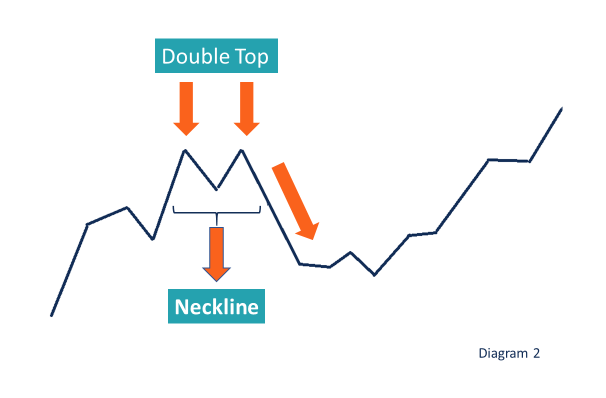
A double top is a reversal of a bearish movement in the stock price. It consists of two peaks. The first peak comes after a bullish movementBullish and BearishProfessionals in corporate finance regularly refer to markets as being bullish and bearish based on positive or negative price movements. A bear market is typically considered to exist when there has been a price decline of 20% or more from the peak, and a bull market is considered to be a 20% recovery from a market bottom., after which it goes down to the neckline. It is followed by another bullish movement to reach the second peak.
It is important to note that for a double top, the bearish movement after the second peak should be more significant than the bearish movement after the first peak for the pattern to be termed as a double top.
Investors who trade during a double top usually go short during the second peak in anticipation of a huge fall in price.
How is Trading Done During a Double Bottom
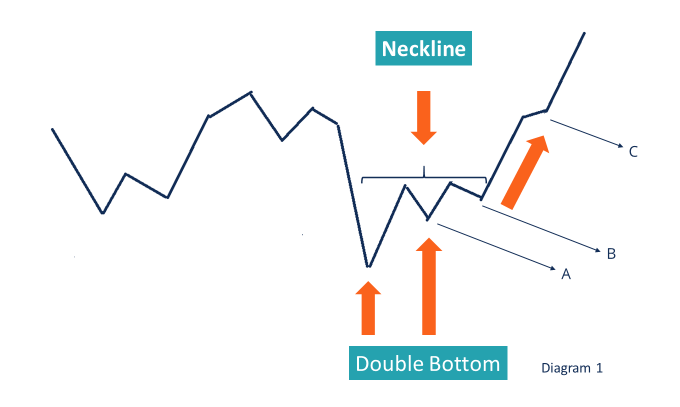
As stated earlier, a double bottom reversal is a bullish movement in the stock prices. It contains two lows. When we look at diagram 1 above, the first low comes after a bearish movement in the stock prices followed by a bullish movement to reach the neckline.
The second low comes after and is followed by a bullish movement. It is important to note that the second bullish movement should be more significant than the first bullish movement to attain a double bottom.
Investors trading during the double bottom usually go long during the second low in anticipation of a bullish run.
Trading Strategies During a Double Bottom
1. Aggressive strategy
At point A in diagram 1, traders will use an aggressive strategy by betting for a double bottom. At the second peak, they will assume for the pattern to complete by expecting a bearish movement, thus helping their portfolio to increase in value.
2. Less aggressive strategy
At point B in diagram 1, the double bottom pattern has already taken place. Hence, at this point and beyond, the investor will see a smaller opportunity to earn a higher profit as compared to point A.
3. Conservative strategy
At this point, the investors will see much of an advantage to earn a profit, as beyond this point, it will be difficult to know in which direction the prices will go.
Related Readings
CFI offers the Capital Markets & Securities Analyst (CMSA)®Program Page - CMSAEnroll in CFI's CMSA® program and become a certified Capital Markets &Securities Analyst. Advance your career with our certification programs and courses. certification program for those looking to take their careers to the next level. To keep learning and developing your knowledge base, please explore the additional relevant resources below:
- Advanced Technical AnalysisAdvanced Technical AnalysisAdvanced technical analysis usually involves using either multiple technical indicators or a rather sophisticated (i.e., complex) indicator. "Sophisticated"
- Momentum IndicatorsMomentum IndicatorsMomentum indicators are tools utilized by traders to get a better understanding of the speed or rate at which the price of a security changes. Momentum
- Bull vs. BearBull vs BearThe term bull vs. bear denotes the ensuing trends in stock markets – whether they are appreciating or depreciating in value – and what is the
- Long and Short PositionsLong and Short PositionsIn investing, long and short positions represent directional bets by investors that a security will either go up (when long) or down (when short). In the trading of assets, an investor can take two types of positions: long and short. An investor can either buy an asset (going long), or sell it (going short).
-

Anchoring Bias: Understanding How First Impressions Influence Decisions
Anchoring bias occurs when people rely too much on pre-existing information or the first information they find when making decisions. For example, if you first see a T-shirt that costs $1,200 –
-
Double Bottom Pattern: Technical Analysis Explained
A double bottom is a type of price movement identified in technical analysis where there is a fall in price led by gain and then another drop (similar to the previous drop), and finally, a rise in pri
invest
- PC Banking: A Comprehensive Guide to Online Banking Security & Features
- IRA CDs: Secure Retirement Savings with FDIC Insurance
- Understanding Double Dipping in Retirement: Risks & Strategies
- Double Gearing Explained: Risks & Rewards of Leveraged Stock Investing
- Understanding Double Taxation: Corporate & International Aspects
- Double Exponential Moving Average (DEMA): A Trading Guide
- Double Top Pattern: Definition, Trading Signals & Analysis
- Understanding Double-Entry Bookkeeping: A Comprehensive Guide
- Understanding Cryptocurrency: A Beginner's Guide to Digital Currency
-
 0x: A Comprehensive Guide to Decentralized Ethereum Trading
What Is 0x? 0x is a decentralized exchange for trading ERC 20 tokens. (See also: What Is ERC 20 And What Does It Mean For Ethereum?). It is among the most high-profile examples of decentra...
-
Annuities Explained: A Simple Guide to Retirement Income
So you're wondering what is an annuity? There are dozens of different flavours of annuities that perform different functions and pay their holders out in different ways, but for our purposes let’...