
Understanding Held Orders: A Quick Guide for Traders
A held order refers to a market order that should be executed promptly with no hesitation. When a trader receives instructions by way of a held order, implementation time is instant, as the order needs to be filled immediately. In financial markets jargon, it is called “hit the bid or take the offer line.” Like all market orders, held orders are instructions to buy and sell securities such as stocks, bondsCorporate BondsCorporate bonds are issued by corporations and usually mature within 1 to 30 years. They usually offer a higher yield than government bonds but carry more risk., or other hybrid marketable instruments in financial markets.

A derivative of the held order is the held limit order, where the held order comes with a limit on either the buying or selling price. A variant of the held order is the not-held order (the opposite of a held order), which gives traders both time and price discretion in filling the order.
Held orders are typically issued by investors who wish to swiftly change their exposure to certain stocks by liquidating or switching to other stocks or a different instrument altogether. Hence, with the immediate execution feature, a held order is the best market order a trader can use to guarantee an instantaneous transaction.
Summary
- A held order refers to a market order that requires immediate execution. Held orders are issued by investors who want to quickly change their exposure to certain stocks.
- A variation of the held order is the held limit order, where a held order comes with a limit on either the buying or selling price.
- Held orders are ideal for trading breakouts and closing error positions. However, they are not ideal when trading illiquid stocks, as they make a trader incur a huge spread in settling the order.
Understanding Held Orders
A trader who receives a held order must act on it immediately. It does not give ample discretion to prowl the market to find a better deal as in other exchange orders, particularly the not-held order. The major constraint of a held order is time, since the order needs to be immediately filled. Let us look at an example of two held orders – a sell held order and a buy held order.
Sell Held Order
The sell held order instruction is to sell Alphabet Class A shares with a bid-ask price as below:
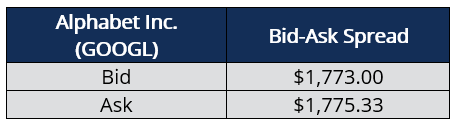
A trader must satisfy the order by matching the highest bid price; in this case, the price is $1,773. Through such action, a transaction is executed immediately under normal market conditions.
Buy Held Order
The buy held order instruction is to buy Under Armour (UA.C) Class C shares with a bid-ask price as below:
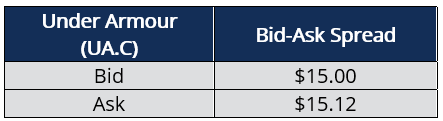
A buy held order instructs the trader to satisfy the order through matching the lowest offer (ask price); in this case, $15.12. A purchase transaction is executed immediately under normal market conditions.
Conditions for Issuing a Held Order
There are two circumstances where issuing a held order is ideal – i.e., trading a breakout and closing an error position.
1. Trading Breakouts
Held orders are particularly useful if a trader wants to immediately enter the market on a breakout. A breakout is defined as an increase in a security’s price above a resistance level (previous high) or a drop below a level of support (previous low). In addition, the trader should not be concerned about slippage costs.
Slippage occurs when, after receiving a market order, a market makerMarket MakerMarket maker refers to a firm or an individual that engages in two-sided markets of a given security. It means that it provides bids and asks in tandem with changes the bid-ask spread to their benefit. Hence, with a high turnover stock, a trader can choose to incur slippage costs in order to fill the order. It, therefore, depends if the trader is prepared to incur slippage to fill the order promptly.
2. Closing an Error Position
Such a scenario occurs when a trader makes an error in purchasing a security (for whatever reason). A held order, in this case, is placed to reverse the error position immediately in order to limit any foreseen or unforeseen downside riskDownside RiskDownside risk refers to the probability that an asset or security will fall in price. It is the potential loss that could result from a fall. Because of its instantaneous execution attribute, a held order is perfect for unwinding an error position and immediately executing the correct trade.
Conditions Not Ideal for Issuing a Held Order
1. Illiquid Securities
Illiquid securities normally generate wide bid-ask spreads. Hence, a held order placed on an illiquid stock will force the trader to incur a huge spread in settling the order. Below is an example of a liquid and illiquid stock and the resultant spread incurred by a trader with a held order.

A trader executing a held order on an illiquid stock will incur a 37.5% spread compared to one executing a liquid stock at a 2.9% spread. The trader is better off sitting on top of a bid and enticing the seller through a gradual order price increase.
Learn More
CFI is the official provider of the global Capital Markets & Securities Analyst (CMSA)®Program Page - CMSAEnroll in CFI's CMSA® program and become a certified Capital Markets &Securities Analyst. Advance your career with our certification programs and courses. certification program, designed to help anyone become a world-class financial analyst. To keep advancing your career, the additional resources below will be useful:
- Day OrderDay OrderA day order is a type of trading order that an investor gives to his or her broker – a directive that the broker will buy and/or sell certain
- Spread TradingSpread TradingSpread trading – also known as relative value trading – is a method of trading that involves an investor simultaneously buying one security and selling a
- Trade Order TimingTrade Order Timing - TradingTrade order timing refers to the shelf-life of a specific trade order. The most common types of trade order timing are market orders, GTC orders,
- Six Essential Skills of Master TradersSix Essential Skills of Master TradersJust about anyone can become a trader, but to be one of the master traders takes more than investment capital and a three-piece suit. Keep in mind: there is a sea of individuals looking to join the ranks of master traders and bring home the kind of money that goes with that title.
-

Market-on-Close (MOC) Orders: A Comprehensive Guide
A market-on-close (MOC) order refers to a market order that is not subject to a limit. Traders execute market-on-close orders as close to the closing price of a stockStockWhat is a stock? An individua
-

Understanding Trade Execution: A Comprehensive Guide
Trade execution is when a buy or sell order gets fulfilled. In order for a trade to be executed, an investor who trades using a brokerageBrokerageA brokerage provides intermediary services in various
invest
- Limit Orders: A Comprehensive Guide for Investors
- Day Orders: A Comprehensive Guide for Investors
- Iceberg Orders: A Comprehensive Guide for Investors
- Market Orders: A Comprehensive Guide for Investors
- Understanding Not-Held Orders: A Guide for Investors
- Stop Orders: A Comprehensive Guide for Investors
- Stop-Loss Orders: Protecting Your Investments & Managing Risk
- Understanding Money Orders: A Comprehensive Guide
- Money Orders: A Comprehensive Guide to Usage, Benefits & Alternatives
-
 Fill or Kill (FOK) Orders: Definition & Trading Strategy
A fill or kill (FOK) order is a conditional order requiring the transaction to be executed immediately and to its full amount at a stated price. If any of the conditions are broken, then the order mus...
-
 Understanding Closely Held Stock: Definition & Investor Implications
Closely held stock is a type of stock that you will find in many different companies. Here are the basics of closely held stock and what it means to investors. Closely Held Stock The term closel...