
Stop Orders: A Comprehensive Guide for Investors
A stop order is a contingent order that an investor utilizes to either enter or exit a market position. A stop order is activated, or triggered, into effect when a traded security – such as a particular stock – reaches a certain market price that is specified in the order. The market price that is referred to, in the context of a stop order, is the stop price.
When a stop order is triggered, it then effectively becomes a market orderMarket OrderMarket order is a request made by an investor to purchase or sell a security at the best possible price. It is executed by a broker or brokerage service., to be executed immediately at the best available price. An exception to such a situation exists if the order is entered as a “stop-limit” order.
Stop-limit orders, in addition to specifying the stop price, also specify a limit price. Specifying a limit price means that the stop order will only be executed if it can be filled at the limit price or better – that is, at a price that is more advantageous for the investor.
Summary
- A stop order is a contingent order that an investor utilizes to either enter or exit a market position if the traded security reaches a specified price level.
- Stop orders are utilized to conserve profits, limit losses, or to enter a new trade under specified conditions.
- Stop orders may be orders to buy or to sell and may be used to exit an existing trade or to initiate a new trade.
How are Stop Orders Used by Investors
Stop orders are used by investors in the stock, commoditiesCommoditiesCommodities are another class of assets just like stocks and bonds. Most commodities are products that come from the earth that possess, forex, and other financial trading markets for a variety of purposes. They can be used to conserve profits, to avoid or limit losses, or to enter a new market position when a trader believes that it may be profitable to do so.
A stop order is always either a “buy-stop” order or a “sell-stop” order. A buy-stop order is an order to execute a buy transaction if and when the specified stop price is reached. The order can only be placed with a specified stop price that is higher than the current market price when the order is entered.
Conversely, a sell-stop order is an order to execute a sell transaction if and when the specified stop price is reached. The order can only be placed with a specified stop price below the current market price. Both buy-stop and sell-stop orders may be used to either enter or exit a trade.
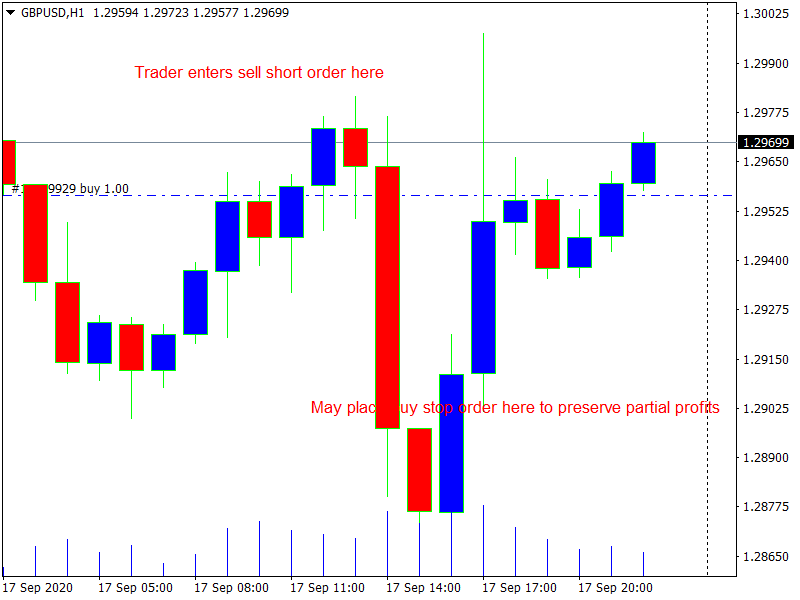
1. Using a Stop Order to Conserve Profits
After initiating a trade in the financial marketsFinancial MarketsFinancial markets, from the name itself, are a type of marketplace that provides an avenue for the sale and purchase of assets such as bonds, stocks, foreign exchange, and derivatives. Often, they are called by different names, including "Wall Street" and "capital market," but all of them still mean one and the same thing., which subsequently becomes profitable for an investor, the investor may enter a stop order for the purpose of protecting and preserving at least part of their profits.
For example, assume an investor buys some stock shares at $50 per share. The stock price subsequently rises to $70 a share. The investor does not want to liquidate his position then, as he is hopeful, the stock price will go higher. However, he also wants to guard against losing all of the profit he has from buying the stock.
Therefore, the investor may enter a sell stop order with a stop price of $60. If the stock’s price then falls to $60, the stop order will be triggered, and the investor’s position will be closed out, preserving roughly half of his profits and assuring that his winning trade doesn’t become a losing trade.
2. Using a Stop Order to Limit Losses
Stop orders are frequently placed by traders immediately after entering a new market position, to limit potential losses. Using the same example as before, when the investor buys stock shares at $50 a share, they may decide that they do not want to risk losing more than $5 per share on the trade.
They can then enter a sell-stop order with a stop price of $45. If the stock price falls as low as $45, the sell-stop will be triggered, and the investor’s position closed out with a contained loss. Such a type of stop order is commonly referred to as a “stop-loss order.”
3. Using a Stop Order to Enter a New Market Position
Stop orders are also commonly used by traders to initiate a new market position only in the event of certain circumstances that the investor believes will make a trade likely to be profitable. For example, a trader sees that a stock’s been trading back and forth in a range between $40 and $45 a share. They believe that if the stock breaks out of its trading range to the upside – trades higher than $45 – it is likely to continue rising to a substantially higher price.
Therefore, to take advantage of such a move if it occurs, the trader enters a buy-stop order to purchase 100 shares, with a specified stop price of $46. The order will only be executed if the stock trades as high as $46. By using the contingent stop order, the trader need not constantly monitor the stock to see where it is trading – they are assured of entering the market if the stock’s price movement meets their specified condition.
Read More
CFI is the official provider of the Capital Markets & Securities Analyst (CMSA)™Program Page - CMSAEnroll in CFI's CMSA® program and become a certified Capital Markets &Securities Analyst. Advance your career with our certification programs and courses. certification program, designed to transform anyone into a world-class financial analyst.
To keep learning and developing your knowledge of financial analysis, we highly recommend the additional resources below:
- Trade Order TimingTrade Order Timing - TradingTrade order timing refers to the shelf-life of a specific trade order. The most common types of trade order timing are market orders, GTC orders,
- Exit StrategiesExit StrategiesExit strategies are plans executed by business owners, investors, traders, or venture capitalists to exit their position in an asset at a certain point
- Six Essential Skills of Master TradersSix Essential Skills of Master TradersJust about anyone can become a trader, but to be one of the master traders takes more than investment capital and a three-piece suit. Keep in mind: there is a sea of individuals looking to join the ranks of master traders and bring home the kind of money that goes with that title.
- Investing: A Beginner’s GuideInvesting: A Beginner's GuideCFI's Investing for Beginners guide will teach you the basics of investing and how to get started. Learn about different strategies and techniques for trading
-

Fill or Kill (FOK) Orders: Definition & Trading Strategy
A fill or kill (FOK) order is a conditional order requiring the transaction to be executed immediately and to its full amount at a stated price. If any of the conditions are broken, then the order mus
-

Stop Orders: Protecting Your Investments from Market Volatility
A stop order is used to protect against major losses in the market. This can be a buy stop or a sell stop to protect for short or long positions that may get out of hand. In addition, there is a
invest
- Limit Orders: A Comprehensive Guide for Investors
- Stop Payment Orders: Definition, Process & How to Request
- Day Orders: A Comprehensive Guide for Investors
- Hard Stop Orders: Protecting Your Investments in Volatile Markets
- Understanding Held Orders: A Quick Guide for Traders
- Stop-Loss Orders: Protecting Your Investments & Managing Risk
- Trailing Stop Orders: A Comprehensive Guide for Traders
- Understanding Money Orders: A Comprehensive Guide
- Money Orders: A Comprehensive Guide to Usage, Benefits & Alternatives
-
Economic Order Quantity (EOQ): Definition & Importance
EOQ stands for Economic Order Quantity. It is a measurement used in the field of Operations, Logistics, and Supply Management. In essence, EOQ is a tool used to determine the volume and frequency of o...
-
 Make to Order (MTO): Definition, Benefits & Applications
Make to Order (MTO) is a production technique in which producers start manufacturing a product only after the customer places an order for it. In such a case, commodities are produced in a customized ...