
Iceberg Orders: A Comprehensive Guide for Investors
An iceberg order is an order to buy or sell a large quantity of a financial security that, rather than being entered as a single, large order, is broken up into several smaller orders. The term “iceberg” is used to describe this method of buying or selling securities because each small order represents just “the tip of the iceberg” – the total order quantity.
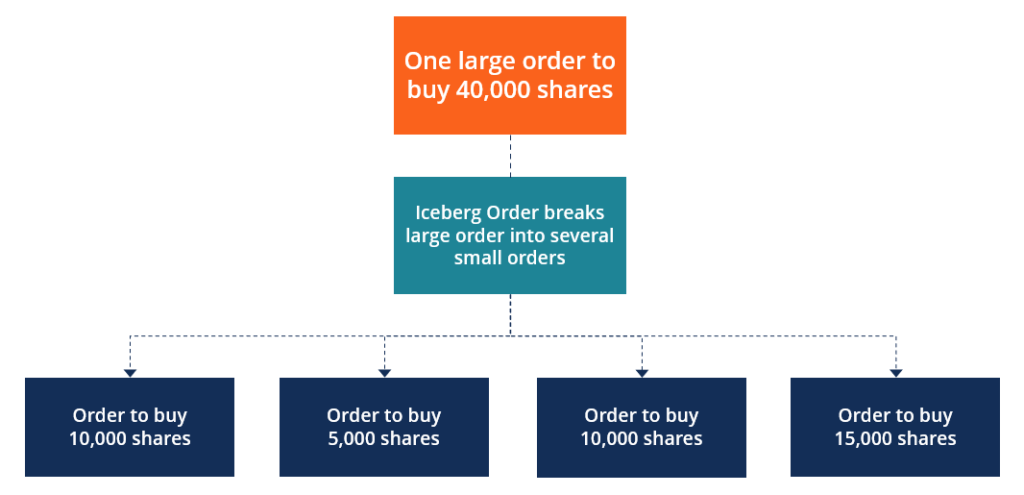
Large, institutional traders typically utilize iceberg orders because they are the types of traders that buy and sell securities in exceptionally large quantities. They use iceberg orders as a trading technique that helps enable them to get the best possible buy or sell price when trading stocks or other financial securities.
Summary
- An iceberg order is an order to buy or sell a large quantity of a financial security that, rather than being entered as a single, large order, is broken up into several smaller orders.
- Iceberg orders are primarily used by large, institutional traders who wish to conceal a large trade they are making.
- Using iceberg orders can help a trader execute a large buy or sell of securities in the market at a more favorable price.
How Iceberg Orders Work
Traders who trade large quantities of financial securities want to use iceberg orders. The large volume of trading they need to execute comes with the potential to substantially change the current market price of a security as many buy or sell orders increase the pressure of demand or supplySupply and DemandThe laws of supply and demand are microeconomic concepts that state that in efficient markets, the quantity supplied of a good and quantity in the marketplace.
A single order to buy, say, 50,000 shares of a single stock, likely represents a significant increase in the level of demand for the stock. Therefore, the price of the stock is likely to be pushed higher. In the same manner, an order to sell 50,000 shares of a stock is likely to pressure the stock price lower.
Large traders use iceberg orders to execute the total amount of buying or selling they wish to do in relatively small increments. They hope that by doing so, their orders will not cause the stock’s price to shift significantly adversely against them and that they will be able to execute all of their buys or sells at or near their desired price.
Large, institutional traders looking to execute large orders face another concern that can prevent them from obtaining their desired price. If they place a single large order, the order quantity then becomes visible to other market participants.
If a lot of other traders see that the institutional trader is, for example, trying to buy a massive number of shares of a certain stock, then they may look to jump in and buy a lot of shares themselves. The additional buying pressure may drive the stock’s price up significantly, forcing the institutional trader to pay a higher price for their shares than they wanted to.
Practical Example
Assume that a large, institutional trader, such as a hedge fund, wants to buy 200,000 shares of Company AAA’s stock. Also, assume that the average daily trading volumeAverage Daily Trading Volume (ADTV)Average Daily Trading Volume (ADTV) is a technical indicator used by investors that refers to the number of shares of a particular stock that in AAA stock is only 35,000 shares. Thus, the share purchase that the hedge fund is looking to make is roughly six times more than the total average volume of trading in the stock each day.
If the hedge fund puts in a single order to buy 200,000 shares, other traders will notice the order in the stock. Some traders may think that the hedge fund manager is privy to some inside informationInsider InformationInsider information, also called inside information, refers to non-public facts regarding a publicly traded company that can provide a financial advantage in the markets. In other words, insider information is knowledge and information on the operations, products/services pipeline that tells them that the stock will rise substantially in price. The traders may then rush to “front-run” the hedge fund, buying a bunch of the stock before the hedge fund can get its large order completely filled. Also, holders of AAA stock may see the large buy order and raise their asking price.
In the end, the result of putting in a single order to buy 200,000 shares may be that the hedge fund ends up needing to pay an average of $40 a share for the stock when the current market price when it placed its large order was only $35 a share.
In order to be able to buy AAA stock right around the desired price of $35 a share, the hedge fund manager decides to use an iceberg order. The iceberg order breaks up the order to buy 200,000 shares in increments of 5,000 shares at a time.
As each order to buy 5,000 shares is filled, it triggers the release of the next order to buy 5,000 more shares. The trades continue, and they may be spread out not just across one trading day but over a period of several days or weeks until the total desired amount of 200,000 shares is purchased. By using smaller orders, the hedge fund’s buying of the stock is less likely to be noticed and cause a significant price increase for the shares.
Keep Learning
CFI is the official provider of the global Capital Markets & Securities Analyst (CMSA)®Program Page - CMSAEnroll in CFI's CMSA® program and become a certified Capital Markets &Securities Analyst. Advance your career with our certification programs and courses. certification program, designed to help anyone become a world-class financial analyst. To keep advancing your career, the additional CFI resources below will be useful:
- Hedge Fund StrategiesHedge Fund StrategiesA hedge fund is an investment fund created by accredited individuals and institutional investors for the purpose of maximizing returns and
- Institutional InvestorInstitutional InvestorAn institutional investor is a legal entity that accumulates the funds of numerous investors (which may be private investors or other legal entities) to
- Demand TheoryDemand TheoryDemand theory is a principle that emphasizes the relationship between consumer demand and the price for goods and services within the market
- Trade OrdersTrade Orders - TradingTrade orders refer to the different types of orders that can be placed on trading exchanges for financial assets, such as stocks or futures contracts.
-
Understanding Trade Orders: A Comprehensive Guide
Trade orders refer to the different types of orders that can be placed on trading exchanges for financial assets, such as stocks or futures contracts. The order-driven style of trading mechanisms Trad
-

Make to Order (MTO): Definition, Benefits & Applications
Make to Order (MTO) is a production technique in which producers start manufacturing a product only after the customer places an order for it. In such a case, commodities are produced in a customized
invest
- Limit Orders: A Comprehensive Guide for Investors
- Day Orders: A Comprehensive Guide for Investors
- Understanding Held Orders: A Quick Guide for Traders
- Market Orders: A Comprehensive Guide for Investors
- Understanding Not-Held Orders: A Guide for Investors
- Stop Orders: A Comprehensive Guide for Investors
- Stop-Loss Orders: Protecting Your Investments & Managing Risk
- Understanding Money Orders: A Comprehensive Guide
- Money Orders: A Comprehensive Guide to Usage, Benefits & Alternatives
-
 Understanding Trade Execution: A Comprehensive Guide
Trade execution is when a buy or sell order gets fulfilled. In order for a trade to be executed, an investor who trades using a brokerageBrokerageA brokerage provides intermediary services in various ...
-
 Understanding Trade Order Timing: A Comprehensive Guide
Trade order timing allows investors to set the amount of time a trade orderTrade Orders - TradingTrade orders refer to the different types of orders that can be placed on trading exchanges for financi...