
Index Funds Explained: A Beginner's Guide to Tracking Market Performance
Index funds are mutual fundsMutual FundsA mutual fund is a pool of money collected from many investors for the purpose of investing in stocks, bonds, or other securities. Mutual funds are owned by a group of investors and managed by professionals. Learn about the various types of fund, how they work, and benefits and tradeoffs of investing in them or exchange-traded funds (ETFs) that are designed to track the performance of a market index. Currently available funds track different market indices, including the S&P 500S&P – Standard and Poor'sStandard & Poor’s is an American financial intelligence company that operates as a division of S&P Global. S&P is a market leader in the, Russell 2000, and FTSE 100.
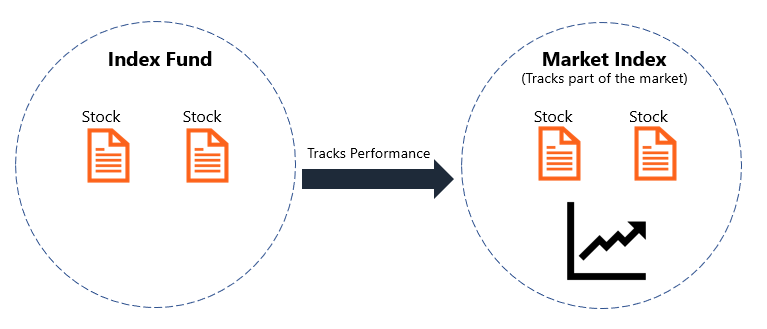
An index fund is a form of passive investment. This means that portfolio managersPortfolio ManagerPortfolio managers manage investment portfolios using a six-step portfolio management process. Learn exactly what does a portfolio manager do in this guide. Portfolio managers are professionals who manage investment portfolios, with the goal of achieving their clients’ investment objectives. do not need to spend a lot of time and resources on choosing suitable stocks for investments or rebalancing the portfolio. On average, the portfolio is rebalanced once every six months. Few operational and administrative requirements mean cost efficiency for such funds.
Generally, these funds are considered safe and simple long-term investments. Thus, they are actively used in retirement plans. Learn more about Index Funds and Personal Investing on YoutTube.
Index Funds vs. Actively Managed Funds
Index funds are a viable alternative to actively managed funds. Index and actively managed funds can be compared according to the following parameters:
1. Performance
While index funds may seem like an unsophisticated means of investing, they tend to outperform their actively managed counterparts. Statistics show that more than 90% of actively managed funds not only cannot beat the market but perform worse than the market benchmarks. However, this is not always the case, since hedge fundsHedge Fund StrategiesA hedge fund is an investment fund created by accredited individuals and institutional investors for the purpose of maximizing returns and perform better in down markets.
2. Cost
Index funds are less costly to the investors relative to actively managed funds. The expense ratio (the annual fee that a fund charges its investors for administrative and operating expensesSG&ASG&A includes all non-production expenses incurred by a company in any given period. It includes expenses such as rent, advertising, marketing) usually does not exceed 0.1%. On the other hand, actively managed funds may ask for expense ratios up to 0.7%. However, an investor should still pick the type of investment fund based on his/her investment style and goals.
Index-based funds work best if an investor needs a safe and diversified investment with almost a guaranteed return over a long investment horizon. Also, they are suitable for unsophisticated investors who do not wish to invest time or money in extensive investment research.
Actively managed funds provide an investor with the opportunity to beat the market. The funds may deliver a greater return over a short investment horizon. Investors in such funds should possess some investment experience and knowledge to be able to understand the strategy employed by the fund.
Additional Resources
CFI is the official provider of the Financial Modeling & Valuation Analyst (FMVA)™Become a Certified Financial Modeling & Valuation Analyst (FMVA)®CFI's Financial Modeling and Valuation Analyst (FMVA)® certification will help you gain the confidence you need in your finance career. Enroll today! designation for financial analysts. From here, we recommend continuing to build out your knowledge and understanding of more corporate finance topics such as:
- Dow Jones Industrial Average (DJIA)Dow Jones Industrial Average (DJIA)The Dow Jones Industrial Average (DJIA), also referred to as "Dow Jones” or "the Dow", is one of the most widely-recognized stock market indices.
- Investing: A Beginner’s GuideInvesting: A Beginner's GuideCFI's Investing for Beginners guide will teach you the basics of investing and how to get started. Learn about different strategies and techniques for trading
- Stock MarketStock MarketThe stock market refers to public markets that exist for issuing, buying and selling stocks that trade on a stock exchange or over-the-counter. Stocks, also known as equities, represent fractional ownership in a company
- Types of Markets – Dealers, Brokers, ExchangesTypes of Markets - Dealers, Brokers, ExchangesMarkets include brokers, dealers, and exchange markets. Each market operates under different trading mechanisms, which affect liquidity and control. The different types of markets allow for different trading characteristics, outlined in this guide
-

Crypto Hedge Funds: Navigating the Emerging Market
Traditional hedge funds have been active in the financial markets for several years, allowing investors to practically invest in every asset class such as fixed income, equity, currency, and commodi
-

Quantitative Funds (Quant Funds): An In-Depth Explanation
In the wealth and asset management company, investments are managed by fund managers. They are aided by teams of research analysts in analyzing diverse and voluminous information. Investment strategie
invest
- Mutual Funds: A Beginner's Guide to Diversified Investing
- Understanding Foregone Earnings: Definition & Examples
- Understanding FTSE Indices: A Guide for Investors
- Mutual Funds Explained: A Beginner's Guide to Investing
- Understanding Pooled Funds: A Comprehensive Guide
- Vulture Funds Explained: Investing in Distressed Debt
- Slush Funds: Definition, Purpose, and Illicit Uses
- Segregated Funds: Understanding Insurance-Backed Investments
- Mutual Funds Explained: A Simple Guide to Investing
-
 Vanguard ETFs: A Comprehensive Guide to Index-Tracking Investments
Vanguard Exchange-Traded Funds (ETFs) are a collection of index-based traded securities managed and issued by Vanguard Group. The ETFs give investors the chance to buy and sell shares as a single secu...
-
Index Fund Liquidity: Understanding How Easily You Can Buy & Sell
Index funds are a popular type of mutual fund that tracks the movement of a particular financial index. If you are an investor, you should consider the level of liquidity of these funds before g...