
Understanding FTSE Indices: A Guide for Investors
FTSE indices refer to several major UK stock market indexes. Stock indexes provide market analysts and investors with a gauge for monitoring the overall equity market. Specifically, the FTSE (Financial Times Stock Exchange) indices represent stocks traded on the London Stock Exchange (LSE). They reflect the performance of UK stock sharesStockWhat is a stock? An individual who owns stock in a company is called a shareholder and is eligible to claim part of the company’s residual assets and earnings (should the company ever be dissolved). The terms "stock", "shares", and "equity" are used interchangeably. as it unfolds in real time. A stock index provides investors with a reliable scale to monitor and compare overall market performance to returnsExpected ReturnThe expected return on an investment is the expected value of the probability distribution of possible returns it can provide to investors. The return on the investment is an unknown variable that has different values associated with different probabilities. on their specific equity portfolios.
History of the FTSE Group
The FTSE group, which is commonly termed “footsie”, is a joint venture that was created by the Financial Times of London and the London Stock Exchange (LSE)Stock MarketThe stock market refers to public markets that exist for issuing, buying and selling stocks that trade on a stock exchange or over-the-counter. Stocks, also known as equities, represent fractional ownership in a company in 1984. The FTSE indices comprise blue-chip and other companiesBlue ChipA blue chip is a stock of a well-established corporation with a reputation for reliability, quality, and financial stability. Blue chip stocks are usually the market leaders in their sectors and have a market capitalization running into billions of dollars. that are listed on the London Stock Exchange.
What are the Various Indices?
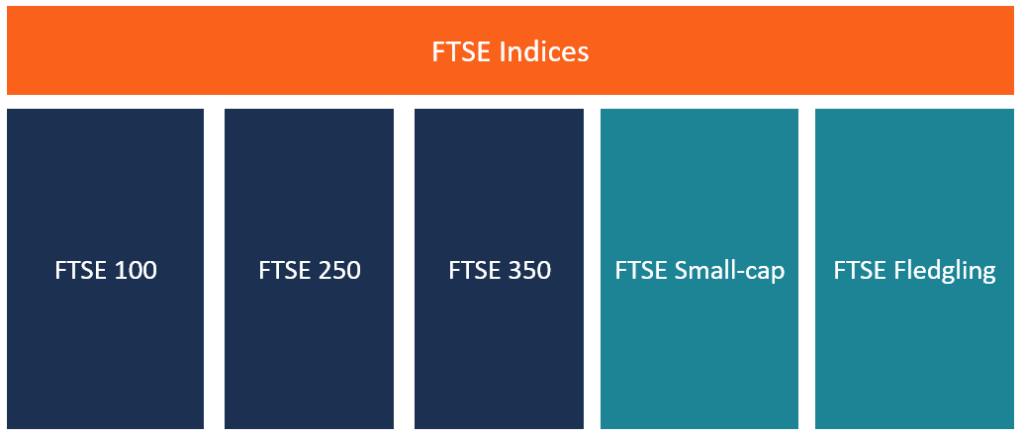
There are a number of different FTSE indexes that represent different segments of the UK stock market. They include the following:
FTSE 100 Index
The FTSE 100 index is viewed as an indicator of the overall health of the UK economy, as well as a qualifier for UK companies. It represents around 81% of the capitalized market of the LSE. It is made up of the 100 companies traded on the LSE with the largest market capitalization value. Components of the index must follow several requirements established by the FTSE Group, including free float and liquidity minimums.
It is not always the most reliable gauge of the domestic UK economy because many of its components are large multinational firms. The index is also vulnerable to fluctuations in the exchange rate for the British pound. Nonetheless, it is still the most frequently-quoted UK market index. It is a market cap weighted index. Among the component firms are Barclays (BARC), Royal Dutch Shell (RDSA), and Vodaphone Group (VOD).
FTSE 250 Index
The FTSE 250 index usually shows the performance of the UK economy better than the FTSE 100 index – primarily because it contains relatively more domestic, rather than international, companies. It represents mid-cap stocks traded on the LSE, consisting of the 101st to 350th largest companies by market cap. A significant number of companies in the FTSE 250 are UK investment trusts. Noteworthy component firms include Aston Martin Lagonda Global Holdings (AML) and City of London Investment Trust (CTY).
FTSE 350 Index
The FTSE 350 Index comprises the largest 350 companies, by market cap, listed on the LSE. In other words, it consists of all the companies contained in the FTSE 100 index and in the FTSE 250 index. In effect, it consists of the largest, and largest mid-cap, companies traded on the exchange. However, in comparison to the prior two indices, it is much less widely followed.
FTSE Small Cap Index
The FTSE Small Cap Index, as its name implies, is comprised of companies with relatively lower market capitalization values. Specifically, it contains the 351st to 619th next largest market cap firms (beyond the FTSE 350) traded on the London Stock Exchange. Laura Ashley (ALY) and BlackRock Commodities Income Investment Trust (BRCI) belong to this group of stocks.
FTSE Fledging Index
The FTSE Fledging Index is comprised of the companies that meet the minimum listing requirements to be included in the main market of the LSE. However, due to their small market capitalization, they do not meet the requirements for inclusion in the FTSE All-Share Index, which includes all the components of the FTSE 100, FTSE 250, and FTSE SmallCap indices. There are, as of 2018, no liquidity requirements for constituents of the Fledgling Index. Component companies include Tex Holdings (TXH) and Hornby Railways (HRN).
The name of the index is somewhat misleading, as the components are not necessarily new firms – although many younger companies are contained in it. They are merely much smaller market cap value companies.
How to Invest in FTSE Indices
Investors cannot invest directly in the indices. However, indirect investment is possible through the use of Exchange Traded Funds (ETFs)Exchange Traded Fund (ETF)An Exchange Traded Fund (ETF) is a popular investment vehicle where portfolios can be more flexible and diversified across a broad range of all the available asset classes. Learn about various types of ETFs by reading this guide. that track the indexes. Two of the most popular ETFs designed to mirror the performance of the FTSE 100 Index are the Vanguard FTSE 100 UCTIS ETF and the iShares Core FTSE 100 UCITS ETF. Of course, investors also have the option of simply buying shares in all the separate component companies of the index.
Summary
The major UK stock indexes are followed not only in the UK but globally as well. This is because the London Stock Exchange is considered the most important equity market worldwide, behind only the New York Stock Exchange.
Related Readings
CFI offers the Financial Modeling & Valuation Analyst (FMVA)™Become a Certified Financial Modeling & Valuation Analyst (FMVA)®CFI's Financial Modeling and Valuation Analyst (FMVA)® certification will help you gain the confidence you need in your finance career. Enroll today! certification program for those looking to take their careers to the next level. To keep learning and advancing your career, the following resources will be helpful:
- Types of Markets – Dealers, Brokers and ExchangesTypes of Markets - Dealers, Brokers, ExchangesMarkets include brokers, dealers, and exchange markets. Each market operates under different trading mechanisms, which affect liquidity and control. The different types of markets allow for different trading characteristics, outlined in this guide
- Stock Investment StrategiesStock Investment StrategiesStock investment strategies pertain to the different types of stock investing. These strategies are namely value, growth and index investing. The strategy an investor chooses is affected by a number of factors, such as the investor’s financial situation, investing goals, and risk tolerance.
- Trading MechanismsTrading MechanismsTrading mechanisms refer to the different methods by which assets are traded. The two main types of trading mechanisms are quote driven and order driven trading mechanisms
- Small Cap StockSmall Cap StockA small cap stock is a stock of a publicly traded company whose market capitalization ranges from $300 million to approximately $2 billion.
-

Understanding Exotic Options: A Comprehensive Guide
Exotic options are the classes of optionOptions: Calls and PutsAn option is a derivative contract that gives the holder the right, but not the obligation, to buy or sell an asset by a certain date at
-
Gilts: Understanding UK Government Bonds | LSE
Gilts are bonds issued by the UK government. More specifically, the debt securities are issued by the Bank of England, by His or Her Majesty’s treasury, and are listed on the London Stock Exchan
invest
- FTSE 100 Trading Hours: A Complete Guide
- BTK Index: Stocks & What It Represents in Biotech Investing
- Understanding Price Indices: A Comprehensive Guide
- High-Low Index: Understanding 52-Week Highs & Lows | [Your Brand]
- Index Funds Explained: A Beginner's Guide to Tracking Market Performance
- Index Investing: A Beginner's Guide to Passive Investing
- Understanding Market Indexes: A Comprehensive Guide
- Stock Indexes Explained: A Beginner's Guide to Market Benchmarks
- Composite Indexes: Understanding Financial Benchmarks & Their Use
-
 Equal-Weighted Index Explained: Benefits & How It Works
An equal-weighted index is a stock market index – comprised of a group of publicly traded companiesPrivate vs Public CompanyThe main difference between a private vs public company is that the sh...
-
 Understanding Exchange-Traded Derivatives: Options & Futures
Exchange-traded derivatives consist mostly of options and futures traded on public exchanges, with a standardized contract. Through the contracts, the exchange determines an expiration dateExpiration ...