
Master-Feeder Structures: A Hedge Fund Investment Overview
A master-feeder structure is an investment structure used by hedge fundsHedge FundA hedge fund, an alternative investment vehicle, is a partnership where investors (accredited investors or institutional investors) pool under which multiple investors invest in onshore and offshore “feeder” funds, which, in turn, invest in a larger “master” fund. The master and feeder funds are typically managed by the same designated investment manager, and investments are made in accordance with the partnership agreement.

The master-feeder structure allows investment managers to manage a larger pooled portfolio (i.e., the master fund) and provides investors with benefits such as tax gains, interest, income gains, and dividends – which are generated by the master fund. Usually, master-feeder structures include one onshore feeder fund, one offshore feeder fund, and one master fund.
How the Master-Feeder Structure Works
The diagram below depicts how a typical master-feeder structure functions:
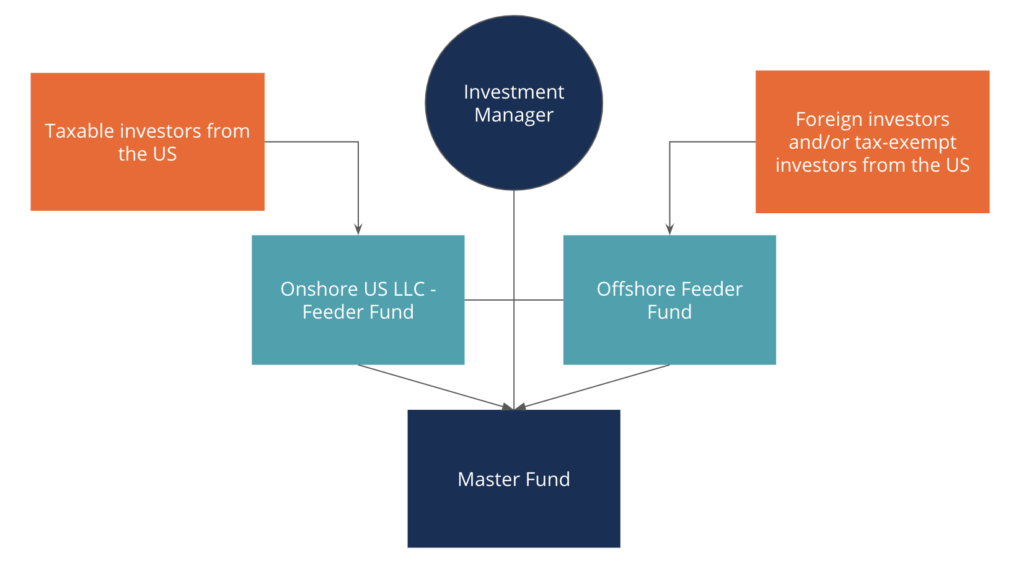
- Taxable investors from the US invest in onshore limited liability companies (LLCs)Limited Liability Company (LLC)A limited liability company (LLC) is a business structure for private companies in the United States, one that combines aspects of partnerships and corp, which function as feeder funds. Similarly, tax-exempt investors from the U.S. and foreign investors invest in offshore feeder funds.
- Feeder funds are the companies where the funds are actively invested -– funds flow from investors to the feeder companies, which in turn, invest all or part of the investors’ money in the master fund.
- The master fund pools the capital from both types of feeder funds and invests in different types of securities based on market conditions and agreements with investors. The profits and losses generated by the master fund are shared among the feeder funds according to the amount invested. The feeder funds then allocate these profits and losses to individual investors.
- The investment manager is responsible for allocating funds to securities and managing the overall portfolio of the master fund. The manager is typically paid a percentage fee for their advisory and management services.
Advantages and Disadvantages of Master-Feeder Structures
1. Reduced trading costs
By pooling together a large number of funds from various investors, investment managers reduce the trading fees associated with managing multiple portfolios. In other words, trading fees are generally a percentage of the transaction value. By carrying out one transaction that affects multiple portfolios, investment managers can avoid paying trading fees multiple times.
2. Economies of scale
Creating a master fund generates economies of scaleEconomies of ScaleEconomies of scale refer to the cost advantage experienced by a firm when it increases its level of output.The advantage arises due to the that can provide benefits in various ways, reducing operational and transaction costs. For example, instead of conducting risk and security analyses for different portfolios in different feeder funds, the master fund requires just one set of analysis that affects all investors.
3. Diversity of investors
The flexibility of master-feeder structures allows tax-exempt and foreign investors to invest in the master fund, creating a larger overall pool of funds. At the same time, the onshore and offshore feeder funds ensure that the tax processes are maintained for taxable US investors.
Disadvantages of Master-Feeder Structures
1. Complex tax accounting
The feeder funds are registered as separate legal entities, and therefore, need to maintain their own accounting and bookkeeping processes in addition to the master fund. It makes the accounting process highly complex and tedious since the profits and losses generated by the master fund also need to be distributed equally.
2. Strategic conflicts
The master fund pools the investments of numerous individual investors from multiple feeder funds. Each investor may have a different investment goal, and each feeder fund may be tailored to different investors (e.g., one can appeal to a risk-averse investorRisk Averse DefinitionSomeone who is risk averse has the characteristic or trait of preferring avoiding loss over making a gain. This characteristic is usually attached to investors or market participants who prefer investments with lower returns and relatively known risks over investments with potentially higher returns but also with higher uncertainty and more risk., whereas another can appeal to a risk-seeking investor).
Therefore, each decision made by the investment manager leads to different consequences for various investors. It may lead to strategic conflicts during the investment management process.
3. Securities constrained by regional restrictions
Given that investments from foreign investors are also included in the master fund, regional restrictions that stop the foreign investors from buying certain types of securities (e.g., foreign government bonds or stocks) also restrict the master fund from doing so. It limits the types of securities that can be invested in.
Summary
Master-feeder structures are investment structures whereby domestic and foreign investors choose to invest in a master fund that combines their assets. Usually, the first step is for investors to invest in feeder funds, which, in turn, inject the capital into the master fund managed by the investment manager.
A larger, combined pool of assets allows investors to reap the benefits of economies of scale, reduced trading costs, and tax benefits. However, given the diversity of investors involved, the risk of strategic conflicts and accounting complications remains high.
More Resources
CFI offers the Commercial Banking & Credit Analyst (CBCA)™Program Page - CBCAGet CFI's CBCA™ certification and become a Commercial Banking & Credit Analyst. Enroll and advance your career with our certification programs and courses. certification program for those looking to take their careers to the next level. To keep learning and developing your knowledge base, please explore the additional relevant resources below:
- Tax HavenTax HavenA tax haven or offshore financial center is any country or jurisdiction that offers minimal tax liability to foreign individuals and businesses.
- Hedge Fund StrategiesHedge Fund StrategiesA hedge fund is an investment fund created by accredited individuals and institutional investors for the purpose of maximizing returns and
- Transaction CostsTransaction CostsTransaction costs are costs incurred that don’t accrue to any participant of the transaction. They are sunk costs resulting from economic trade in a market. In economics, the theory of transaction costs is based on the assumption that people are influenced by competitive self-interest.
- Investing: A Beginner’s GuideInvesting: A Beginner's GuideCFI's Investing for Beginners guide will teach you the basics of investing and how to get started. Learn about different strategies and techniques for trading
-

Fund of Funds (FOF): A Comprehensive Guide for Investors
A Fund of Funds (FOF) is an investment vehicle where a fund invests in a portfolio composed of shares of other funds rather than investing directly in stocksStockWhat is a stock? An individual who own
-

HODL Explained: Understanding the Cryptocurrency Investment Strategy
“HODL” is a term that is often used in the BitcoinBitcoinBitcoin is the forerunner of the cryptocurrency market. Operating on blockchain technology, Bitcoin is set to disrupt the currency
invest
- Master-Feeder Structures: Hedge Fund Capital Pooling Explained
- Understanding Corporate Structure: Types & Importance
- Emergency Fund: What It Is & Why You Need One
- Endowment Funds: A Comprehensive Guide for Investors & Donors
- Hedge Funds Explained: Strategies, Risks & Investment
- NFO Explained: Understanding New Fund Offers & Investment
- No-Load Funds: Understanding Commission-Free Mutual Funds
- Understanding Vice Funds: A Guide to Controversial Investments
- Understanding Private Equity Fund Structures: A Comprehensive Guide
-
 Floating Rate Funds: Understanding & Investing in Variable Interest Rates
A floating rate fund is a type of mutual fund that invests in securities paying fluctuating interest rates. Floating rate funds primarily invest in debt instrumentsDebt InstrumentA debt instrument is ...
-
 Understanding Foreign Funds: Investing in Global Markets
A foreign fund refers to a fund that invests in businesses outside the country of origin of the investor. They can be exchange-traded funds, closed-end funds, or mutual fundsMutual FundsA mutual fund ...