
Endowment Funds: A Comprehensive Guide for Investors & Donors
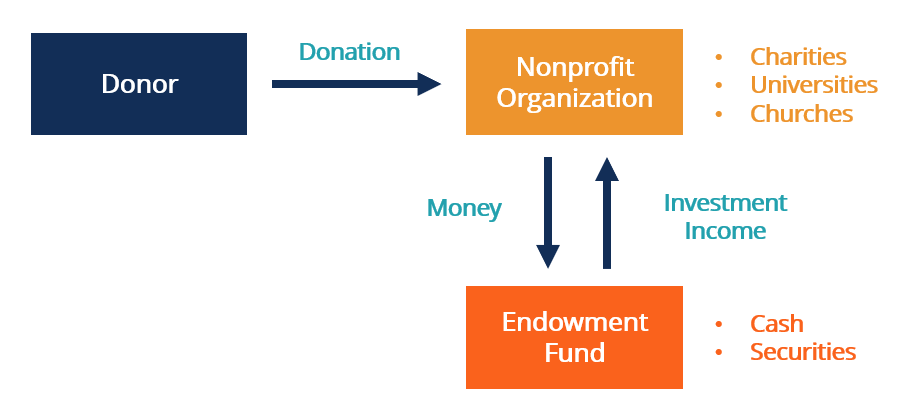
An endowment fund is an investment portfolio with the initial capital deriving from donations. Endowment funds are established to fund charitable and nonprofit institutions such as churches, hospitals, and universities. Donations to endowment funds are tax-deductible. The Harvard University endowment is the largest academic endowment fund in the world, with a $40.9 billion asset under managementAssets Under Management (AUM)Assets under management (AUM) is the total market value of the securities a financial institution owns or manages on behalf of its clients. as of 2019.
Summary
- Endowment funds are established to fund nonprofit organizations and activities, including universities, hospitals, and charities.
- They are typically structured with intact principals and investment income available for use.
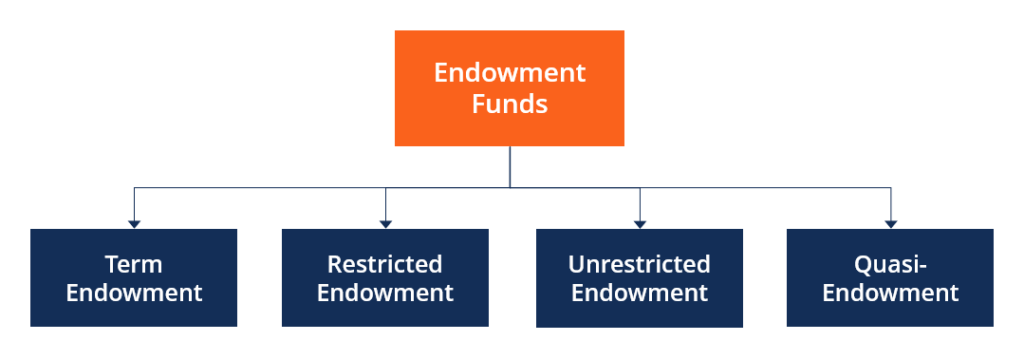
- Term endowment, restricted and unrestricted endowment, and quasi-endowment funds are some types of endowment funds.
How Endowment Funds Work
Endowment funds are initially invested by donors for certain charitable purposes. They are usually established as trusts, which keep them independent of the organizations that they support. Endowment funds consist of cash, equities, bonds, and other types of securities that can generate investment income.
The major difference between an endowment fund and a typical investment fund – such as a mutual fund – is that the beneficiary of an endowment fund is a non-profit organizationHow to Start a Non-Profit OrganizationA non-profit organization is one that is formed for any other purpose other than making a profit. Instead of distributing the profits among the directors instead of individual investors. Typically, the principal value of an endowment fund is kept intact, while the investment income can be used for certain purposes.
Thus, an endowment fund can be held permanently. The donors restrict the purposes an endowment fund can be used for. For example, a donor may provide capital to a fund with an intent to save animals exclusively.
Types of Endowment Funds
1. Term Endowment
As mentioned above, many endowment funds are structured with their principals reserved and not available for the daily use of the organizations. A term endowment is a type of fund that all or a part of the principal can only be used after a certain time or the occurrence of a certain event.
The term or the triggering event is pre-determined in the fund policy according to the donor’s intent. However, the principal can be invested to generate investment income, which is available for the use of an organization.
2. Restricted Endowment
There are limitations to the use of capital in a restricted endowment fund. It can only be used for certain purposes determined by the donor. For example, a restricted university endowment fund may only serve to pay scholarships to students with certain academic achievements.
3. Unrestricted Endowment
In contrast to a restricted endowment, the donor of an unrestricted endowment fund does not limit the purpose of the usage. The recipient is allowed to spend the money for any purpose. This type of funds is much less common than the restricted ones.
4. Quasi-Endowment
The typical type of endowment fund is permanent funds, which are established to exist in perpetuity. In contrast, a quasi-endowment fund is not required by any legal restriction to exist permanently, which means the principal of a quasi-endowment is allowed to be spent at some point.
A quasi-endowment is also known as a “board designated” endowment fund. It works as a typical endowment does, except the use of funds can be determined by the governing board of the organization that the fund serves, instead of the donors.
Usage and withdrawal restrictions may exist in a quasi-endowment fund, but the board can end the restrictions for any reason and use the money for any purpose at any time. Compared with typical endowment funds, a quasi-endowment offers more flexibility to an organization in funding special projects in the future.
Relevant Policies
Most endowment funds are subject to the following policies, according to donors’ intents:
1. Investment Policies
Investment policies outline the types of investment that the fund manager is allowed to make. The policies may cover asset allocation, risk level, targeted return, and so on. Endowment funds usually come with a lower risk level and more liquidity concerns than mutual fundsMutual FundsA mutual fund is a pool of money collected from many investors for the purpose of investing in stocks, bonds, or other securities. Mutual funds are owned by a group of investors and managed by professionals. Learn about the various types of fund, how they work, and benefits and tradeoffs of investing in them and hedge funds. The liquidity requirement ensures that cash is available for withdrawal when the organization needs it.
2. Withdrawal Policies
Withdrawal policies limit the amount of money that the organization can take out of a fund within each period. The annual withdrawal is usually capped at a certain percentage of the total amount of a fund. The percentage is usually low, so that the fund will be able to last in perpetuity.
3. Usage Policies
Usage policies determine for what purposes a fund can be used. Examples include scholarships, scientific research, public services, and other charitable activities. Usage policies are set with a purpose to ensure the fund can be used effectively and properly.
Additional Resources
CFI offers the Commercial Banking & Credit Analyst (CBCA)™Program Page - CBCAGet CFI's CBCA™ certification and become a Commercial Banking & Credit Analyst. Enroll and advance your career with our certification programs and courses. certification program for those looking to take their careers to the next level. To keep learning and developing your knowledge base, please explore the additional relevant resources below:
- Corporate Social Responsibility (CSR)Corporate Social Responsibility (CSR)Corporate social responsibility (CSR) refers to strategies that companies put into action as part of corporate governance that are designed to
- Education LoanEducation LoanAn education loan refers to a type of loan that is borrowed by students to finance their expenses related to post-secondary or higher
- Not-For-Profit OrganizationsNot-for-Profit OrganizationsA not-for-profit organization focuses on a particular social cause, and all the money earned or donated is used in pursuing its objectives.
- Discretionary Investment ManagementDiscretionary Investment ManagementDiscretionary investment management is an investment management style that refers to when an investment team makes buying and selling decisions on behalf of
-
Load Funds Explained: Understanding Commissions & Mutual Funds
A load fund is a mutual fundMutual FundsA mutual fund is a pool of money collected from many investors for the purpose of investing in stocks, bonds, or other securities. Mutual funds are owned by a g
-

Understanding Net Exposure in Hedge Funds: A Comprehensive Guide
Net exposure underlines the difference between a hedge fund’s long positions and its short positions. Once calculated, the net exposure of a fund is presented in a percentage. It will display th
invest
- Endowment Funds: A Comprehensive Guide for Institutions & Donors
- Emergency Fund: What It Is & Why You Need One
- Reserve Funds: A Comprehensive Guide for Businesses & Individuals
- Sinking Funds: Definition, Purpose & How They Work
- Hedge Funds Explained: Strategies, Risks & Investment
- NFO Explained: Understanding New Fund Offers & Investment
- No-Load Funds: Understanding Commission-Free Mutual Funds
- Sinking Funds: Definition, How They Work & Benefits
- Understanding Vice Funds: A Guide to Controversial Investments
-
 Fund of Funds (FOF): A Comprehensive Guide for Investors
A Fund of Funds (FOF) is an investment vehicle where a fund invests in a portfolio composed of shares of other funds rather than investing directly in stocksStockWhat is a stock? An individual who own...
-
 Income Funds: A Comprehensive Guide to Current Income Investments
An income fund is an investment vehicle similar to a mutual fund or an exchange-traded fund (ETF)Exchange-Traded Note (ETN)An exchange-traded note (ETN) is a loan instrument issued by a financial enti...