
NFO Explained: Understanding New Fund Offers & Investment
An NFO (new fund offer) is a call for investors made by an asset management company (AMC) to invest money into a new fund. An AMC is an enterprise that collects money from different clients and places the funds into different investment opportunities, like equity stocks and real estateReal EstateReal estate is real property that consists of land and improvements, which include buildings, fixtures, roads, structures, and utility systems. Property rights give a title of ownership to the land, improvements, and natural resources such as minerals, plants, animals, water, etc..

AMCs generally fix a particular amount of money to be invested in a specific security and divide the entire capital into units worth smaller denominations. The price per unit of an NFO, also known as Net Asset Value (NAV)Net Asset ValueNet asset value (NAV) is defined as the value of a fund’s assets minus the value of its liabilities. The term "net asset value" is commonly used in relation to mutual funds and is used to determine the value of the assets held. According to the SEC, mutual funds and Unit Investment Trusts (UITs) are required to calculate their NAV, can range between a few dollars to several hundred dollars.
Summary
- A new fund offer (NFO) is a call for investors to invest money into a new fund.
- An NFO is similar to Initial Public Offering (IPO) in the sense that investors’ money is used to purchase securities.
- NFOs can be issued for a limited number of units (closed-ended funds) or can be available for purchase and redemption on a continuous basis.
NFO vs. IPO
An Initial Public Offering (IPO)Initial Public Offering (IPO)An Initial Public Offering (IPO) is the first sale of stocks issued by a company to the public. Prior to an IPO, a company is considered a private company, usually with a small number of investors (founders, friends, family, and business investors such as venture capitalists or angel investors). Learn what an IPO is is the call to raise capital for a new company or to raise additional capital for an existing company. It is similar to a new fund offer in the sense that a company is collecting a large sum of money from different investors. However, it is different from NFO in the following ways:
1. Price of Issue
The NAV of an NFO is fixed on the basis of the price of the security in which the collected funds will be invested. On the other hand, the price of an IPO is set by the issuing company. It can be fixed above or below the face value of the stock, depending on the preferences of the issuer.
2. Type of investment
In an IPO, the investor invests his money directly into the issuing company. In an NFO, however, investors give their money to the AMC, which, in turn, invests it into different kinds of securities, including but not restricted to stocks.
3. Trading
Shares purchased through an IPO can be traded on a stock exchange platformNew York Stock Exchange (NYSE)The New York Stock Exchange (NYSE) is the largest securities exchange in the world, hosting 82% of the S&P 500, as well as 70 of the biggest. On the other hand, some kinds of NFO cannot be traded like stocks. They can only be purchased at one time and redeemed when required.
Practical Example
Consider the following example. An AMC launches an NFO for a closed-ended Fund X for one year. It sets the NAV at $100 per unit, and there are 100 units in total, fixing the total capital at $10,000. The annual rate of return is 15%.
Person A decides to buy 10 units of Fund X on January 1, the day of its launch. Due to a bullish phase in the market, the price of the tradeable fund rises to $120 per unit on May 31, and A sells all of their units in the stock market.
On October 1, A again buys 10 units of X at $110 and retains them until the end of the year, when they are redeemed. The company pays $100 for each unit of the fund and provides $15 per unit as return.
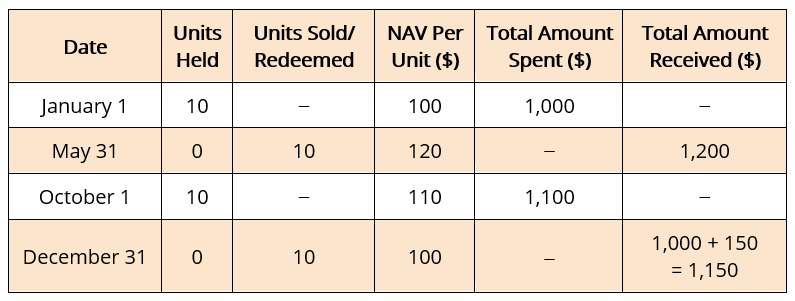
The profit made by A in cash is $250 (-1,000+1,200-1,100+1,150).
Units of the fund can be redeemed only at the end of the specified period, but the same can be traded on a stock exchange. However, the NAV per unit does not change.
Now, if Fund X was an open-ended fundOpen-end vs Closed-end Mutual FundsMany investors consider open-end vs. closed-end mutual funds similar due to both mutual funds allowing them a low-cost way to pool capital together and with the same NAV at $100 per unit and an annual rate of return at 15%, but no limit on the total number of units or total capital, it could’ve been redeemed at any time. Person A buys 10 units of X on January 1, thereby giving the company $1,000 to invest.
On March 31, A redeems 6 units. Assume A is the only holder of the fund in the market. Therefore, the size of the fund now falls to $400 ($100 x 4). The company wants to maintain the size of the fund at $1,000, so it invests the remaining $600 on its own.
On October 1, A decides to purchase four units of X. Now, the company sets the NAV at $150 per unit ($600/4). On December 31, A redeems all eight units of X for a total of $1,000.
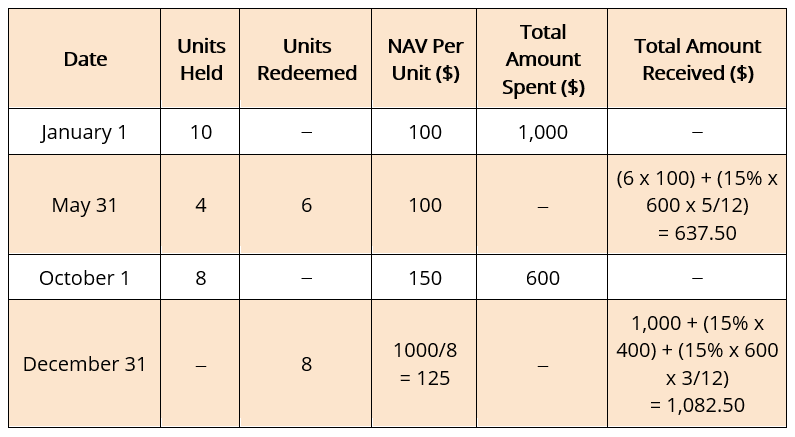
The units of the fund can be redeemed at any time, but they cannot be traded. Every time units are purchased or sold by investors, the size of the fund changes and the NAV per unit varies accordingly.
The profit made by Person A in cash is $120 (-1,000 + 637.50 – 600 + 1,082.50).
Is It Safe to Invest in an NFO?
It is very important to run a background check on the AMC that is offering the NFO and the security in which the fund will be invested. An NFO entails the added risk of not knowing what the portfolio will be like or how much return the new securities are likely to offer.
Although funds are a relatively safer investment option than stocks, the following points must be kept in mind while investing in the securities.
1. Track record of AMC
It is always better to invest in the funds of an existing AMC. Investors can analyze past track records in order to estimate the worth of the AMC and judge the profitability of its investments.
2. Lower NAV does not necessarily mean better investment
Investors tend to invest in closed-ended funds since they achieve lower NAVs than open-ended ones. However, open-ended funds are existing schemes with a track record that can be evaluated and are, therefore, less risky.
3. Invest according to personal requirements
NFOs can be launched for funds that invest in different kinds of securities. An investor with no previous experience should invest in an NFO that will invest in a portfolio of various securities, such as stocks of companies from different industries.
On the other hand, a seasoned investor looking to add a specific kind of security to their portfolio, say, stocks of pharmaceutical companies should invest in an NFO for the same.
Related Readings
CFI offers the Commercial Banking & Credit Analyst (CBCA)™Program Page - CBCAGet CFI's CBCA™ certification and become a Commercial Banking & Credit Analyst. Enroll and advance your career with our certification programs and courses. certification program for those looking to take their careers to the next level. To keep learning and developing your knowledge base, please explore the additional relevant resources below:
- Asset Management Company (AMC)Asset Management Company (AMC)An asset management company (AMC) is a firm that invests a pooled fund of capital on behalf of its clients. The capital is used to fund different
- NAVPSNet Asset Value Per Share (NAVPS)The Net Asset Value Per Share (NAVPS) is a metric used to assess the value of a real estate investment trust (REIT), and it indicates the worth of one share
- IPO ProcessIPO ProcessThe IPO Process is where a private company issues new and/or existing securities to the public for the first time. The 5 steps discussed in detail
- NAV ReturnNAV ReturnNAV return, or net asset value return, is a performance measurement for an entity’s assets minus liabilities. NAV return is typically used to measure the
-

Understanding Net Exposure in Hedge Funds: A Comprehensive Guide
Net exposure underlines the difference between a hedge fund’s long positions and its short positions. Once calculated, the net exposure of a fund is presented in a percentage. It will display th
-

Quantitative Funds: A Deep Dive into Algorithmic Investing
A quant fund (short for quantitative fund) is an investment fund that uses mathematical and statistical techniques together with automated algorithms and advanced quantitative models to make investmen
invest
- Emergency Fund: What It Is & Why You Need One
- Reserve Funds: A Comprehensive Guide for Businesses & Individuals
- Sinking Funds: Definition, Purpose & How They Work
- Endowment Funds: A Comprehensive Guide for Investors & Donors
- Hedge Funds Explained: Strategies, Risks & Investment
- No-Load Funds: Understanding Commission-Free Mutual Funds
- Sinking Funds: Definition, How They Work & Benefits
- Understanding Vice Funds: A Guide to Controversial Investments
- Commingled Funds: Understanding Pooled Investment Strategies
-
 Income Funds: A Comprehensive Guide to Current Income Investments
An income fund is an investment vehicle similar to a mutual fund or an exchange-traded fund (ETF)Exchange-Traded Note (ETN)An exchange-traded note (ETN) is a loan instrument issued by a financial enti...
-
 Load Funds Explained: Understanding Commissions & Mutual Funds
A load fund is a mutual fundMutual FundsA mutual fund is a pool of money collected from many investors for the purpose of investing in stocks, bonds, or other securities. Mutual funds are owned by a g...