
Understanding Currency Pegs: EUR/USD and Exchange Rate Basics
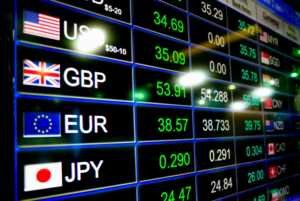
In finance, pegging refers to two different actions. 1) A peg is the act of linking the exchange rateEUR/USD Currency CrossThe Euro to Dollar exchange rate (EUR/USD or €/$ for short) is the number of U.S. dollars for every 1 Euro. It is the convention for quoting the exchange rate between the two currencies. This guide will provide an overview of the factors that impact the FX rate, and what investors and speculators need to know of one currency to another. For most countries, the general practice is to peg the exchange rate of their currency to that of the U.S. dollar. However, some countries peg to currency baskets. This means that a currency’s exchange rate is pegged to a group of other currencies’ exchange rates.
2) Pegging may refer to the process of purchasing or selling a large quantity of a securityPublic SecuritiesPublic securities, or marketable securities, are investments that are openly or easily traded in a market. The securities are either equity or debt-based. in order to affect its price. This may be done by a government seeking to stabilize the price of the security or underlying asset. However, it may also be performed by companies or individuals as an unethical attempt to drive price in one direction or another for the benefit/profit of option writers.
Managing Market Volatility
One of the primary goals of currency pegging is to help decrease volatility in the market. During periods of economic or political upheaval, the exchange rates of some currencies can be drastically affected. A peg can help to stabilize a currency’s value.
When pegging currency value, countries aren’t limited to only using other currencies. A peg to a commodity such as gold is another option. Commodities with relatively stable prices make them a good stabilizer for a currency that may be experiencing excessive volatility.
Relation to the U.S. Dollar
Because the U.S. dollar is the lead reserve currency, many nations choose to peg their currency exchange rate to it. The primary reason for this move is because the majority of the world’s financial transactions and international trade occurs in U.S. dollars. For countries that rely heavily on their financial sector and/or international trade, the U.S. dollar connection makes sound financial sense.
For countries that export a lot to the United States, such as China, pegging to the U.S. dollar is key to maintaining competitive pricing of goods. However, China uses a fixed exchange rate in order to keep their currency value lower than the dollar. This makes their exports to the U.S. cheaper, giving them a comparative price advantage on their goods.
Currency pegs are an excellent way for countries to maintain the exchange rate of their currencies. More broadly, it is a good way to cut down on market volatility worldwide.
Related Readings
CFI offers the global Financial Modeling & Valuation AnalystBecome a Certified Financial Modeling & Valuation Analyst (FMVA)®CFI's Financial Modeling and Valuation Analyst (FMVA)® certification will help you gain the confidence you need in your finance career. Enroll today! certification program, designed to help anyone become a world-class financial analyst. The following resources will be helpful in furthering your financial education:
- Capital ControlsCapital ControlsCapital controls are measures taken by either the government or the central bank of an economy to regulate the outflow and inflow of foreign capital in the country. The measures taken may be in the form of taxes, tariffs, volume restrictions, or outright legislation.
- Currency RiskCurrency RiskCurrency risk, or exchange rate risk, refers to the exposure faced by investors or companies that operate across different countries, in regard to unpredictable gains or losses due to changes in the value of one currency in relation to another currency.
- Economic ExposureEconomic ExposureEconomic exposure, also sometimes called operating exposure, is a measure of the change in the future cash flows of a company as a result of
- Trade-Weighted Exchange RateTrade-Weighted Exchange RateThe Trade-Weighted Exchange Rate is a complex measure of a country's currency exchange rate. It measures the strength of a currency weighted by the amount of trade with other countries.
-
Cross-Currency Transactions: Definition & How They Work
A cross currency transaction involves the use of more than one currency. For example, you may be involved in a cross currency transaction in order to convert one currency into another currency. Previo
-

Cross Rates Explained: Understanding Currency Valuation
A cross rate is a foreign exchange market quote between two currencies (not involving the U.S. dollar) that are then both valued against a third currency. If used as a base currency, the U.S. dollar i
invest
- Understanding Foreign Exchange: Impact on Investment & Economy
- Currency Forward Explained: Contracts for Future Exchange Rates
- Understanding Foreign Exchange Rates: A Comprehensive Guide
- Understanding the Temporal Method for Currency Translation
- Understanding Currency Risk: A Comprehensive Guide
- Understanding Foreign Exchange Gains & Losses: A Comprehensive Guide
- Bitcoin Explained: A Comprehensive Guide to Cryptocurrency
- Understanding Currency Exchange Rates: Key Factors & Influences
- 1031 Exchange: A Comprehensive Guide for Real Estate Investors
-
 Cross Currency Settlement: A Comprehensive Guide
Cross currency settlement refers to a transaction or cross currency pair that does not use the U.S. dollarUnited States Dollar (USD)The United States Dollar refers to the national currency of the U.S ...
-
 Cross Currency Swaps: Definition, Mechanics & Benefits
Cross currency swap refers to an agreement between two parties to trade currencies. Over the duration of the swap, the interest payments are exchanged periodically, with the equal value principal exch...