
Short-Term vs. Long-Term Investors: Understanding the Difference
In this article, learn more about short-term investors vs long-term investors. Short-term investors are investors who invest in financial instruments intended to be held in an investment portfolio for less than one fiscal year. Conversely, long-term investors represent people investing in long-term financial instruments that they hold for more than one year.
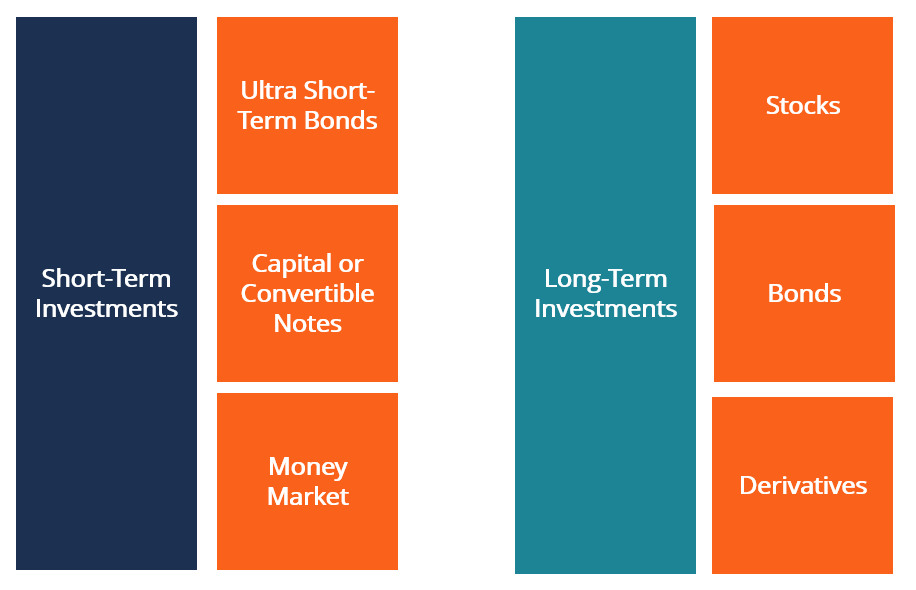
Short-term investment instruments can be ultra-short-term bonds maturing in less than one year, capital or convertible notesConvertible NoteA convertible note refers to a short-term debt instrument (security) that can be converted into equity (ownership portion in a company)., investments into money markets (e.g., buying and selling currencies), etc.
On the other hand, long-term investors aim to hold investment vehicles, such as stocks, bonds, or derivative contracts for several years.
Short-Term Investing vs Long-Term investing
Short-term investments and long-term investments are different in nature and thus carry different expectations. When an individual makes an investment in something to keep for many years, they expect the investment to increase in value.
Once the investment, say, a stock, appreciates in value, the holder sells it off in the open market to profit from the price appreciation. On the other hand, when someone intends to make an investment to earn in the short term, the person or entity may consider short-term investment vehicles, such as a certificate of deposit (CD), bridge loanBridge LoanA bridge loan is a short-term form of financing that is used to meet current obligations before securing permanent financing. It provides immediate cash flow when funding is needed but is not yet available. A bridge loan comes with relatively high interest rates and must be backed by some form of collateral, capital note, etc.
Typically, short-term investment vehicles are purchased to provide a higher degree of principal protection.
So, short-term and long-term investments meet different needs at different times of life. Young people who are just starting out their careers might want a combination of short-term and long-term investments. Short-term investment vehicles may assist in paying off the down payment on a mortgageMortgageA mortgage is a loan – provided by a mortgage lender or a bank – that enables an individual to purchase a home. While it’s possible to take out loans to cover the entire cost of a home, it’s more common to secure a loan for about 80% of the home’s value., while the long-term ones can be aimed at generating a passive income to be saved for retirement. Once retirement comes, one may need to focus more on short-term investing. Of course, it all depends on an individual’s overall goals.
Investing Goals and Risks
Speaking about investing goals, if one keeps a long-term goal, for example, to buy a large house worth $1,000,000, he or she should consider purchasing a long-term investment to gain the resources for the house project. A short-term investment would be more appropriate when one needs a particular amount of money at a certain time. It can be either buying a car or going on a vacation.
We are speaking about investments that imply bearing a certain level of risk. All investments differ regarding the level of risk. There are risk-free investments, such as government bonds, and risky investments in new companies (startups) without a track record or unsecured loans to entities with financial distress. However, the higher the risk, the higher the return an investor will claim for taking the risk.
One of the major risks long-term investors are exposed to is volatilityVolatilityVolatility is a measure of the rate of fluctuations in the price of a security over time. It indicates the level of risk associated with the price changes of a security. Investors and traders calculate the volatility of a security to assess past variations in the prices or fluctuations in the financial markets that can trigger investments to decline in value. As far as short-term investors are concerned, the main risk exposure, in such a case, represents the purchasing power risk or the risk associated with inflation. Investment returns may not be worth much as long as the level of inflation increases, thus depreciating the currency.
Investors usually diversify their investment portfolios, making both short-term and long-term investments. Diversification means spreading out risks across various types of investment instruments.
Tactics of Long-Term Investors
As previously mentioned, long-term investments are vehicles one expects to benefit from owning for several years. Long-term investors approach investing by determining the rate of returnRate of ReturnThe Rate of Return (ROR) is the gain or loss of an investment over a period of time copmared to the initial cost of the investment expressed as a percentage. This guide teaches the most common formulas acceptable by them.
When investing long term, investors should account for the value dropdowns in their investments, which is called dispersion. When dispersion happens, investors should not panic and sell their instruments just because of a temporary market decline. Markets are cyclical and always recover from dropdowns. The question is in time – what time is needed for recovery?
An example of long-term investment can be an investment in company stocks. If one believes in a certain business model pursued by a company in an industry, he can invest in it and keep it for some years. Another long-term investment is in a bond that matures in 10 or 30 years. The bond can be either a government bond or a corporate bond.
Find the Right Balance
It is very important that investors find the right balance in their investing strategies. It will, of course, depend on the situation, so make sure they know what to achieve before they begin investing. Using both short-term and long-term investment instruments will provide a good diversification level to investors.
Additional Resources
CFI offers the Commercial Banking & Credit Analyst (CBCA)™ certification program for those looking to take their careers to the next level. To keep learning and developing your knowledge base, please explore the additional relevant resources below:
- Business Strategy vs Business ModelBusiness Strategy vs Business ModelSetting up and running a business involves differentiating between business strategy vs business model. To reach their goals and achieve success, owners
- Fixed Income SecuritiesFixed Income SecuritiesFixed income securities are a type of debt instrument that provides returns in the form of regular, or fixed, interest payments and repayments of the
- Investing: A Beginner’s GuideInvesting: A Beginner's GuideCFI's Investing for Beginners guide will teach you the basics of investing and how to get started. Learn about different strategies and techniques for trading
- Return on Investment (ROI)Return on Investment (ROI)Return on Investment (ROI) is a performance measure used to evaluate the returns of an investment or compare efficiency of different investments.
-

Fixed Annuities: Are They Right for You? | [Your Brand]
Some of the best fixed annuities can provide you with a very solid investment. However, this type of investment is not for every investor. Here are a few things to consider about whether or not
-
Balancing Short-Term & Long-Term Financial Goals: A Practical Guide
We all have financial goals — sometimes they’re shorter-term things like buying a car, and sometimes they’re longer-term like saving for a child’s education or our own retireme
invest
- Understanding Long-Term Investments: A Comprehensive Guide
- Understanding Pooled Funds: A Comprehensive Guide
- Understanding Short-Term Investments: A Comprehensive Guide
- Short-Term vs. Long-Term Investors: Understanding the Difference
- Understanding Stock Promoters: How They Influence Investment
- Understanding Long-Term vs. Short-Term Capital Gains: A Comprehensive Guide
- Commodity Futures Market: Key Players & Investor Profiles
- Activist Investors: Understanding Their Role in the Stock Market
- Retire Early: The Unexpected Strategies of Investors Who Achieved Financial Freedom by 35
-
CDs vs. Bonds: Which Investment is Right for You?
Certificates of deposit (CDs) and bonds both have a useful place in investors’ portfolios, and they function similarly, providing a contractual stream of cash flows over a defined period. But ...
-
 High-Profile IPOs: The Rise of Loss-Making Companies on Wall Street
A disturbing trend is hitting Wall Street, and it’s affecting some of the highest-profile tech IPOs of the last few years. Financiers have been peddling new stock in money-losing companies...