
Understanding Stock Market Signaling: Insider Information Explained
Signaling refers to the act of using insider information to initiate a trading position. It occurs when an insider releases crucial information about a company that triggers the buying or selling of its stock by people who do not ordinarily possess insider informationInsider InformationInsider information, also called inside information, refers to non-public facts regarding a publicly traded company that can provide a financial advantage in the markets. In other words, insider information is knowledge and information on the operations, products/services pipeline. The actions of the insider are considered a market signal to outsiders.
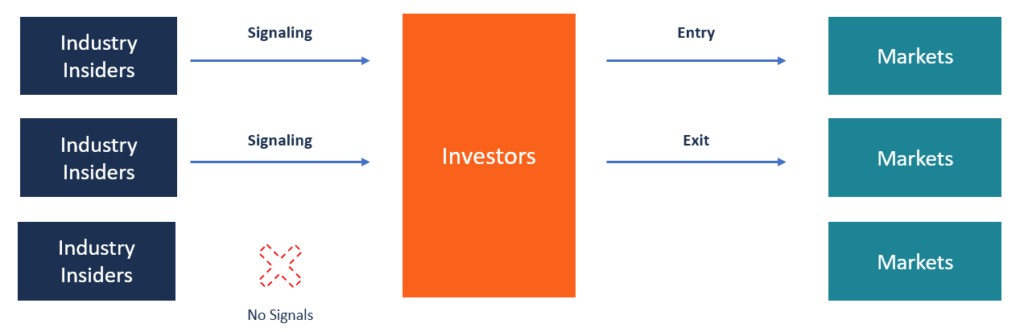
Market signaling may be obtained by tracking the shareholding and trading positions of a company’s insiders. Insiders are usually senior executivesBoard of DirectorsA board of directors is a panel of people elected to represent shareholders. Every public company is required to install a board of directors. or other large shareholders of the company. They may possess decision-making powers and be able to access internal information about the company.
What is Insider Information?
Insider information is a non-public fact that gives traders an advantage when trading the company’s stock. Insider information is usually obtained by a person who is an employee or executive of the company. An “insider” may also be an outsider who is closely associated with the company.
When such persons gain knowledge about company developments that can affect its stock price, that information provides an unfair advantage over outsiders, unless the information is made public.
Insider tradingInsider TradingInsider trading refers to the practice of purchasing or selling a publicly-traded company’s securities while in possession of material information that is is considered illegal. Insider trading exists when an officer, employee, or director of the company uses material, non-public information about the company to place trades or advise third parties to initiate trades. This is viewed as an unfair manipulation of the free market.
How to Interpret Insider Information Signaling
Using insider trading activity for market signals is one of the strategies investors use in trading stocks. This is because insiders have a broader knowledge of the company, which can provide helpful insights into the value of the company’s stock.
For example, when an insider sells a large quantity of company stock, this can be a negative indicator for the stock’s future price movement. Outside investors can read this signal and follow suit by disposing of their own shareholdings.
Conversely, when a senior executive buys the company’s stock in large volumes, he or she may be doing that based on knowledge only held by a few people within the company. Such behavior signals that the company expects positive future growth or improvement in its financials. Investors can follow the lead given by the executive and buy the company’s stock.
Dividend Signaling Theory
The dividend signaling theory states that when a company announces an increase in its dividend payout, financial analystsFinancial Analysts - What Do They Do and investors read that as indicating a positive future financial outlook for the business. While many analysts are skeptical about the dividend signaling theory, there is some evidence for its validity.
Generally, increases in dividend payouts paint a positive outlook for the company’s financials and future stock price. A decrease in dividend payouts may indicate expected hardships for the company’s financials. The dividend signaling theory basically suggests that companies that pay the highest dividends will be more profitable. However, some studies have concluded that dividend payouts are not necessarily related to earnings.
With most large companies, increases in dividend payouts are approved by the board of directors if they are satisfied that the company anticipates making profits in the future and that the cost is manageable. Examples of companies that have increased their dividend payouts consistently include FedEx Corporation, Nordson Corporation, and Procter and Gamble. Companies that have increased their dividend payout for at least 25 years straight are known as “dividend aristocrats”.
Technical Analysis of Candlestick Signals
In technical analysis, trading is based on identifying and interpreting the market signals provided by various technical indicators. For example, the price of a security may be analyzed using candlestick patterns to predict future price movement.
Bullish and bearishBullish and BearishProfessionals in corporate finance regularly refer to markets as being bullish and bearish based on positive or negative price movements. A bear market is typically considered to exist when there has been a price decline of 20% or more from the peak, and a bull market is considered to be a 20% recovery from a market bottom. trend movements send different signals to traders. The pattern of a candlestick produces market signals that indicate whether to enter a long or short position in the market.
Related Readings
We hope you’ve enjoyed reading CFI’s discussion of signaling. CFI offers the Financial Modeling & Valuation Analyst (FMVA)™Become a Certified Financial Modeling & Valuation Analyst (FMVA)®CFI's Financial Modeling and Valuation Analyst (FMVA)® certification will help you gain the confidence you need in your finance career. Enroll today! certification program for those looking to take their careers to the next level. To keep learning and advancing your career, the following resources will be helpful:
- Earnings GuidanceEarnings GuidanceAn earnings guidance is the information provided by the management of a publicly traded company regarding its expected future results, including estimates
- Sarbanes Oxley ActSarbanes Oxley ActThe Sarbanes-Oxley Act is a U.S. federal law that aimed to protect investors by making corporate disclosures more reliable and accurate.
- Technical Analysis – A Beginner’s GuideTechnical Analysis - A Beginner's GuideTechnical analysis is a form of investment valuation that analyses past prices to predict future price action. Technical analysts believe that the collective actions of all the participants in the market accurately reflect all relevant information, and therefore, continually assign a fair market value to securities.
- Types of SEC FilingsTypes of SEC FilingsThe US SEC makes it mandatory for publicly traded companies to submit different types of SEC filings, forms include 10-K, 10-Q, S-1, S-4, see examples. If you are a serious investor or finance professional, knowing and being able to interpret the various types of SEC filings will help you in making informed investment decisions.
-
Ramp-Up: Definition, Benefits & How to Achieve It
In business, ramp-up is a term that describes a significant increase in the output of a company’s products or services. Essentially, ramp-up implies bringing the company’s capacity utiliza
-

Streamlining Processes: Definition, Benefits & Techniques
Streamlining refers to the improvement of the efficiency of a certain process within an organization. It can be done by automationExcel vs Automation in Financial ModelingBefore we discuss Excel vs au
invest
- Acquirer Definition: Understanding Corporate Acquisitions
- Asymmetric Information: Definition, Examples & Implications
- Understanding Clawbacks: Protecting Stakeholders from Failed Performance
- Understanding Financial Gearing: Debt & Leverage Explained
- Leverage in Finance: Strategies, Types & Risks
- Parent Company Explained: Definition, Control & Examples
- Insider Information: Definition, Examples & Legal Implications
- Insider Trading Explained: Definition, Risks & Legal Implications
- Understanding Net-Net: A Financial Health Indicator
-
 Kaizen: Understanding Continuous Improvement for Business
Kaizen is a Japanese word (改善) that means “improvement” or “to improve.” When applied to the world of business, kaizen refers to every action, operation, or rule ...
-
 Outsourcing: A Comprehensive Guide to Benefits & Strategy
Outsourcing is a strategic decisionCorporate StrategyCorporate Strategy focuses on how to manage resources, risk and return across a firm, as opposed to looking at competitive advantages in business s...