
Stockbroker: Your Guide to Finding & Working with Financial Professionals
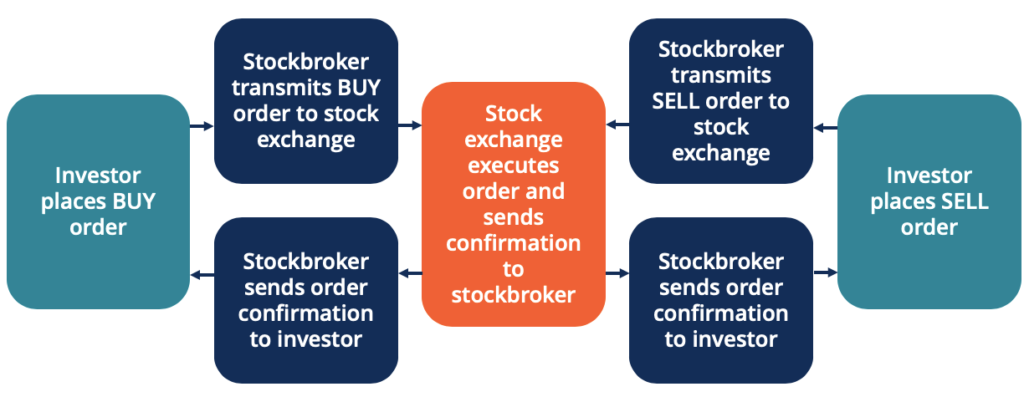
A stockbroker is a regulated representative of the financial market who enables the buying and selling of securities on behalf of financial institutions, investor clients, and firms. A stockbroker is also called a registered representative or a broker. The trading or purchase or sale of stocks on the national stock exchanges are usually executed through a stockbroker.

Stockbrokers handle transactions for both institutional and retail customers. The primary job of a stockbroker is to obtain buy and sell orders and execute them. Many market participants depend on stockbrokers’ knowledge and expertise regarding the dynamics of the market to invest in securities. A stockbroker can work either individually or with a brokerage firm. Sometimes, broker-dealers and brokerage firms are also called stockbrokers.
Summary
- A stockbroker is a regulated representative of the financial market who enables the buying and selling of securities for different clients.
- Discount stockbrokers offer more research tools and trading options with smaller commissions; hence, they attract active day traders and investors.
- A stockbroker needs to have a strong understanding of the financial market and regulations and must pass the General Securities Representative Exam.
Types of Stockbrokers
The choice of a stockbroker should be related to the trading needs of the traders. Traders should focus on their trading strategy and choose a stockbroker who will help meet their trading needs. For example, for short-selling stocks, traders would need to find stockbrokers with a deep list of stocks available to short.
The following are the various types of stockbrokers:
1. Full-Service Stockbroker
A full-service stockbroker offers a variety of financial services to clients. Usually, clients are assigned individual licensed stockbrokers. The brokerage firms employ research departments providing analyst recommendations and access to initial public offerings (IPOs)Initial Public Offering (IPO)An Initial Public Offering (IPO) is the first sale of stocks issued by a company to the public. Prior to an IPO, a company is considered a private company, usually with a small number of investors (founders, friends, family, and business investors such as venture capitalists or angel investors). Learn what an IPO is.
Full-service stockbrokers also provide services like financial planning, business and personal home loans, banking services, and asset management. Clients can either contact their personal stockbroker for trading options or use mobile and online platforms.
However, stockbrokers offering trading functions and online access charge higher commissions. Moreover, as the online platforms of full-service stockbrokers usually cater to long-term investors, the platforms provide fewer indicators and tools for day trading investors.
2. Discount Stockbroker
Discount stockbrokers provide financial products, access to mutual fundsMutual FundsA mutual fund is a pool of money collected from many investors for the purpose of investing in stocks, bonds, or other securities. Mutual funds are owned by a group of investors and managed by professionals. Learn about the various types of fund, how they work, and benefits and tradeoffs of investing in them, banking products, and other services. A discount stockbroker offers many products and services that are similar to a full-service stockbroker, but with smaller commissions.
Hence, swing traders and day traders who are more active may find discount stockbrokers appealing. Moreover, the platforms serve active day traders and investors; hence, they provide more research tools and trading options than full-service platforms.
3. Online Stockbroker
Also called a direct access stockbroker, an online stockbroker offers services to active day traders with the smallest commission – usually priced on a per-stock basis. Online stockbrokers offer direct access platforms with capabilities of routing and charting, and access to multiple exchanges, market makers, and electronic communication networks (ECN).
Also, online stockbrokers offer the advantages of access and speed, allowing executions of orders on point-and-click. The platforms also enable the placing of complex options and stock orders. The access to heavy-duty platforms usually comes with a monthly fee consisting of software and exchange fees; however, the software fees can be discounted or waived depending on the actual number of shares traded monthly by the client.
Qualifications of a Stockbroker
Education
An undergraduate degree in finance or business administration is required if a stockbroker seeks to work with an institutional client. Additionally, an understanding of accounting methods, financial forecastingFinancial ForecastingFinancial forecasting is the process of estimating or predicting how a business will perform in the future. This guide on how to build a financial forecast and planning, and related laws and regulations is preferred.
Experience
A stockbroker can start working with a brokerage firm in any role, even as a college intern, and gain experience on the job. However, to be a stockbroker, he/she must show a strong understanding of accounting standards and regulations of the financial market.
Exams
A stockbroker must pass the General Securities Representative Exam, controlled by the Financial Industry Regulatory Authority (FINRA). A person needs to be financed by a member firm of FINRA or a Self-Regulatory Organization (SRO).
Additional Resources
CFI is the official provider of the Capital Markets & Securities Analyst (CMSA)™Program Page - CMSAEnroll in CFI's CMSA® program and become a certified Capital Markets &Securities Analyst. Advance your career with our certification programs and courses. certification program, designed to transform anyone into a world-class financial analyst.
To keep learning and developing your knowledge of financial analysis, we highly recommend the additional resources below:
- Alternative Trading System (ATS)Alternative Trading System (ATS)An Alternative Trading System (ATS) is a North American term that refers to a trading venue that matches buyers and sellers for transactions.
- Institutional InvestorInstitutional InvestorAn institutional investor is a legal entity that accumulates the funds of numerous investors (which may be private investors or other legal entities) to
- Trade OrderTrade OrderPlacing a trade order seems intuitive – a “buy” button to initiate a trade and a “sell” button to close a trade.
- Self-Regulatory Organization (SRO)Self-Regulatory Organization (SRO)A Self-regulatory Organization or SRO is an organization that is formed to regulate certain professions or industry. They are usually non-governmental
-

Backtesting: A Comprehensive Guide to Strategy Validation
Backtesting involves applying a strategy or predictive model to historical data to determine its accuracy. It can be used to test and compare the viability of trading strategies so tradersSix Essentia
-
Banker's Acceptance: Definition, Function & Key Features
A banker’s acceptance refers to a financial instrument that represents a promised future payment from a bank. It states the name of the entity to which the funds need to be transferred, along wi
invest
- PC Banking: A Comprehensive Guide to Online Banking Security & Features
- IRA CDs: Secure Retirement Savings with FDIC Insurance
- Understanding the DU: Your Mortgage Approval Explained
- Decentralized Finance (DeFi): A Comprehensive Overview
- Jumbo CDs: Higher Rates & Deposits Explained
- Stockbroker: Your Guide to Finding & Working with Financial Professionals
- Understanding Cryptocurrency: A Beginner's Guide to Digital Currency
- DB(k) Plans: A Hybrid Retirement Solution for Employers & Employees
- Understanding Regulation Z: Your Rights as a Borrower
-
 Understanding Loan Lifespan: What is Average Life?
Average life is the length of time that each unit of unpaid principal is expected to remain outstanding. The average life of mortgagesMortgageA mortgage is a loan – provided by a mortgage lender...
-
 Understanding Average Return: A Simple Guide
Average return is the mathematical average of a sequence of returns that have accrued over time. In its simplest terms, average return is the total return over a time period divided by the number of p...