
Venture Capital Trusts (VCTs) Explained: Tax-Efficient UK Investment
A venture capital trust (VCT) is a tax-efficient investment vehicle that provides capital to small, growing businesses in the United Kingdom. A specialized investment manager manages the fund, and the investors are primarily individuals. Below is an overview of a typical venture capital trust structure:
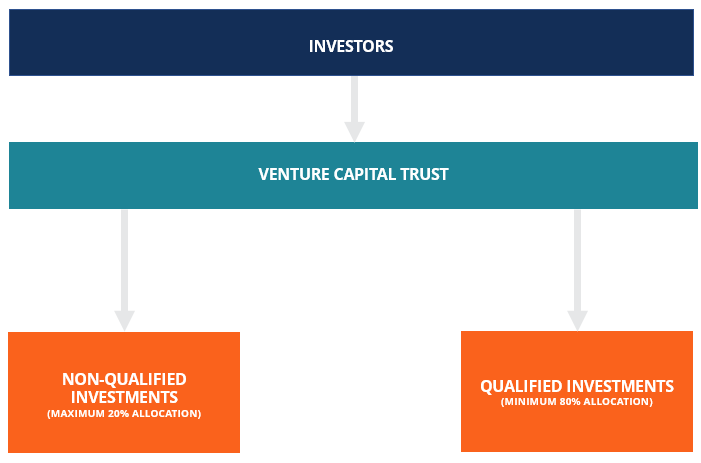
Venture Capital Trust – Overview
Venture capital trusts were first introduced in 1995 by the UK government to boost investment in new local businesses. VCTs are structured as closed-end investment funds whose units list on the London Stock ExchangeLondon Stock Exchange (LSE)The London Stock Exchange (LSE), which is based in London, the United Kingdom, is one of the leading stock markets in the world. Owned by the London Stock Exchange Group, the LSE was established in 1571, making it one of the oldest stock exchanges in the world.
Like business development companies in the United States, venture capital trusts are a form of publicly-traded private equity fundsPrivate Equity FundsPrivate equity funds are pools of capital to be invested in companies that represent an opportunity for a high rate of return. They come with a fixed. Investors can purchase units of the fund directly in a primary issue or the secondary market via the London Stock Exchange.
Types of Venture Capital Trusts
Venture capital trusts come in multiple variations and typically break down as follows:
1. Themes
- Generalist VCTs: Invest in a diverse group of unlisted companies from various industries and sectors.
- Specialist VCTs: Investment focus is on specific industries and sectors.
- AIM VCTs: Invests mainly in companies listed on the AIM exchange. It can have a specialist or generalist approach.
2. Time Horizon
- Evergreen VCTs: With an indefinite lifespan.
- Limited Life VCTs: Set a minimum holding period of at least five years, at which point the wind-down process begins, and the manager allocates capital back to the investors.
VCT – Life Cycle
After inception, the VCT manager is given three years to find and invest at least 80% of the portfolio’s assets into qualified investments. Until then, the manager invests in money markets or bonds to generate returns for investors without jeopardizing the investable assets.
VCT – Investment Criteria
A qualified investment involves taking a debt or equity position in a UK-based company that is either privately-owned or listed on the Alternative Investment MarketAlternative Investment Market (AIM)The Alternative Investment Market (AIM) was launched on 19 June 1995 as a sub-exchange market of the London Stock Exchange (LSE). The market was designed to (a sub-market of the London Stock Exchange focused on smaller, less developed companies). Unlike most private equity firms, VCTs only invest in minority stakes of companies.
VCT – Tax Benefits
For investors who purchase shares of the VCT in the secondary market (via an exchange), the following tax benefits apply:
- Income tax exemption on VCT share dividends
- Capital gains tax exemption on disposal of the shares
For investors who purchase VCT shares in the primary market (directly from the VCT), they enjoy all the same benefits as above, in addition to 30% income tax relief on the principal investment amount of up to £200,000 in a given tax year.
The tax relief is conditional on the investor holding shares for five years. Because shares purchased in the secondary market do not allow for this additional benefit, they often trade at a discount to reflect this reduced subsidy.
VCT – Fee Structure
Since venture capital trusts require a specialized skill set and very high touch service from fund managers, the fees are often much higher than more traditional investment vehicles. VCT managers typically charge an initial upfront fee of as high as 5% of the initial investment amount. Managers also charge an annual management fee, usually of around 2%.
VCT – Risks
Like other venture capital investments, the returns on venture capital trusts can be potentially very large. However, there is a significant amount of risk involved since many small businesses fail. Such a risk can lead to substantial losses for investors, although proper diversificationDiversificationDiversification is a technique of allocating portfolio resources or capital to a variety of investments.The goal of diversification is to mitigate losses can help lower the overall risk of the portfolio.
Related Readings
CFI is the official provider of the global Commercial Banking & Credit Analyst (CBCA)™Program Page - CBCAGet CFI's CBCA™ certification and become a Commercial Banking & Credit Analyst. Enroll and advance your career with our certification programs and courses. certification program, designed to help anyone become a world-class financial analyst. To keep advancing your career, the additional CFI resources below will be useful:
- Capital Investment ModelCapital Investment ModelA capital investment model helps company calculate key valuation metrics of a capital investment including the cash flows, NPV, IRR, and payback period.
- Secondary MarketSecondary MarketThe secondary market is where investors buy and sell securities from other investors. Examples: New York Stock Exchange (NYSE), London Stock Exchange (LSE).
- Venture Capital InvestingVenture Capital InvestingVenture capital investing is a type of private equity investing that involves investment in a business that requires capital. The business often requires capital for initial setup (or expansion). Venture capital investing may be done at an even earlier stage known as the "idea phase".
- Investment MethodsInvestment MethodsThis guide and overview of investment methods outlines they main ways investors try to make money and manage risk in capital markets. An investment is any asset or instrument purchased with the intention of selling it for a price higher than the purchase price at some future point in time (capital gains), or with the hope that the asset will directly bring in income (such as rental income or dividends).
-
Understanding Mispricing: Market Prices vs. True Value
Mispricing causes a divergence between the market price of a security and the fundamental value of that security. The law of one price states that the market price of a security is equal to the presen
-
Venture Philanthropy: Investing in Social Impact
Venture philanthropy is a form of impact investing that combines venture capital funding with charitable and humanitarian aspirations. Venture philanthropy is conducted through Social Purpose Organiza
invest
- Capital Investment: Definition, Types & Examples | [Your Company Name]
- Venture Capital Trusts (VCTs) in the UK: An Investor's Guide
- Venture Capital: Funding Startups & Understanding Equity
- Capital Preservation: A Guide to Protecting Your Investments
- Venture Capital Funds: Investing in High-Growth Startups
- Venture Capital Investing: A Comprehensive Guide
- Investment Trusts Explained: A Comprehensive Guide
- Venture Capital Funding: A Guide for Business Growth
- Capital Budgeting: Evaluating Investments for Business Growth
-
 Understanding Drawdowns: A Key Investment Risk
A drawdown is an investment term that refers to the decline in value of a single investment or an investment portfolio from a relative peak value to a relative trough. It is an important risk factor f...
-
 Understanding Investment Horizon: A Comprehensive Guide
Investment horizon is a term used to identify the length of time an investor is aiming to maintain their portfolio before selling their securitiesMarketable SecuritiesMarketable securities are unrestr...