
Venture Capitalists: Funding for High-Growth Startups
Venture capitalists are investors who provide financing to start-ups or small companies that are looking to expand. The beneficiary companies are usually considered to be with high growth potential, but the high failure risks that accompany the potential return makes it difficult or costly for them to borrow from banks.
Venture capitalists, who are willing to bear higher risks for higher returns, invest in the companies in exchange for an equity stake. They can be wealthy investors, investment banksList of Top Investment BanksList of the top 100 investment banks in the world sorted alphabetically. Top investment banks on the list are Goldman Sachs, Morgan Stanley, BAML, JP Morgan, Blackstone, Rothschild, Scotiabank, RBC, UBS, Wells Fargo, Deutsche Bank, Citi, Macquarie, HSBC, ICBC, Credit Suisse, Bank of America Merril Lynch, and other financial institutions.

A start-up that attracts venture capitalists generally develops or owns an innovative technology or business modelStartup Valuation Metrics (for internet companies)Startup Valuation Metrics for internet companies. This guide outlines the 17 most important e-commerce valuation metrics for internet starts to be valued. One of the most important skills of venture capitalists is the ability to identify the growth potential of innovation. They also participate in the management of the companies that they invest in by owning a significant ownership stake.
Different from general investors, venture capitalists not only provide capital financing but also offer expert management and technical support to the start-ups to boost their chances of success. Regarding such features, venture capitalists are higher in net worth and adopt a longer investment horizon and closer relationships with the investee companies, compared with general public market investors.
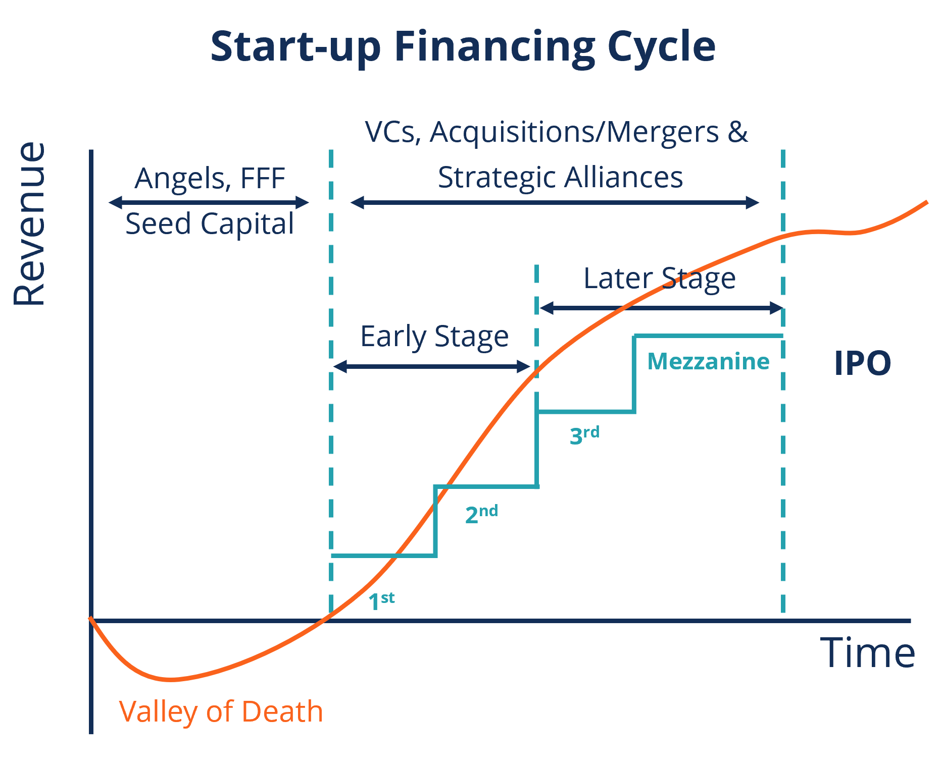
Start-up Financing Cycle
The major difference between venture capital and private equity investors is the stage that the investee company is in. In general, a venture capitalist invests in the companies at their early stages, as a private equity investor invests in mature firms with relatively stable cash flows.
The financing cycle of a start-up consists of five stages. It starts with the seed capital invested by the founders themselves, family, and friends. When seed capital is limited, the startup seeks investment from angel investorsAngel InvestorAn angel investor is a person or company that provides capital for start-up businesses in exchange for ownership equity or convertible debt. They may provide a one-time investment or an ongoing capital injection to help the business move through the difficult early stages.. The funding is mainly used for research and development and team build-up at the seed capital stage.
When the company moves to production and selling (the early stage), it is the time that venture capitalists start to come in. At this stage, venture capitalists face much smaller risks than the investors at the previous stage, since the company has started to generate revenues and cash flows from its sales. However, the risk of failure is still considerable.
The later stage is when the company is seeking for growth and expansion. Venture capitalists also invest at this stage, and the risk is even lower than in the early stage. If the company can survive through all the stages successfully, it can reach to the public equity market through an initial public offering (IPO)Initial Public Offering (IPO)An Initial Public Offering (IPO) is the first sale of stocks issued by a company to the public. Prior to an IPO, a company is considered a private company, usually with a small number of investors (founders, friends, family, and business investors such as venture capitalists or angel investors). Learn what an IPO is. The venture capitalists can thus earn returns by selling their shares to other investors.
Venture Capitalist Exit Strategies
The process that allows venture capitalists to realize their returns is called an “exit.” Venture capitalists can exit at different stages and with different exit strategies. A proper decision on how and when to exit also significantly impacts the return of the investment.
1. Secondary market
Before the company goes public, the venture capitalists who invested in the earlier stage can sell their holdings to new investors during the later rounds. Since the shares have not been issued in the public exchanges, the trades take place in the private equity secondary market.
2. Share buyback
The new investors can be other venture capitalists, private equity investors, or acquirers. In addition to the new investors, the shares can also be acquired back by the investee companies, which is called a “buyback.”
3. Initial Public Offering (IPO)
If the company is operating well and moving to the public exchange, the venture capitalists can take the IPO strategy by selling their portions of shares in the open marketplace after the IPO. There is usually a lock-up period after the initial offering that insiders (including venture capitalists) are not allowed to sell their shares. It is to prevent a decline in the stock price as a result of large numbers of shares flooding into the market. The length of the lock-up period is specified in the contract.
Liquidation is one form of an involuntary exit for venture capitalists. It happens when the company fails and must pay its claimants by distributing its assets, which is a very unfavorable situation to venture capitalists. The liquidation preference is specified in the contract, which gives the order that claimants can be paid. It is one of the most important terms that venture capitalists need to pay attention to.
Venture Capital vs Private Equity Investors
Although venture capital and private equity investors are both active in the private equity market by investing in and exiting companies through equity financing, there are still significant differences between the two types of investors.
1. Type of investee companies
One of the major differences is the type of investee companies. Private equity investors usually buy mature companies that may be deteriorating in value due to inefficient management. The investee companies are not limited to private ones, as private equity investors can also acquire control of public companies and take them private.
On the other hand, venture capitalists target start-up companies that demonstrate significant growth potential with innovative technology but require capital financing. The companies are all private and small in size.
2. Size of ownership stake
Another key difference is that private equity investors usually acquire 100% ownership of the target companies through leveraged buyouts (LBO)Leveraged Buyout (LBO)A leveraged buyout (LBO) is a transaction where a business is acquired using debt as the main source of consideration., financing the cost of acquisition with a significant portion of borrowed money.
However, venture capitalists generally purchase no more than 50% of the investee company, mainly through equity only. It allows them to diversify their investments into various companies to spread out the risks.
Related Readings
CFI is the official provider of the Commercial Banking & Credit Analyst (CBCA)™Program Page - CBCAGet CFI's CBCA™ certification and become a Commercial Banking & Credit Analyst. Enroll and advance your career with our certification programs and courses. certification program, designed to transform anyone into a world-class financial analyst.
In order to help you become a world-class financial analyst and advance your career to your fullest potential, these additional resources will be very helpful:
- Private Equity vs Venture Capital, Angel/Seed InvestorsPrivate Equity vs Venture Capital, Angel/Seed InvestorsCompare private equity vs venture capital vs angel and seed investors in terms of risk, stage of business, size & type of investment, metrics, management. This guide provides a detailed comparison of private equity vs venture capital vs angel and seed investors. It's easy to confuse the three classes of investors
- Seed FinancingSeed FinancingSeed financing (also known as seed capital, seed money, or seed funding) is the earliest stage of the capital-raising process of a startup. Seed financing is a type of equity-based financing. In other words, investors commit their capital in exchange for an equity interest in a company.
- Top 10 Private Equity FirmsTop 10 Private Equity FirmsWho are the top 10 private equity firms in the world? Our list of the top ten largest PE firms, sorted by total capital raised. Common strategies within P.E. include leveraged buyouts (LBO), venture capital, growth capital, distressed investments and mezzanine capital.
- Venture Capital InvestingVenture Capital InvestingVenture capital investing is a type of private equity investing that involves investment in a business that requires capital. The business often requires capital for initial setup (or expansion). Venture capital investing may be done at an even earlier stage known as the "idea phase".
-

Managed Futures: A Comprehensive Guide for Diversified Investing
Managed futures is a subclass of alternative investment strategies used by large funds and institutional investors to achieve both portfolio and market diversification. With the ability to take both l
-

Understanding Management Fees: What They Are & How They Work
Management fees are fees paid to professionals entrusted with managing investments on a client’s behalf. Typically determined as a percentage of the total assets under management (AUM)Assets Und
invest
- Venture Capital: Funding Startups & Understanding Equity
- Venture Debt: A Comprehensive Guide for Startups
- Baby Bonds: A Comprehensive Guide to Investing in Children's Futures
- Understanding Bonds: A Comprehensive Guide for Investors
- Understanding Commodities: A Beginner's Guide to Investing
- Defensive Industries: Stability in Economic Uncertainty | [Your Company Name]
- Understanding Financial Derivatives: A Comprehensive Guide
- Understanding Distressed Securities: Risks & Opportunities
- Venture Philanthropy: Investing in Social Impact
-
 Investment-Grade Bonds: Understanding Credit Risk & Ratings
An investment-grade bond is a bond classification used to denote bonds that carry a relatively low credit riskCredit RiskCredit risk is the risk of loss that may occur from the failure of any party to...
-
 Understanding Junk Bonds: Risks, Rewards, and Investment Strategies
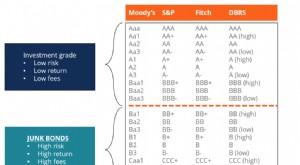
Junk bonds, also known as high-yield bonds, are bonds that are rated below investment grade by the big three rating agencies (see image below). Junk bonds carry a higher risk of defaultMarket Ri...