
Understanding Budget Variance Analysis: A Key to Financial Control

Most firms prepare a budget for every activity they engage in, as well as their normal operations. At the end of the time period or project, the budget is compared with the actual costs and income and any differences between the budget and the actual costs and expenses analyzed. This practice, called "variance analysis," is important in management accounting, which focuses on producing forward-looking information, such as developing budgets and measuring performance, to assist managers in formulating business strategies, planning business activities and evaluating business results.
Creating Budget
Based on information from financial accounting, management accountants often create budget plans for various aspects of a business's operations, and managers can then use them as a guide to make more informed decisions. While financial accountants stress compliance and record keeping, management accountants forecast and plan future business developments and suggest courses of action. Budget planning provides the basis against which actual results can be measured and evaluated.
Measuring Results
Measuring actual results against budget is aimed at monitoring and recording business activities, the results of which are used for further performance evaluation. The comparison of actual vs. budget often shows a difference, or "variance," that can be either favorable or unfavorable. For example, in a cost budget, a lower actual number than the budgeted figure would be considered favorable, while in a sales budget, a higher actual number than the budgeted figure would be seen as favorable.
Analyzing Variance
Variance is analyzed to find out what caused the variation between actual and budget. Planning budgets and measuring results are only the start of the process of comparing actual vs. budget. Management uses the budget report to identify the reasons for any variation so that it can recommend appropriate corrective actions. Potential causes for unfavorable variances may include unrealistic budget or subpar performance.
Taking Actions
Variance analysis better informs managers about current business operations. Knowing what has performed and what has not, managers can take reinforcing measures or corrective actions. The purpose of comparing actual vs. budget is to add value to the business through better planning, monitoring, evaluating and controlling. Management may adjust a budget upward or downward to better reflect reality and implement new cost-cutting or sales-promoting measures.
-

Unlock Savings: Your Complete Guide to Budget Airlines
Budget airlines are frequently used by business and personal travelers everywhere. This type of airline has become very popular in society and does not show any signs of slowing down in the futu
-

Simplify Your Budget: The 80/20 Rule for Financial Freedom
You may have been meaning to get on a budget but get overwhelmed on where to start or what budget method would work best for you. The idea of tracking all of your expens
investing
- Simplify Your Finances: The Ultimate Guide to iPhone Budget Apps
- Boost Your Wealth: 4 Key Benefits of Budgeting
- Unlock Affordable Adventures: The Joy of Budget Travel
- Budgeting 101: Understanding & Creating a Personal Budget
- Create a Budget: Achieve Financial Security & Peace of Mind
- The Importance of Fun Money: Budgeting for Financial Wellbeing
- The Pitfalls of Online Budgeting Tools: Why Traditional Methods Still Reign
- Why Isn't Your Budget Working? Common Mistakes & Solutions
- From Budget Dread to Budget Freedom: A Personal Transformation
-
 Budget Variance Explained: Causes, Types & Analysis
Budget variance deals with a company’s accounting discrepancies. The term is most often used in conjunction with a negative scenario. An example is when a company fails to accurately budget for ...
-
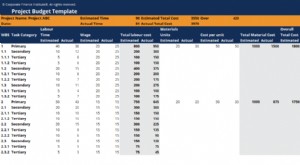 Project Budget: Definition, Template & Cost Estimation
The Project Budget is a tool used by project managers to estimate the total cost of a project. A project budget template includes a detailed estimate of all costs that are likely to be incurred before...