
Understanding Taxes on Pension Benefits: A Comprehensive Guide

Many companies offer some type of tax-advantaged retirement plan for their employees through a 401(k), 403(b) or other qualified retirement pension plan. Most of these pension plans are tax-deferred, meaning that while the employee does not have to count the amount of the contributions to the account as taxable income in the year they make the contribution, they are responsible for paying taxes on it when the money comes out of the pension.
Federal Income Taxes
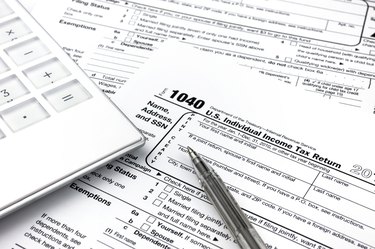
When you take money out of your tax-deferred pension plan, you must include the amount that you receive as taxable income when you file your federal income taxes. Taxable pension benefits are reported on your federal tax return on line 12a and 12b if you use form 1040A or lines 16a and 16b of form 1040, and are taxed as ordinary income. However, if you have a Roth pension, such as a Roth 401(k) plan or Roth 403(b) plan, your withdrawals come out tax free as long as your withdrawals are qualified. If this is the case, you would still report the money as pension income on line 12a of form 1040A or 16a of form 1040, but you would not include it as taxable pension income on line 12b of form 1040A or line 16b of form 1040.
State Income Taxes
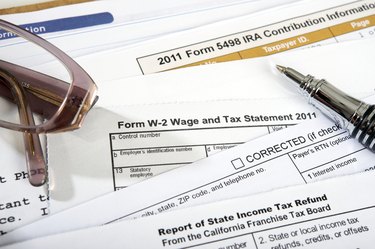
If you live in a state that charges income tax--43 states plus the District of Columbia do--you may have to pay state income taxes on your pension as well. The tax rate varies from state to state, and often depends upon your total taxable income for the state. In addition, some states tax different types of pensions differently. For example, according to Retirement Living, Alabama, Hawaii, Illinois, Kansas, Louisiana, Massachusetts, Michigan, Mississippi, New York and Pennsylvania do not tax any government pensions whether they come from the federal, state or local government level. At the opposite end of the spectrum, California, Connecticut, Nebraska, Rhode Island and Vermont do not grant taxpayers any breaks on pension income.
Tax Penalties

If you take an early withdrawal from your pension, you will usually have to pay a tax penalty on the amount of the withdrawal. The tax penalty is a one-time fee amounting to 10 percent of the unqualified distribution. This penalty is on top of any other income taxes that you have to pay on the withdrawal. In order to calculate and document this tax penalty, you need to complete form 5329 and attach it to your form 1040 tax return.
-

Income Stocks: A Guide to Dividend Investing
Income stocks are equity financial securities that pay regular and predictable dividendsDividendA dividend is a share of profits and retained earnings that a company pays out to its shareholders. When
-

Understanding After-Tax Income: A Comprehensive Guide
After-tax income refers to the net income after deducting all applicable taxes. Therefore, the after-tax income is simply one’s gross income minus taxes. For individuals and corporations, the af
retirement
- Understanding the Advantages of Swipe Cards: Convenience, Security & Uses
- Cash Budget: Benefits & How to Limit Expenses - [Year]
- Unlock Savings & Sustainability: The Benefits of Electricity Conservation
- Walmart Benefits: Convenience, Low Prices & Services | Official Walmart
- Understanding the Benefits of Public Housing Programs
- Medicaid Income Limits: Federal & State Guidelines (2024)
- Voluntary Retirement: Benefits, Packages & Considerations
- Objectives of Income Tax Accounting: A Comprehensive Overview
- LLC Tax Benefits: Maximize Your Savings & Business Growth
-
 Marriage Tax Benefits: A Comprehensive Guide for Couples
It’s a common question we get as financial advisors: What are the tax benefits of marriage? As couples plan for their big day, the last thing most people think about is taxes. However, marriage ...
-
 Federal Income Tax Filing Requirements: Minimum Income Thresholds
This article was fact-checked by our editors and Tolla Tu, tax specialist with Credit Karma Tax®. It has been updated for the 2020 tax year. The tax code has specific rules about w...