
Boost Profitability: Achieve Accurate Inventory Management
Correctly calculating inventory accuracy is essential to businesses of all types.
Inaccurate inventory counts plague both retail and wholesale businesses. Consumer retailers have more frequent issues, though, because of the volume of products sold and returned, as well as expiring, restocked incorrectly and more.
 What is Inventory Accuracy?
Inventory accuracy refers to any disparity that exists between your business's electronic records reflecting your inventory and your actual inventory.
Businesses need to regularly reconcile two inventory-related numbers:
- Electronic or paper records should be available inventory based on deliveries, sales and shipments
- What’s actually counted in a physical check of the inventory on hand
This process - referred to as inventory accuracy cycle counting - helps expose errors before the discrepancies grow so large that fixing them becomes a major accounting and sales problem.
How to Calculate Inventory Accuracy
Assuming all four of the data points are available and correct, the math behind calculating inventory accuracy looks like this:
- Determine the number of sampled inventory test items
- Determine the total number of all inventory items sampled
- Divide the number of sampled inventory test items by the number of all inventory items sampled
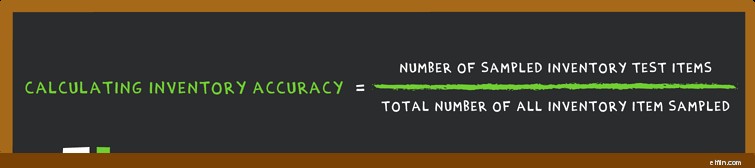
If either A or B is inaccurate, the formula will produce a number that isn’t useful and should be discarded.
Inventory Accuracy Best Practices
A 2008 study found widespread inaccuracies in the inventory records of retailers despite the cumulative billions being spent on automated tools to make stock replenishment and other tasks more simple.
In order for inventory counts to be correct, they must contain the following details:
- Quantity on hand
- Location of inventory
- Unit of measure (single items, multipacks, etc.)
- Unique product number or identifier
If any of these is missing or is inaccurate, the formula will be thrown off and can’t be calculated correctly. Inventory management systems can be used to collect numbers electronically and aid in ensuring accuracy.
It should be noted that calculating inventory accuracy is different than calculating finished goods inventory. Both are important numbers to have on hand, but serve very different purposes.
Businesses without plans to regularly calculate inventory accuracy risk product outages that can negatively impact their reputation among customers. Don’t get caught with inaccurate inventory numbers that can hurt their sales and profits.
-

Calculate Average Inventory: Formula & Importance
What is average inventory? Average inventory refers to the average quantity of stock available in a specified period of time. The purpose of the average inventory formula is to calculate the val
-

Reduce Inventory Shrinkage: 6 Proven Strategies for Businesses
Inventory shrinkage refers to the difference between the physical count of your stock and the amount your records say you should have. Unlike dead stock, which refers to stock that’s sitting on shel
Stock management
- Inventory Management: Optimizing Supply Chain & Financial Health
- Inventory Management: Concepts, Trends & Best Practices
- Understanding and Managing Inventory Costs: A Comprehensive Guide
- Inventory Write-Down: Definition, Causes & Accounting Impact
- Free Budget Template: Simplify Your Personal Finances
- Understanding Investment Risk: The Sheep and Wolf Analogy
- Understanding Inherited IRAs: Rules, Taxes & Estate Planning
- Boost Profitability: Achieve Accurate Inventory Management
- ETFs vs. Mutual Funds: Which Investment is Right for You?
-
 Perpetual Inventory System: A Comprehensive Guide for Businesses
Any business owner will tell you that effective inventory management is the lifeline of any business. A company has to find an optimal balance between too much inventory that accumu...
-
Beginning Inventory: Definition & Calculation Formula
What is beginning inventory? Beginning inventory is the dollar value of all inventory held by a business at the start of an accounting period, and represents all the goods a business can put toward ge...