
Absorption Costing: A Comprehensive Guide for Businesses
Absorption costing is a costing system that is used in valuing inventoryInventoryInventory is a current asset account found on the balance sheet, consisting of all raw materials, work-in-progress, and finished goods that a. It not only includes the cost of materialsCost of Goods Manufactured (COGM)Cost of Goods Manufactured (COGM) is a term used in managerial accounting that refers to a schedule or statement that shows the total and labor, but also both variable and fixed manufacturing overhead costs. Absorption costing is also referred to as full costing. This guide will show you what’s included, how to calculate it, and the advantages or disadvantages of using this accounting method.
Components of Absorption Costing
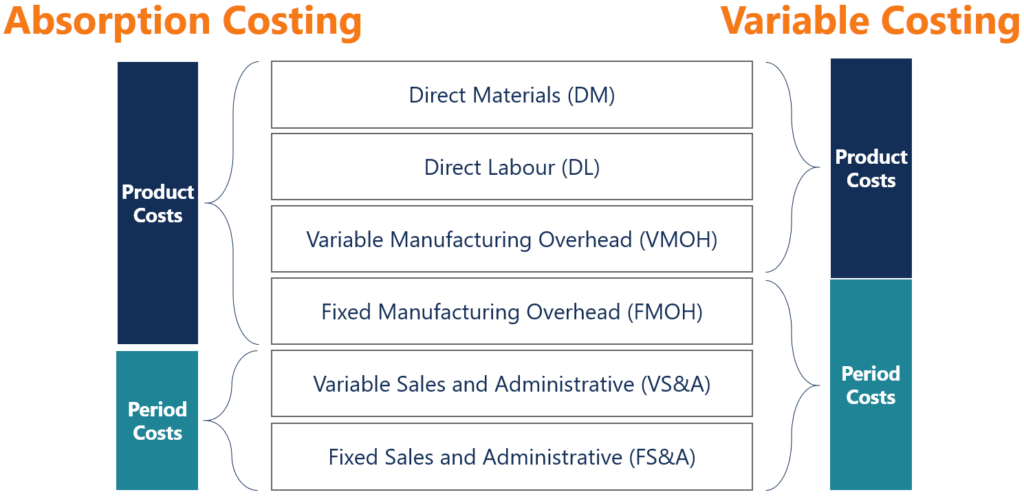
Under the absorption method of costing (aka “full costing”), the following costs go into the product:
- Direct material (DM)
- Direct labor (DL)
- Variable manufacturing overhead (VMOH)
- Fixed manufacturing overhead (FMOH)
Under absorption costing, the costs below are considered period costs and do not go into the cost of a product. They are, instead, expensed in the period occurred:
- Variable selling and administrative
- Fixed selling and administrative
For your reference, the following diagram gives an overview of costs that go into absorption costing compared to variable costing:
Example of Absorption Costing
Company A is a manufacturer and seller of a single product. In 2016, the company reported the following costs:
Variable costs per unit:
- Direct materials cost: $25
- Direct labor cost: $20
- Variable manufacturing overhead cost: $10
- Variable selling and administrative cost: $5
Fixed costs:
- Fixed manufacturing overhead of $300,000
- Fixed selling and administrative of $200,000
Over the year, the company sold 50,000 units and produced 60,000 units, with a unit selling price of $100 per unit.
Using the absorption method of costing, the unit product costProduct CostsProduct costs are costs that are incurred to create a product that is intended for sale to customers. Product costs include direct material is calculated as follows:
Direct materials + Direct labor + Variable overhead + Fixed manufacturing overhead allocated = $25 + $20 + $10 + $300,000 / 60,000 units = $60 unit product cost under absorption costing
Recall that selling and administrative costs (fixed and variable) are considered period costs and are expensed in the period occurred. Those costs are not included in the product costs.
Advantages
There are several advantages to using full costing. Its main advantage is that it is GAAP-compliant. It is required in preparing reports for financial statements and stock valuation purposes.
In addition, absorption costing takes into account all costs of production, such as fixed costs of operation, factory rent, and cost of utilities in the factory. It includes direct costs such as direct materials or direct labor and indirect costs such as plant manager’s salary or property taxes. It can be useful in determining an appropriate selling price for products.
Disadvantages
Since absorption costing includes allocating fixed manufacturing overhead to the product cost, it is not useful for product decision-making. Absorption costing provides a poor valuation of the actual cost of manufacturing a product. Therefore, variable costing is used instead to help management make product decisions.
Absorption costing can skew a company’s profit level due to the fact that all fixed costs are not subtracted from revenue unless the products are sold. By allocating fixed costs into the cost of producing a product, the costs can be hidden from a company’s income statement in inventory. Hence, absorption costing can be used as an accounting trick to temporarily increase a company’s profitability by moving fixed manufacturing overhead costs from the income statement to the balance sheet.
For example, recall in the example above that the company incurred fixed manufacturing overhead costs of $300,000. If a company produces 100,000 units (allocating $3 in FMOH to each unit) and only sells 10,000, a significant portion of manufacturing overhead costs would be hidden in inventory in the balance sheet. If the manufactured products are not all sold, the income statement would not show the full expenses incurred during the period.
Related Reading
Thank you for reading this guide to calculating the full costing of inventory. Below are additional accounting resources from CFI, the global provider of the Financial Modeling and Valuation Analyst (FMVA)®Become a Certified Financial Modeling & Valuation Analyst (FMVA)®CFI's Financial Modeling and Valuation Analyst (FMVA)® certification will help you gain the confidence you need in your finance career. Enroll today! designation.
- Job Order Costing GuideJob Order Costing GuideJob Order Costing is used to allocate costs based on a specific job order. This guide will provide the job order costing formula and how to calculate it. As an example, law firms or accounting firms use job order costing because every client is different and unique. Process-costing, on the other hand can be used
- Activity-based Costing GuideActivity-Based CostingActivity-based costing is a more specific way of allocating overhead costs based on “activities” that actually contribute to overhead costs. An activity is
- Cost of Goods Sold (COGS)Cost of Goods Sold (COGS)Cost of Goods Sold (COGS) measures the “direct cost” incurred in the production of any goods or services. It includes material cost, direct
- Fixed and Variable CostsFixed and Variable CostsCost is something that can be classified in several ways depending on its nature. One of the most popular methods is classification according
-

Process Costing: Definition, Benefits & Applications
Process costing is an accounting method typically used by companies that mass produce very similar or identical
-
Understanding Agency Costs: Protecting Shareholder Interests
Agency costs are internal costs incurred due to the competing interests of shareholders Stockholders EquityStockholders Equity (also known as Shareholders Equity) is an account on a companys balance s
Accounting
- Backflush Costing: Definition, Benefits & Implementation
- Capitalized Costs Explained: Definition & Examples
- Understanding Contribution Margin: A Key Profit Metric
- Cost Allocation: Definition, Methods & Importance
- Cost Drivers: Understanding What Impacts Your Business Expenses
- Direct Costs Explained: Definition, Examples & vs. Indirect Costs
- Understanding Implicit Costs: A Comprehensive Guide
- Job Order Costing: A Comprehensive Guide for Businesses
- Activity-Based Costing (ABC) vs. Absorption Costing: A Clear Comparison
-
 Program Budget: Definition, Importance & Creation
Perhaps your organization wishes to develop a team building program or an annual charity program. Whatever the event, such activities cost money. A prime consideration in whether or not a program can ...
-
 Understanding Variable Overhead Costs: A Comprehensive Guide
Variable overhead refers to the fluctuation in the manufacturing costs associated with the operation of businesses. To operate continuously, companies need to spend money on the production and sale of...