
Accelerated Depreciation: A Comprehensive Guide
Accelerated depreciation is a depreciation methodDepreciation MethodsThe most common types of depreciation methods include straight-line, double declining balance, units of production, and sum of years digits. in which a capital asset reduces its book value at a faster (accelerated) rate than it would using traditional depreciation methods such as the straight-line methodStraight Line DepreciationStraight line depreciation is the most commonly used and easiest method for allocating depreciation of an asset. With the straight line. Therefore, under accelerated depreciation, an assetTypes of AssetsCommon types of assets include current, non-current, physical, intangible, operating, and non-operating. Correctly identifying and faces greater deductions in its value in the earlier years than in the later years. Accelerated depreciation is often used as a tax-reduction strategy.
Popular Accelerated Depreciation Methods
The most popular accelerated depreciation methods are the double declining balance methodDouble Declining Balance DepreciationThe double declining balance depreciation method is a form of accelerated depreciation that doubles the regular depreciation approach. It is and the sum of the years’ digits method. The formula for calculating depreciation using each of these methods is given below:
1. Double declining balance method:
Double declining balance = 2 x Straight-line depreciation rate x Book value at the beginning of the year
2. Sum of the years’ digits method:
Applicable percentage (%) = Number of years of estimated life remaining at the beginning of the year / SYD
Where:
SYD = n(n+1) / 2
- SYD stands for sum of the years’ digit
- n = number of years
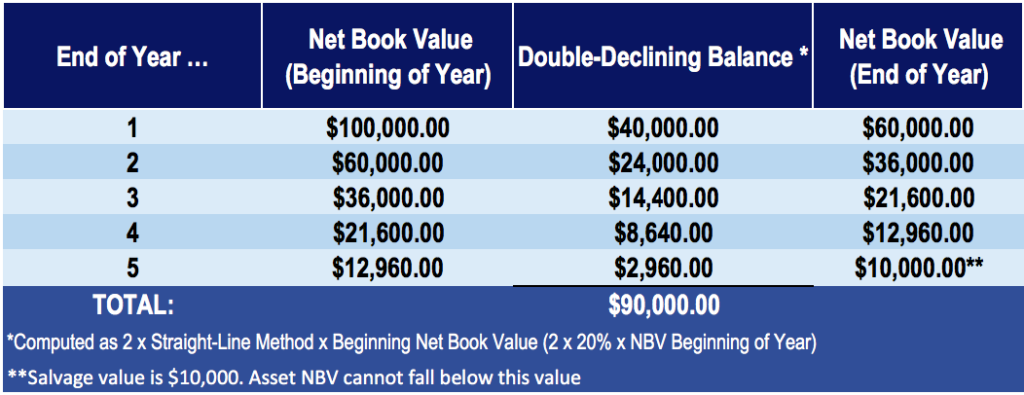
Example of the Double Declining Balance Method
CFI Company purchases a machine for $100,000, with an estimated salvage value of $10,000 and a useful life of 5 years. The straight-line depreciation rate is 20%.
The double declining balance depreciation method calculation is:
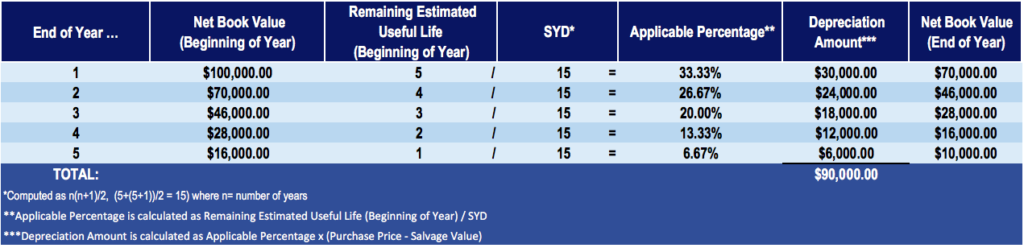
Example of the Sum of the Years’ Digits Method
CFI Company purchases a machine for $100,000 with an estimated salvage value of $10,000 and a useful life of 5 years. The straight-line depreciation rate is 20%.
The sum of the years’ digits method calculation is:
Comparing the Accelerated Depreciation Methods with the Traditional Straight-Line Method
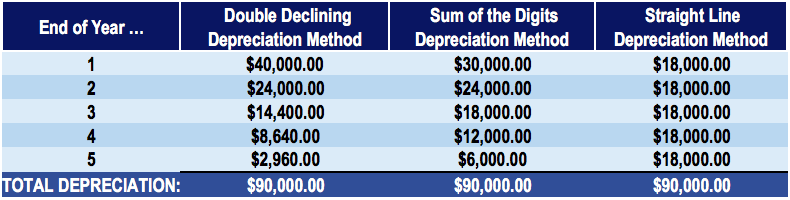
Let us calculate the straight-line depreciation for the same example – a machine worth $100,000, with an estimated salvage value of $10,000 and a useful life of 5 years – and compare it to the accelerated methods of depreciation.
A table with the depreciation amounts each year for each method:
A table with the end of year book values for each method:
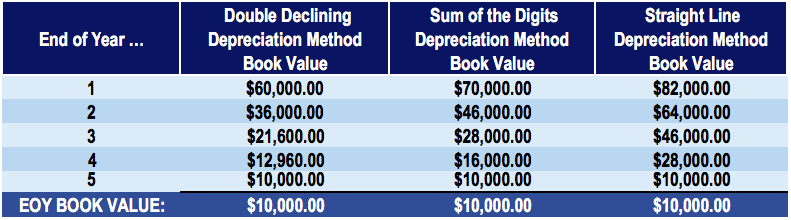
Under all three methods, the total depreciation and book value at the end of the machine’s useful life is the same – $90,000 in total depreciation and $10,000 in ending book, or salvage, value.
Financial Statement Impact of Different Depreciation Methods
Note from the tables above that the amount of depreciation in each year is different under varying methods. With the accelerated methods of depreciation (double declining and sum of the years’ digits), there is greater depreciation in the earlier years, as compared to the straight-line depreciation method. So, how do the accelerated methods of depreciation affect an asset’s value and the company’s net income?
The amount of depreciation of an asset affects the reported profits of a company (through the income statement). Therefore, the accelerated methods of depreciation skew the profits of the company and reveal lower profit in the earlier years of the asset’s acquisition. As the asset comes closer to the end of its useful life, it faces less annual depreciation, with the net effect of the company realizing a higher reported profit in those later years.
For example, consider a company that generates yearly revenues of $100,000. For simplicity, assume that the only operating expense of the company is depreciation expense (no rent expense, wage expense, etc.). Notice the difference in operating income under an accelerated method of depreciation compared to a straight-line depreciation method:
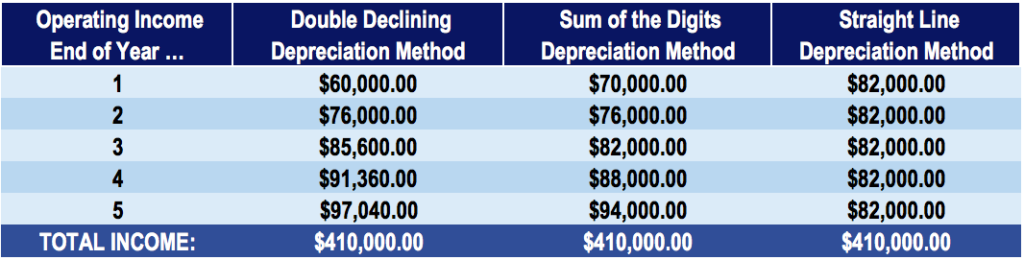
As illustrated in the table above, an accelerated depreciation method results in lower reported profit in earlier years but higher profit in later years as compared to a traditional straight-line depreciation method.
Tax Savings and Net Present Value
Companies often use rapid depreciation methods to reduce taxes in the early years of an asset’s life. It’s important to note that total tax deductions over the life of an asset will be the same no matter what method is used. The only benefit of an accelerated method is the timing of the deductions.
Rapid methods offer more tax savings in the early years and fewer savings in later years. Since managers of businesses take the Time Value of Money into consideration, it’s better to have the savings early rather than later. It helps to improve the Net Present ValueNet Present Value (NPV)Net Present Value (NPV) is the value of all future cash flows (positive and negative) over the entire life of an investment discounted to the present. of the business.
Related Reading
Thank you for reading this article on accelerated depreciation methods and reasons why accountants and managers use them. CFI is the official provider of the Financial Modeling and Valuation Analyst (FMVA)®Become a Certified Financial Modeling & Valuation Analyst (FMVA)®CFI's Financial Modeling and Valuation Analyst (FMVA)® certification will help you gain the confidence you need in your finance career. Enroll today! certification program, designed to help anyone become a world-class financial analyst. To keep advancing your career, the additional CFI resources below may be useful:
- Accumulated DepreciationAccumulated DepreciationAccumulated depreciation is the total amount of depreciation expense allocated to a specific asset since the asset was put into use.
- Depreciation ExpenseDepreciation ExpenseWhen a long-term asset is purchased, it should be capitalized instead of being expensed in the accounting period it is purchased in.
- Depreciation ScheduleDepreciation ScheduleA depreciation schedule is required in financial modeling to link the three financial statements (income, balance sheet, cash flow) in Excel.
- Depreciation Methods TemplateDepreciation Methods TemplateThis depreciation methods template will show you the calculation of depreciation expenses using four types of commonly use depreciation methods. There are several types of depreciation expense and different formulas for determining the book value of an asset. The most common depreciation methods include: Straight-line
-
Understanding Depreciation Methods: A Comprehensive Guide
There are several types of depreciation expenseDepreciation ExpenseWhen a long-term asset is purchased, it should be capitalized instead of being expensed in the accounting period it is purchased in.
-

Accelerated Depreciation: Benefits & Tax Advantages
Accelerated depreciation allows a company to count a higher portion of depreciation of an assets value to the early years of the assets use. Essentially, the company is stating the asset will be
Accounting
- Accelerated Dividends: Understanding Early Dividend Payments
- Accounting vs. Tax Depreciation: Key Differences Explained
- Understanding Accumulated Depreciation: A Comprehensive Guide
- Understanding Allowed Depreciation: Tax Deductions for Businesses
- Understanding Depreciation Expense: A Comprehensive Guide
- Listed Property Explained: Tax Implications & Business Use
- Understanding MACRS Depreciation: A Guide for U.S. Taxpayers
- Sum of Years Depreciation (SYD): Definition & Calculation
- Tax Depreciation Explained: A Comprehensive Guide for Taxpayers
-
Understanding Dollar Value: Factors Influencing Appreciation & Depreciation
The dollar's worth is determined by the amount of goods, services and foreign currency it can purchase. The value of the dollar can change significantly over time. To illustrate, according to the ...
-
 Half-Year Convention for Depreciation: Understanding the Rules
The half-year convention for depreciation assumes fixed assetsFixed AssetsFixed assets refer to long-term tangible assets that are used in the operations of a business. They provide long-term financia...