
Understanding Accounting Policies: A Guide for Businesses
Accounting policies are rules and guidelines that are selected by a company for use in preparing and presenting its financial statements. Accounting policies are important, as they set a framework, which all companies follow, and provide comparable and consistent standard financial statements across years and relative to other companies.

Summary
- Accounting policies are rules and guidelines that help a company prepare and present its financial statements.
- Accounting policies can be selected to be conservative or aggressive, based on a company’s motives.
- Full disclosure of accounting policies is important so that potential investors can better interpret a company’s financial statements.
Accounting policies can vary among different companies and geographies. However, most companies generally follow one of the two accounting standards – the Generally Accepted Accounting Principles (GAAP)GAAPGAAP, Generally Accepted Accounting Principles, is a recognized set of rules and procedures that govern corporate accounting and financial or the International Financial Reporting Standards (IFRS). Accounting policies are different from accounting principles, as the principles are the overarching accounting rules, whereas policies are the way a company follows the rules.
IFRS vs. GAAP
The International Financial Reporting Standards (IFRS)IFRS StandardsIFRS standards are International Financial Reporting Standards (IFRS) that consist of a set of accounting rules that determine how transactions and other accounting events are required to be reported in financial statements. They are designed to maintain credibility and transparency in the financial world and the Generally Accepted Accounting Principles (GAAP) are accounting principles that provide guidelines on how companies should prepare financial statements. IFRS is more principles-based and, therefore, can better capture the economics of a certain transaction.
GAAP, on the other hand, is a more rules-based approach. The differences between the two methods are evident in the different standards related to accounting policies (for example, some accounting policies that are allowed under GAAP may not be allowed under IFRS).
Conservative vs. Aggressive Policies
Conservative accounting policies understate a company’s current financial performance and show better financial performance in subsequent years. It is a more sustainable approach and it allows companies to show improvement over the years, which is a positive signal for investors.
Aggressive policies tend to employ accounting policies in a way such that they overstate the performance in earlier years, and it leads to a decline in a company’s performance in later years (even though the company may be doing).
Aggressive accounting policies can also raise a red flag from auditors or investors if they feel management is misrepresenting earnings or allocating costs.
Prominent Accounting Policies
Accounting policies can vary widely but all are included in the standards dictated by either the IFRS or GAAP. The list below mentions some key policies used by companies (please note that our list is not exhaustive, and policy use can differ depending on the industry the company operates in).
- Accounting conventions followed
- Valuation of fixed assets
- Depreciation and inventory policies
- Valuation of investments
- Translation of foreign currency items
- Costs incurred for research and development
- Historical or current cost accounting
- Treatment of leases
- Treatment of goodwill
- Recognition of profits on long-term contracts
- Treatment of contingent liabilitiesContingent LiabilityA contingent liability is a potential liability that may or may not occur. The relevance of a contingent liability depends on the probability of the contingency becoming an actual liability, its timing, and the accuracy with which the amount associated with it can be estimated.
Importance of Accounting Policies
There are several reasons as to why accounting policies are extremely important to a company preparing the financial statements, but also to the investor and the government.
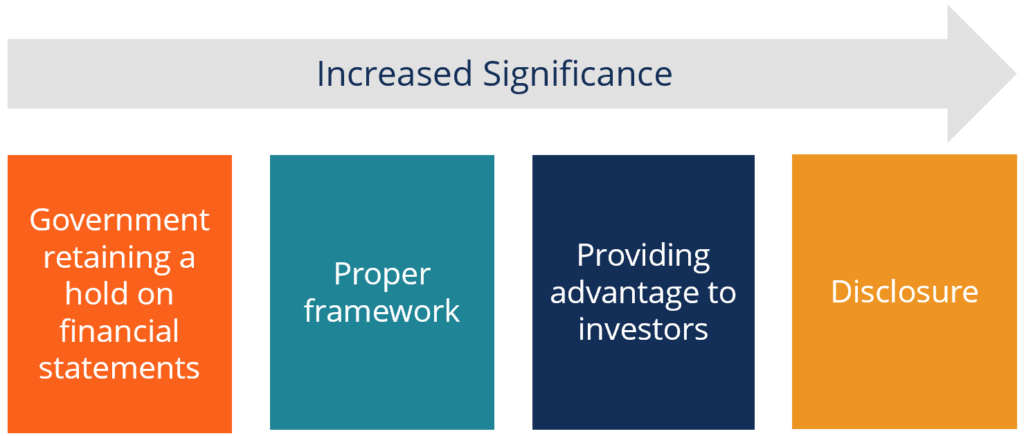
1. Government retaining a hold on financial statements
All companies should follow either the GAAP or IFRS when preparing financial statements. It is a way the government can keep a check on financial statements and simultaneously protect the interests of investors.
2. Proper framework
As mentioned earlier, accounting policies essentially provide companies with a framework to report their financial statements, so they follow a standardized format throughout.
3. Providing advantage to investors
By mentioning to investors that they’ve followed particular accounting policies, investors will gain added confidence in the company and the numbers, and the statements can easily be compared to other companies’ financial statements (as they follow a standardized format).
4. Disclosure
A company must disclose the accounting policies they follow. The policies comprise separate rules on how to disclose information to investors and companies should comply with adequate disclosure requirements.
The diagram below shows the order of significance of accounting policies. Out of the four reasons mentioned above, disclosure is extremely crucial, as it sets the basis for the policies used in preparing the financial statements and allows the investor to analyze and interpret financial statements with confidence.
Real-Life Example of an Accounting Policy
A company can use accounting policies in various ways, and it will provide different outcomes for earnings in a particular year (depending on if the policy is conservative or aggressive).
Taking the example of accounting for inventory, a company can use one of three methods: first-in-first-out (FIFO)First-In First-Out (FIFO)The First-In First-Out (FIFO) method of inventory valuation accounting is based on the practice of having the sale or usage of goods follow, average cost method, or last-in-first-out (LIFO). Under the FIFO method, when a company sells goods, the cost of inventory that is procured first is recorded on its books, whereas for LIFO, the cost of inventory procured most recently is recorded as cost of goods sold.
In the average cost method, the weighted average cost of all inventory on hand is used for the cost of goods sold. In a market where prices are rising, using FIFO is better, as it reduces the cost of goods sold and increases earnings. Therefore, it may be said that FIFO is a more aggressive method than LIFO in this case only.
Assuming a person owns a shirt factory. The retail price of shirts is $50, and he purchases them from a vendor. Last month, he purchased 100 shirts for $10 (until the 15th of the month) and another 100 shirts for $20 (from the 15th to the end of the month). During the month, the person sold 30 shirts. His total sales, regardless of the accounting policy, would be $1,500 ($50 x 30 shirts).
- If he were using the FIFO method, the cost of goods sold for the shirts would be $300 ($10 x 30 shirts) or a net income of $1,200.
- The COGS under LIFO would be $600 ($20 x 30 shirts) or a net income of $900, and under average cost would be $500 (($20 + $10) / 2 x 30 shirts) or a net income of $1,000.
- We can see that the highest net income would be coming from the FIFO method, as the COGS is the lowest.
It helps us understand how a company can use different accounting policies to use its earnings to its benefit.
Related Readings
CFI is the official provider of the Commercial Banking & Credit Analyst (CBCA)™Program Page - CBCAGet CFI's CBCA™ certification and become a Commercial Banking & Credit Analyst. Enroll and advance your career with our certification programs and courses. certification program, designed to transform anyone into a world-class financial analyst.
In order to help you become a world-class financial analyst and advance your career to your fullest potential, these additional resources will be very helpful:
- Audited Financial StatementsAudited Financial StatementsPublic companies are obligated by law to ensure that their financial statements are audited by a registered CPA. The purpose of the
- IFRS vs. US GAAPIFRS vs. US GAAPThe IFRS vs US GAAP refers to two accounting standards and principles adhered to by countries in the world in relation to financial reporting
- Non-GAAP EarningsNon-GAAP EarningsNon-GAAP earnings are earnings measures that do not follow GAAP’s (Generally Accepted Accounting Principles) standard calculations
- Internal vs. External ReportingInternal vs External Financial ReportingInternal vs external financial reporting comes with several differences that every interested party must be aware of. Internal financial
-

Understanding Assurance Services: Risk Reduction & Improved Decisions
Assurance services are an independent examination of a company’s processes and controls. Assurance aims to reduce information risk by improving the quality or context of the information. &n
-

Biological Assets: Definition, Examples & Accounting
Biological Assets are assets that are living – for example, trees, animals, or cannabis. The balance sheetBalance SheetThe balance sheet is one of the three fundamental financial statements. The
Accounting
- Accounting Explained: Understanding Financial Records & Reporting
- Understanding Accounting Income: A Key Financial Metric
- Understanding Accounting Methods: Cash vs. Accrual
- Understanding Accounting Ratios: A Comprehensive Guide
- Understanding Accounting Transactions: A Comprehensive Guide
- Hedge Accounting Explained: A Comprehensive Guide
- Understanding IFRS Standards: A Comprehensive Guide
- Understanding Inflation Accounting: A Guide for Multinational Corporations
- Understanding Journal Entries in Accounting: A Comprehensive Guide
-
 Understanding Accounting Standards: Principles & Importance
An accounting standard is a standardized guiding principle that determines the policies and practices of financial accounting. Accounting standards not only improve the transparency of financial repor...
-
 Understanding Administrative Expenses: A Comprehensive Guide
Administrative expenses refer to the costs incurred by a company or organization that include, but are not limited to, the salaries and benefitsRemunerationRemuneration is any type of compensation or ...