
Biological Assets: Definition, Examples & Accounting
Biological Assets are assets that are living – for example, trees, animals, or cannabis. The balance sheetBalance SheetThe balance sheet is one of the three fundamental financial statements. The financial statements are key to both financial modeling and accounting. breaks down a company’s assetsTypes of AssetsCommon types of assets include current, non-current, physical, intangible, operating, and non-operating. Correctly identifying and at a given point in time, classifying them by type and attributing a value to them. The International Accounting Standard 41 (IAS 41) states that a biological asset is any living plant or animal owned by the business, and they are typically measured at fair value minus selling costs.

For example, livestock such as goats, cows, sheep, pigs, and fish are all considered biological assets. Biological assets also include crops grown by farmers – e.g., corn, tomatoes – as well as grapevines, cannabis, trees, and any produce coming from trees, such as apples.
Cannabis Stocks
Cannabis Stocks have gained increased awareness due to the listing of cannabis companies in public stock exchangesInitial Public Offering (IPO)An Initial Public Offering (IPO) is the first sale of stocks issued by a company to the public. Prior to an IPO, a company is considered a private company, usually with a small number of investors (founders, friends, family, and business investors such as venture capitalists or angel investors). Learn what an IPO is. With shares in the public market, they are required by regulation to periodically release their financial statementsAudited Financial StatementsPublic companies are obligated by law to ensure that their financial statements are audited by a registered CPA. The purpose of the. This has given the general public access to their Income StatementsIncome StatementThe Income Statement is one of a company's core financial statements that shows their profit and loss over a period of time. The profit or, Statements of Financial Position,Balance SheetThe balance sheet is one of the three fundamental financial statements. The financial statements are key to both financial modeling and accounting. and Cash Flow StatementsCash Flow StatementA cash flow Statement contains information on how much cash a company generated and used during a given period..
A significant portion of the current assets owned by these companies is biological assets (cannabis), which is typically their primary resource for profit-generating operations. Below is an example of Canopy Growth Corporation’s balance sheet, and highlighted is their Biological Asset holdings.
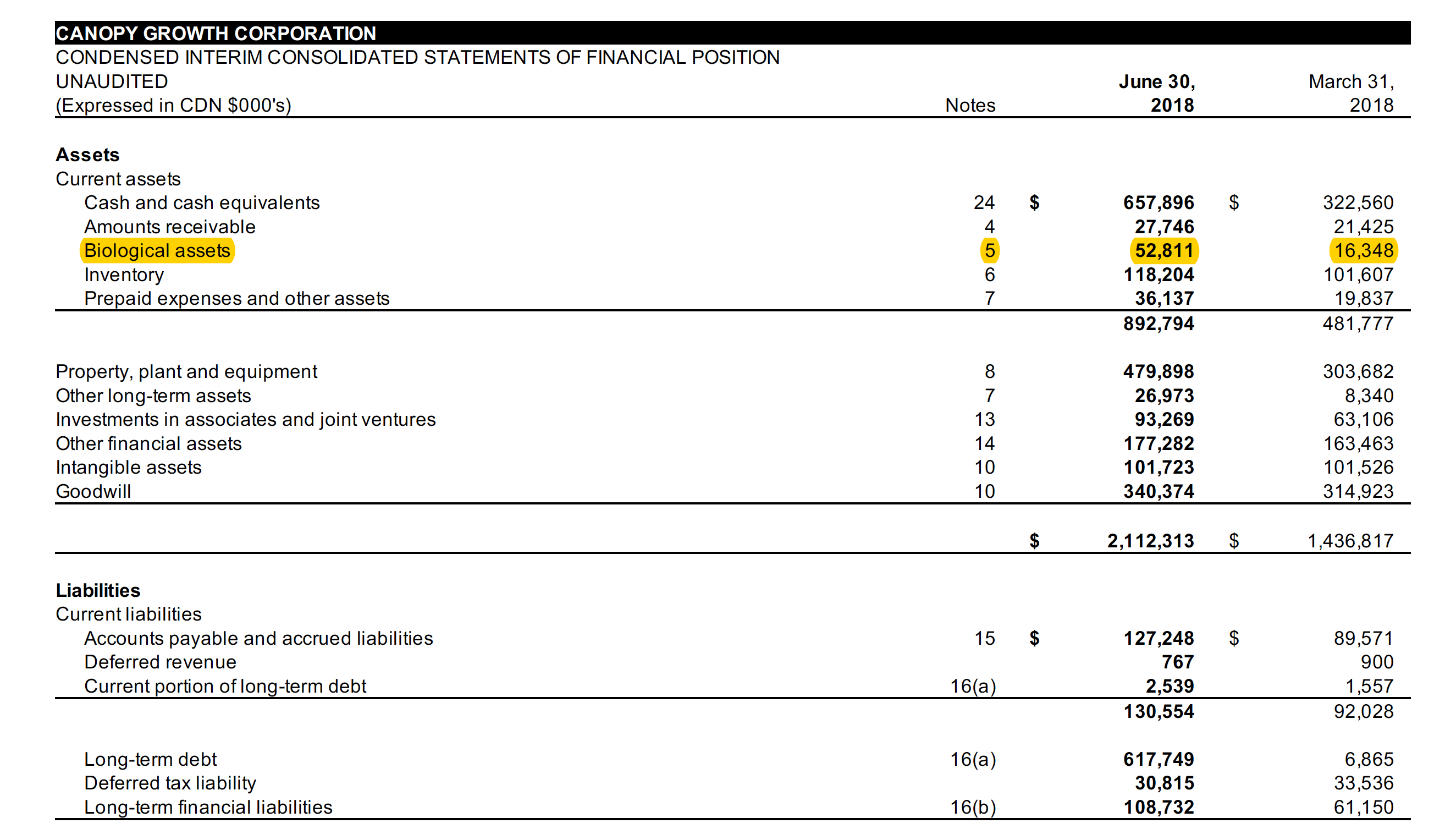
Canopy Growth Corporation Statement of Financial Position
Other Industries that are known for large amounts of biological assets are:
- Paper and Forest Products (Trees)
- Dairy (Cows)
- Agriculture (Crops)
- Meat (Grazing)
- BioFuel (Energy Crops – such as Soybean)
The Nature of Biological Assets
Biological assets can be held and accounted for by any business owner. However, because of their nature, they are, typically, of the utmost importance to farmers or any individuals whose primary source of profit comes from growing, selling, and shipping such goods.
Biological assets, because they are living or have an active component that makes them difficult to maintain, are constantly under the threat of change, both qualitatively and quantitatively. It simply means that plants, animals, and the living things they produce (such as hens producing eggs or cows producing milk) have a period of time where they must grow or be produced, a useful period during which they can be harvested, and a limited amount of time during which they can be moved and sold before they rot, decay, or otherwise become useless to consumers.

The Importance of Biological Assets
Biological assets generate substantial revenue or incomeRevenue vs IncomeRevenue vs income. This guide provides an overview of the main differences between revenue vs income. Revenue is the sales amount a company for businesses in industries such as silviculture, cannabis, vineyards, and livestock, so this asset type is typically seen in the balance sheet of companies in these industries. They are the same as the goods produced by other companies that manufacture items made of plastic, paper, or other materials in terms of generating revenue for the seller and accounting for loss if the goods are damaged or stolen. The only qualitative difference is that the asset is living.
Biological assets change and depreciateDepreciation MethodsThe most common types of depreciation methods include straight-line, double declining balance, units of production, and sum of years digits. naturally and more rapidly than other types of goods. Different types of biological assets, much like other goods, can be in high or low demand, depending on the season. Recently there has been a surge in the demand for cannabis. They can also be lost or damaged, with the loss or damage usually due to things like unexpected periods of rain or drought, cold weather, or the spread of a disease that wipes out crops and/or livestock.
It’s important to note that the term “biological asset” is unique to the field of accountingAccountingAccounting is a term that describes the process of consolidating financial information to make it clear and understandable for all for the purpose of clearly categorizing and identifying assets owned by businesses, such as farms and vineyards, or produce that is a primary source of the company’s income.Annual IncomeAnnual income is the total value of income earned during a fiscal year. Gross annual income refers to all earnings before any deductions are Businesses in various industries and sectors can raise plants and animals for a variety of reasons; classifying them as biological assets denote their nature and their value to the business owner.
Additional Resources
CFI is the official provider of the global Financial Modeling & Valuation Analyst (FMVA)®Become a Certified Financial Modeling & Valuation Analyst (FMVA)®CFI's Financial Modeling and Valuation Analyst (FMVA)® certification will help you gain the confidence you need in your finance career. Enroll today! certification program, designed to help anyone become a world-class financial analyst. The following CFI resources will be helpful in furthering your financial education:
- Accounting Fundamentals
- Balance Sheet Balance SheetThe balance sheet is one of the three fundamental financial statements. The financial statements are key to both financial modeling and accounting.
- Types of AssetsTypes of AssetsCommon types of assets include current, non-current, physical, intangible, operating, and non-operating. Correctly identifying and
- Excel Financial Modeling Fundamentals
-
Understanding Redundant Assets: Definition & Impact on Business
Redundant assets are assets that generate incomeOperating IncomeOperating income is the amount of revenue left after deducting the operational direct and indirect costs from sales revenue. for the bus
-
Risk-Weighted Assets (RWA): A Comprehensive Guide for Finance Professionals
Risk-weighted assets is a banking term that refers to an asset classification system that is used to determine the minimum capital that banks should keep as a reserve to reduce the risk of insolvency.
Accounting
- Investable Assets: A Comprehensive Guide for Investors
- Understanding Household Assets: A Comprehensive Guide
- Fixed Assets: Definition, Examples & Importance for Businesses
- Monetary Assets: Definition, Examples & Key Characteristics
- Understanding Non-Monetary Assets: Definition & Examples
- Understanding Quick Assets: Definition & Examples
- Understanding Hard Assets: Definition, Examples & Investment
- Understanding Financial Assets: Definitions & Types
- Understanding Intangible Assets: Definition & Importance
-
 Net Liquid Assets: Definition, Calculation & Importance
Net liquid assets is a term used to define the immediate liquidity position of a company. It is calculated as the difference between liquid assets and current liabilitiesCurrent LiabilitiesCurrent lia...
-
 Non-Operating Assets: Definition, Examples & Financial Impact
Non-operating assets are assets that are not required in the normal operations of a business but that can generate income nonetheless. The assets are recorded in the balance sheetBalance SheetThe bala...