
Accrued Liabilities: Definition, Accounting & Balance Sheet Impact
An accrued liability represents an expense a business has incurred during a specific period but has yet to be billed for. Accrued liabilities are only reported under accrual accountingAccrual PrincipleThe accrual principle is an accounting concept that requires transactions to be recorded in the time period in which they occur, regardless of to represent the performance of a company regardless of their cash position. They appear on the balance sheet under current liabilities.

Summary
- An accrued liability represents an expense a business has incurred during a specific period but has yet to be billed for.
- There are two types of accrued liabilities: routine/recurring and infrequent/non-routine.
- Examples of accrued liabilities include accrued interest expense, accrued wages, and accrued services.
Understanding Accrued Liability
Accrued liabilities are expenses that have yet to be paid for by a company. They are recorded to better represent the financial position of the company regardless if a cash transaction has occurred.
Recording accrued liabilities is part of the matching accounting principleMatching PrincipleThe matching principle is an accounting concept that dictates that companies report expenses at the same time as the revenues they are related. Under the matching principle, all expenses need to be recorded in the period they are incurred to accurately reflect financial performance.
When an accrued liability is paid for, the balance sheet side is reversed, leaving a net zero effect on the account. Accrued liabilities can also be thought of as the opposite of prepaid expenses.
Accrued Liabilities – Types
There are two types of accrued liabilities: routine or recurring and infrequent or non-routine.
1. Routine/Recurring
Routine/Recurring occurs as a normal operational expense of the business. An example would be accrued wages, as a company knows they have to periodically pay their employees.
2. Infrequent/Non-Routine
Infrequent/Non-Routine is the opposite and does not occur as a normal operational part of the business. An example is a one-off purchase from a supplier where a bill is not immediately received. As the event isn’t recurring, it is considered an infrequent/non-routine accrued liability.
Accrued Liabilities vs. Accounts Payable
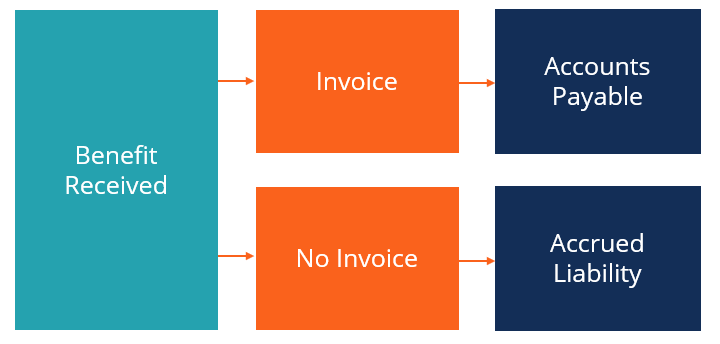
Accrued liabilities and accounts payable are both current liabilities. However, the difference between them is that accrued liabilities have not been billed, while accounts payableAccounts PayableAccounts payable is a liability incurred when an organization receives goods or services from its suppliers on credit. Accounts payables are have. Accrued liabilities may not have been billed either because they are a regular expense that doesn’t require billing (i.e., payroll), or because the company hasn’t received a bill from the supplier.
For example, if a company has received a shipment from a supplier and has yet to receive a bill, they will record an accrued liability. However, if they were to receive the shipment and the bill before the end of the period, they would record an accounts payable.
Journal Entry
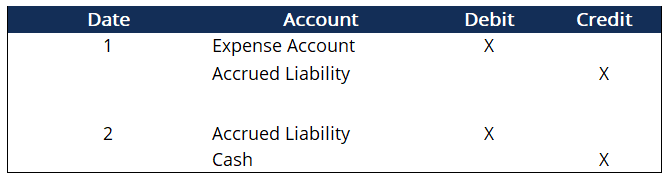
The journal entry is typically a credit to accrued liabilities and a debit to the corresponding expense account. Once the payment is made, accrued liabilities are debited, and cash is credited. At such a point, the accrued liability account will be completely removed from the books.
Accrued Liabilities – Examples
- Accrued interest expense: When a company owes interest on a loan but has yet to be billed by the lender.
- Accrued wages: Employees have not been paid for work completed because their payroll period falls after the reporting date.
- Accrued services: A supplier has provided a service but has yet to bill the customer
Practical Example
Company ABC has received product from their supplier on December 31st, costing $500. However, the supplier has yet to bill them. They receive the bill on January 10th and pay the same day.

Above are the journal entries for December 31st and January 10th. As you can see, the accrued liabilities account is net zero following the payment. The net effect on financial statements is an increase in the expense account and a decrease in the cash account. The purpose of accrued liabilities is to create a timeline of financial events.
Related Readings
CFI offers the Commercial Banking & Credit Analyst (CBCA)™Program Page - CBCAGet CFI's CBCA™ certification and become a Commercial Banking & Credit Analyst. Enroll and advance your career with our certification programs and courses. certification program for those looking to take their careers to the next level. To keep learning and advancing your career, the following resources will be helpful:
- Philosophy of AccountingPhilosophy of AccountingThe philosophy of accounting encompasses the general rules, concepts, and ideas surrounding the preparation and auditing of the accounts and
- Types of LiabilitiesTypes of LiabilitiesThere are three primary types of liabilities: current, non-current, and contingent liabilities. Liabilities are legal obligations or debt
- Projecting Balance Sheet Line ItemsProjecting Balance Sheet Line ItemsProjecting balance sheet line items involves analyzing working capital, PP&E, debt share capital and net income. This guide breaks down how to calculate
- Current LiabilitiesCurrent LiabilitiesCurrent liabilities are financial obligations of a business entity that are due and payable within a year. A company shows these on the
-

Understanding Liability Car Insurance: Coverage & Protection
Car insurance protects the owner of a vehicle against losses and damages related to owning and operating the vehicle. There are several different types of auto insurance such collision insurance, comp
-
Professional Liability Insurance Agents: Protecting Professionals from Lawsuits
A professional liability insurance agent is in the business of offering safety for professionals so they can carry on with their business without worries. An agent can help professions provide th
Accounting
- Accrued vs. Regular Interest: Understanding the Difference
- Understanding Liabilities: A Comprehensive Guide for Businesses
- Accrued Income Explained: Definition & Accounting
- Accrued Interest Explained: Accounting & Financial Definition
- Accrued Revenue: Definition, Examples & Accounting Explained
- Contingent Liabilities: Definition, Accounting & Examples
- Understanding Current Liabilities: Definition & Examples
- Understanding Non-Current Liabilities: Definition & Significance
- Accrued Liability: Definition, Examples & Accounting
-
 Liability-Only Car Insurance: What It Is & When It's Right
On car insurance policies, there are multiple sections and levels of coverage for a consumer to purchase. The different sections dictate which party is paid for damages, and the limits of coverage ava...
-
 Understanding Limited Liability Companies (LLCs): A Comprehensive Guide
A limited liability company (LLC) is a business structure for private companiesPrivately Held CompanyA privately held company is a company’s whose shares are owned by individuals or corporations...