
Understanding Limited Liability Companies (LLCs): A Comprehensive Guide
A limited liability company (LLC) is a business structure for private companiesPrivately Held CompanyA privately held company is a company’s whose shares are owned by individuals or corporations and that does not offer equity interests to investors in the form of stock shares traded on a public stock exchange. in the United States, one that combines aspects of partnershipsGeneral PartnershipA General Partnership (GP) is an agreement between partners to establish and run a business together. It is one of the most common legal entities to form a business. All partners in a general partnership are responsible for the business and are subject to unlimited liability for business debts. and corporations.CorporationA corporation is a legal entity created by individuals, stockholders, or shareholders, with the purpose of operating for profit. Corporations are allowed to enter into contracts, sue and be sued, own assets, remit federal and state taxes, and borrow money from financial institutions. Limited liability companies benefit from the flexibility and flow-through taxation of partnerships and sole proprietorships,ProprietorProprietor means to have ownership of something. Sole proprietorship is the simplest form of business where one person owns the business. while maintaining the limited liability status of corporations.
If you’re looking to start a company, make sure to check out CFI’s introduction to corporate finance course!

Advantages of an LLC
Limited liability companies offer flexibility and protection. This makes the corporate structure appealing to business owners. Rather than shareholders,Stakeholder vs. ShareholderThe terms “stakeholder” and “shareholder” are often used interchangeably in the business environment. Looking closely at the meanings of stakeholder vs shareholder, there are key differences in usage. Generally, a shareholder is a stakeholder of the company while a stakeholder is not necessarily a shareholder. business owners of limited liability companies are referred to as members.
1. Flexibility
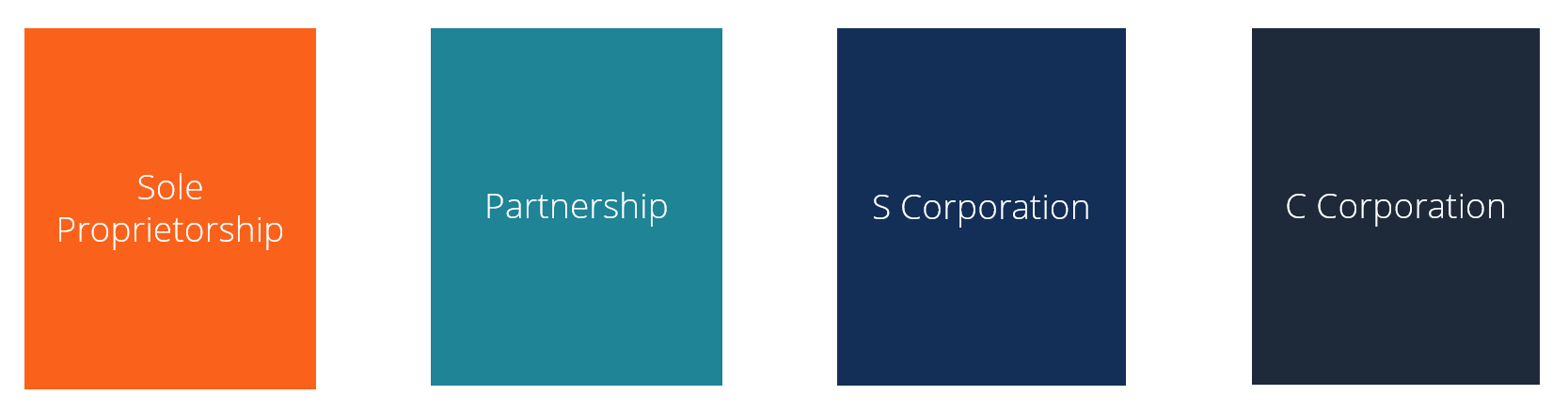
An LLC can choose between different tax treatments. They can choose to adopt the tax regime of sole proprietorships, partnerships, S corporations, or C corporations. This provides the company with the option of being treated as a flow-through entity, so long as it does not choose to be treated as a C corporation.
The income of a flow-through entity is treated as the income of its owners. That means that owners of an LLC are able to avoid double taxation. With double taxation, income gets taxed both at the corporate level and also when distributed as dividendsDividendA dividend is a share of profits and retained earnings that a company pays out to its shareholders. When a company generates a profit and accumulates retained earnings, those earnings can be either reinvested in the business or paid out to shareholders as a dividend. to owners. With an LLC, income is only taxed at an individual member level, rather than at the company level.
If the company chooses to be taxed as a partnership, its income can be allocated across members in forms other than ownership percentage. Members agree upon this in the operating agreement.
The operating agreement of the company acts in a way similar to the bylaws of a corporation. Below is a comparison of terms between an LLC and a corporation:
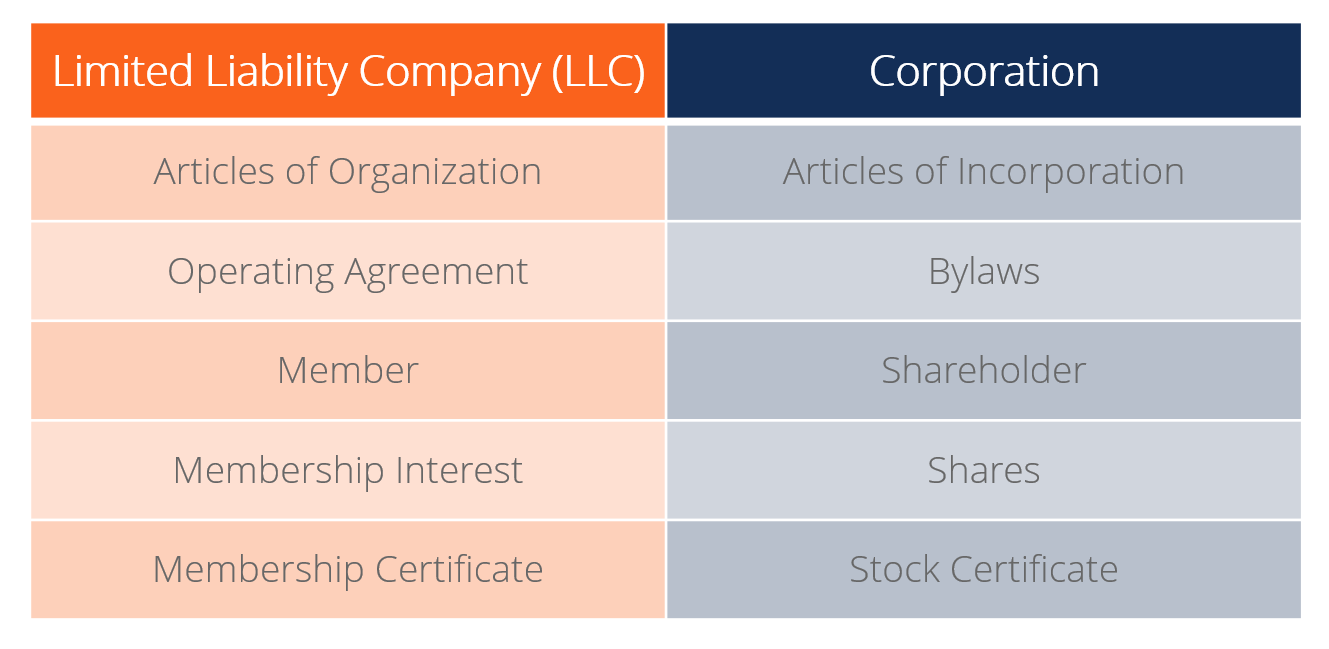
The document governs the company’s finances, organization, structure, and operations. Unlike corporations that are required to appoint officers or a board of directorsBoard of DirectorsA board of directors is a panel of people elected to represent shareholders. Every public company is required to install a board of directors., an LLC is more flexible with its management structuresCorporate StructureCorporate structure refers to the organization of different departments or business units within a company. Depending on a company’s goals and the industry. This, too, is decided on and stated in the operating agreement.
2. Protection
Limited liability companies additionally benefit from the advantages of corporations. The largest benefit is the company’s limited liability status. The company exists as its own legal entity. This protects members and owners from being held personally liable for the operations and debts of the business.
A simple example would be if an employee of the company is found conducting illegal environmental activities. Legal action can be threatened against the company to pay for damages. The court can go after the assets of the firm, but not the owners, to pay for the damages. The exception would be if the owner was aware of the illegal activities and continually allowed them to happen.
Disadvantages of an LLC
The main disadvantages of limited liability companies are the fees and taxes associated with the business structure. However, as LLCs are governed differently by each state, regulations also become a disadvantage.
1. Fees and Taxes
Though owners of a limited liability company benefit by avoiding double-taxation, they are required to pay self-employment taxes. These taxes are paid twice as the owner is both the employee and the employer.
Some states also demand an annual fee for the limited liability benefits that LLCs provide their members. This fee is sometimes referred to as a franchise tax. For example, the state of California charges an $800 annual fee that increases with net incomeNet IncomeNet Income is a key line item, not only in the income statement, but in all three core financial statements. While it is arrived at through for limited liability companies.
2. Regulations
As mentioned previously, an LLC is governed by state law, which can drastically change how the company behaves in different scenarios. As an example, when a member of the limited liability company passes away, some states may dissolve the company. In other states, the company will continue to exist and the deceased member’s membership shares are passed to their executor.
These cases show the default resolutions set by the state. Members of an LLC can decide how they want the company to proceed in situations such as the above, and note it in the operating agreement. As you can see, the operating agreement is a critical document that members should not ignore when creating the company.
It is also important to consider how the company might function in international markets. For example, an American LLC is likely to be treated as a corporation in Canada, as the distinction between the two is not recognized in Canada.
Additional Resources
Looking into starting a business? Corporate Finance Institute offers other resources that will help you expand your knowledge and achieve your goals. Check out the CFI links below:
- Financial Analysis Fundamentals
- Corporate & Business Strategy
- Startup / e-Commerce Financial Model & Valuation Course
- Budgeting and Forecasting
-

Competitive Advantage: Definition & Key Metrics for Business Success
A competitive advantage is an attribute that enables a company to outperform its competitors. This allows a company to achieve superior marginsOperating MarginOperating margin is equal to operating in
-
![Corporate Actions: Definition, Types & Impact | [Your Company Name]](https://www.etffin.com/article/uploadfiles/202110/2021100815410257_S.jpeg)
Corporate Actions: Definition, Types & Impact | [Your Company Name]
A corporate action is a move – enacted by a publicly-traded company – that encourages or furthers processes that have a direct impact on whatever assets the company issues. In other words,
Business strategy
- Divestiture Explained: Definition, Types & Examples
- Bootstrapping: How to Build a Business with Minimal Funding
- Business Operations: Definition, Activities & Optimization
- Business Plan: Definition, Importance & Funding Options
- Understanding Business Structures: A Comprehensive Guide
- Family Limited Partnerships (FLPs): A Comprehensive Guide
- Strategic Management: Definition, Objectives & Implementation
- Understanding Business Structures: A Comprehensive Guide
- Unlimited Liability: Understanding Risks & Protection
-
 Understanding Associate Companies: Definition & Ownership
An associate company, also known as an affiliate company, is a company in which a notable portion of shares is owned by a parent company. The portion usually lies between 20% and 50%. Ownership of hig...
-
 Business Strategy vs. Business Model: Understanding the Difference
Setting up and successfully running a business involves differentiating between business strategy vs business model. To reach their goals and achieve success, owners need to adopt the right strategy f...