
Understanding Liabilities: A Comprehensive Guide for Businesses
A liability is a financial obligation of a company that results in the company’s future sacrifices of economic benefits to other entities or businesses. A liability can be an alternative to equity as a source of a company’s financing. Moreover, some liabilities, such as accounts payableAccounts PayableAccounts payable is a liability incurred when an organization receives goods or services from its suppliers on credit. Accounts payables are or income taxes payable, are essential parts of day-to-day business operations.
Liabilities can help companies organize successful business operations and accelerate value creation. However, poor management of liabilities may result in significant negative consequences, such as a decline in financial performance or, worse, bankruptcyBankruptcyBankruptcy is the legal status of a human or a non-human entity (a firm or a government agency) that is unable to repay its outstanding debts.
In addition, liabilities determine the company’s liquidity and capital structureCapital StructureCapital structure refers to the amount of debt and/or equity employed by a firm to fund its operations and finance its assets. A firm's capital structure.
Accounting Reporting of Liabilities
A company reports its liabilities on its balance sheet. According to the accounting equation, the total amount of the liabilities must be equal to the difference between the total amount of the assets and the total amount of the equity.
Assets = Liabilities + Equity
Liabilities = Assets – Equity
Liabilities must be reported according to the accepted accounting principles. The most common accounting standards are the International Financial Reporting Standards (IFRS). The standards are adopted by many countries around the world. However, many countries also follow their own reporting standards such as the GAAPGAAPGAAP, Generally Accepted Accounting Principles, is a recognized set of rules and procedures that govern corporate accounting and financial in the U.S. or the RAP in Russia. Although the recognition and reporting of the liabilities comply with different accounting standards, the main principles are close to the IFRS.
On a balance sheet, liabilities are listed according to the time when the obligation is due.
Current Liabilities vs. Long-term Liabilities
The primary classification of liabilities is according to their due date. The classification is critical to the company’s management of its financial obligations.
Current liabilities are those that are due within a year. These primarily occur as part of regular business operations. Due to the short-term nature of these financial obligations, they should be managed with consideration of the company’s liquidity. Liquidity is frequently determined as a ratio between current assets and current liabilities. The most common current liabilities are:
- Accounts payable: Accounts PayableAccounts payable is a liability incurred when an organization receives goods or services from its suppliers on credit. Accounts payables areThese are the unpaid bills to the company’s vendors. Generally, accounts payable are the largest current liability for most businesses.
- Interest payable:Interest PayableInterest Payable is a liability account shown on a company’s balance sheet that represents the amount of interest expense that has accrued Interest expenses that have already occurred but have not been paid. Interest payable should not be confused with the interest expenses. Unlike interest payable, interest expenses are expenses that have already been incurred and paid. Therefore, interest expenses are reported on the income statement, while interest payable is recorded on the balance sheet.
- Income taxes payable: The income tax amount owed by a company to the government. The tax amount owed must be payable within one year. Otherwise, the tax owed must be classified as a long-term liability.
- Bank account overdrafts: A type of short-term loan provided by a bank when the payment is processed with insufficient funds available in the bank account.
- Accrued expenses: Accrued ExpensesAccrued expenses are expenses that are recognized even though cash has not been paid. They are usually paired up against revenue via the matching principleExpenses that have incurred but no supporting documentation (e.g., invoice) has been received or issued.
- Short-term loans: Loans with a maturity of one year or less.
Long-term Liabilities
Long-term (non-current) liabilities are those that are due after more than one year. It is important that the long-term liabilities exclude the amounts that are due in the short-term, such as interest payable.
Long-term liabilities can be a source of financing, as well as refer to amounts that arise from business operations. For example, bonds or mortgages can be used to finance the company’s projects that require a large amount of financing. Liabilities are critical to understanding the overall liquidity and capital structure of a company.
Long-term liabilities include:
- Bonds payable: Bond PayablesBonds payable are generated when a company issues bonds to generate cash. Bonds payable refers to the amortized amount that a bond issuerThe amount of outstanding bonds with a maturity of over one year issued by a company. On a balance sheet, the bonds payable account indicates the face value of the company’s outstanding bonds.
- Notes payable:Notes PayableNotes payable are written agreements (promissory notes) in which one party agrees to pay the other party a certain amount of cash. The amount of promissory notes with a maturity of over one year issued by a company. Similar to bonds payable, the notes payable account on a balance sheet indicates the face value of the promissory notes.
- Deferred tax liabilities:Deferred Tax Liability/AssetA deferred tax liability or asset is created when there are temporary differences between book tax and actual income tax. They arise from the difference between the recognized tax amount and the actual tax amount paid to the authorities. Essentially, it means that the company “underpays” the taxes in the current period and will “overpay” the taxes at some point in the future.
- Mortgage payable/long-term debt: Long Term DebtLong Term Debt (LTD) is any amount of outstanding debt a company holds that has a maturity of 12 months or longer. It is classified as a non-current liability on the company’s balance sheet. The time to maturity for LTD can range anywhere from 12 months to 30+ years and the types of debt can include bonds, mortgagesIf a company takes out a mortgage or a long-term debt, it records the face value of the borrowed principal amount as a non-current liability on the balance sheet.
- Capital lease:Capital Lease vs Operating LeaseThe difference between a capital lease vs operating lease - A capital lease (or finance lease) is treated like an asset on a company’s Capital leases are recognized as a liability when a company enters into a long-term rental agreement for equipment. The capital lease amount is a present value of the rental’s obligation.
Contingent Liabilities
Contingent liabilities are a special category of liabilities. They are probable liabilities that may or may not arise, depending on the outcome of an uncertain future event.
A contingent liability is recognized only if both of the following conditions are met:
- The outcome is probable.
- The liability amount can be reasonably estimated.
If one of the conditions is not satisfied, a company does not report a contingent liability on the balance sheet. However, it should disclose this item in a footnote on the financial statements.
One of the most common examples of contingent liabilities is legal liabilities. Suppose that a company is involved in litigation. Due to the stronger evidence provided by the opposite party, the company expects to lose the case in court, which will result in legal expenses. The legal expenses may be recognized as contingent liabilities because:
- The expenses are probable.
- The legal expenses can be reasonably estimated (based on the remedies asked by the opposite party).
Related Readings
Thank you for reading CFI’s explanation of Liability. CFI is the official provider of the global Financial Modeling & Valuation Analyst (FMVA)™Become a Certified Financial Modeling & Valuation Analyst (FMVA)®CFI's Financial Modeling and Valuation Analyst (FMVA)® certification will help you gain the confidence you need in your finance career. Enroll today! certification program, designed to help anyone become a world-class financial analyst. To keep advancing your career, the additional CFI resources below will be useful:
- Accrued ExpensesAccrued ExpensesAccrued expenses are expenses that are recognized even though cash has not been paid. They are usually paired up against revenue via the matching principle
- Financial Accounting TheoryFinancial Accounting TheoryFinancial Accounting Theory explains the why behind accounting - the reasons why transactions are reported in certain ways. This guide will
- Notes PayableNotes PayableNotes payable are written agreements (promissory notes) in which one party agrees to pay the other party a certain amount of cash.
- Projecting Balance Sheet ItemsProjecting Balance Sheet Line ItemsProjecting balance sheet line items involves analyzing working capital, PP&E, debt share capital and net income. This guide breaks down how to calculate
-

Understanding Limited Liability Companies (LLCs): A Comprehensive Guide
A limited liability company (LLC) is a business structure for private companiesPrivately Held CompanyA privately held company is a company’s whose shares are owned by individuals or corporations
-

Professional Liability Insurance Agents: Protecting Professionals from Lawsuits
A professional liability insurance agent is in the business of offering safety for professionals so they can carry on with their business without worries. An agent can help professions provide th
finance
- Accounts Payable (AP): Definition, Function & Importance
- Understanding Income Tax Payable: A Guide for Businesses
- Accrued Liabilities: Definition, Accounting & Balance Sheet Impact
- Contingent Liabilities: Definition, Accounting & Examples
- Understanding Current Liabilities: Definition & Examples
- Interest Payable: Definition, Calculation & Importance
- Understanding Non-Current Liabilities: Definition & Significance
- Understanding Notes Payable: A Comprehensive Guide
- Accrued Liability: Definition, Examples & Accounting
-
 Understanding Days Payable Outstanding (DPO): A Key Metric
Days Payable Outstanding (DPO) refers to the average number of days it takes a company to pay back its accounts payableAccounts PayableAccounts payable is a liability incurred when an organization rec...
-
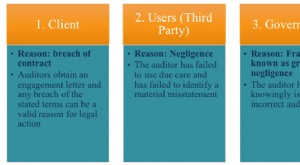 Auditor Legal Liability: Understanding Risks and Responsibilities
Concerns about the legal liability of auditors continue to grow every day. Auditors are highly important people because, ultimately, they are responsible for enhancing the reliability of fin...