
Contingent Liabilities: Definition, Accounting & Examples
A contingent liability is a potential liability that may or may not occur, depending on the result of an uncertain future event. The relevance of a contingent liability depends on the probability of the contingency becoming an actual liability, its timing, and the accuracy with which the amount associated with it can be estimated.

A contingent liability is recorded in the accounting recordsThree Financial StatementsThe three financial statements are the income statement, the balance sheet, and the statement of cash flows. These three core statements are if the contingency is probable and the related amount can be estimated with a reasonable level of accuracy. The most common example of a contingent liability is a product warranty. Other examples include guarantees on debtsCost of DebtThe cost of debt is the return that a company provides to its debtholders and creditors. Cost of debt is used in WACC calculations for valuation analysis., liquidated damages, outstanding lawsuitsTop Accounting ScandalsThe last two decades saw some of the worst accounting scandals in history. Billions of dollars were lost as a result of these financial disasters. In this, and government probes.
Why is a Contingent Liability Recorded?
Both GAAP (Generally Accepted Accounting Principles) and IFRSIFRS StandardsIFRS standards are International Financial Reporting Standards (IFRS) that consist of a set of accounting rules that determine how transactions and other accounting events are required to be reported in financial statements. They are designed to maintain credibility and transparency in the financial world (International Financial Reporting Standards) require companies to record contingent liabilities, due to their connection with three important accounting principles.
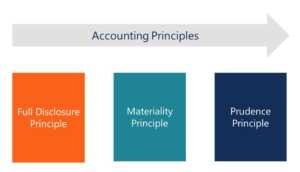
1. Full Disclosure Principle
According to the full disclosure principle, all significant, relevant facts related to the financial performance and fundamentals of a company should be disclosed in the financial statements.
A contingent liability threatens to reduce the company’s assets and net profitability and, thus, comes with the potential to negatively impact the financial performanceAnalysis of Financial StatementsHow to perform Analysis of Financial Statements. This guide will teach you to perform financial statement analysis of the income statement, and health of a company. Therefore, such circumstances or situations must be disclosed in a company’s financial statements, per the full disclosure principle.
2. Materiality Principle
The materiality principle states that all important financial information and matters need to be disclosed in the financial statementsThree Financial StatementsThe three financial statements are the income statement, the balance sheet, and the statement of cash flows. These three core statements are. An item is considered material if the knowledge of it could change the economic decision of users of the company’s financial statements.
In this context, the term “material” is basically synonymous with “significant.” A contingent liability can negatively impact a company’s financial performance and health; clearly, the knowledge of it might influence the decision-making of different users of the company’s financial statements.
3. Prudence Principle
Prudence is a key accounting concept that makes sure that assets and income are not overstated, and liabilities and expenses are not understated. Since the outcome of contingent liabilities cannot be known for certain, the probability of the occurrence of the contingent event is estimated and, if it is greater than 50%, then a liability and a corresponding expense are recorded. The recording of contingent liabilities prevents the understating of liabilities and expenses.
Using Knowledge of a Contingent Liability in Investing
Since a contingent liability can potentially reduce a company’s assets and negatively impact a company’s future net profitability and cash flow, knowledge of a contingent liability can influence the decision of an investor.
An investor buys stock shares in a company to gain a future share of its profits. Since a contingent liability may reduce a company’s ability to generate profits, the knowledge of it can dissuade an investor from investing in the company, depending on the nature of the contingency and the amount associated with it.
Similarly, the knowledge of a contingent liability can influence the decision of creditors considering lending capital to a company. The contingent liability may arise and negatively impact the ability of the company to repay its debt.
Impact of Contingent Liabilities on Share Price
Contingent liabilities are likely to have a negative impact on a company’s share price, as they threaten to negatively impact the company’s ability to generate future profits. The magnitude of the impact on the share price depends on the likelihood of a contingent liability actually arising and the amount associated with it. Due to the uncertain nature of contingent liabilities, it is difficult to estimate and quantify the exact impact that they might have on a company’s share price.
The level of impact also depends on how financially sound the company is. If investors believe that the company is in such a solid financial situation that it can easily absorb any losses that may arise from the contingent liability, then they may choose to invest in the company even if it appears likely that the contingent liability becomes an actual liability.
A contingent liability, unless very large, will not affect a company’s share price in a major way if the company maintains a strong cash flow position and is rapidly growing earnings. The nature of the contingent liability and the associated risk play an important role.
A contingent liability that is expected to be settled in the near future is more likely to impact a company’s share price than one that is not expected to be settled for several years. Often, the longer the span of time it takes for a contingent liability to be settled, the less likely that it will become an actual liability.
Recording
Per GAAP, contingent liabilities can be broken down into three categories based on the likelihood of occurrence. The first category is the “high probability” contingency, which means that the probability of the liability arising is greater than 50% and the amount associated with it can be estimated with reasonable accuracy. Such events are recorded as an expense on the income statement and a liability on the balance sheet.
A “medium probability” contingency is one that satisfies either, but not both, of the parameters of a high probability contingency. These liabilities must be disclosed in the footnotes of the financial statements if either of the two criteria is true.
Contingent liabilities that do not fall into the categories mentioned above are considered “low probability.” The likelihood of a cost arising due to these liabilities is extremely low and, therefore, accountants are not required to report them in the financial statements. However, sometimes companies put in a disclosure of such liabilities anyway.
Incorporating Contingent Liabilities in a Financial Model
Modeling contingent liabilities can be a tricky concept due to the level of subjectivity involved. The opinions of analysts are divided in relation to modeling contingent liabilities.
As a general guideline, the impact of contingent liabilities on cash flow should be incorporated in a financial model if the probability of the contingent liability turning into an actual liability is greater than 50%. In some cases, an analyst might show two scenarios in a financial model, one which incorporates the cash flow impact of contingent liabilities and another which does not.
Launch our financial modeling courses to learn more!
Summary
The accounting of contingent liabilities is a very subjective topic and requires sound professional judgment. Contingent liabilities can be a tricky concept for a company’s management, as well as for investors. Judicious use of a wide variety of techniques for the valuation of liabilities and risk weighting may be required in large companies with multiple lines of business.
Sophisticated analyses include techniques like options pricing methodology, expected loss estimation, and risk simulations of the impacts of changed macroeconomic conditions.
Contingent liabilities should be analyzed with a serious and skeptical eye, since, depending on the specific situation, they can sometimes cost a company several millions of dollars. Sometimes contingent liabilities can arise suddenly and be completely unforeseen. The $4.3 billion liability for Volkswagen related to its 2015 emissions scandal is one such contingent liability example.
Related Readings
CFI offers the Commercial Banking & Credit Analyst (CBCA)™Program Page - CBCAGet CFI's CBCA™ certification and become a Commercial Banking & Credit Analyst. Enroll and advance your career with our certification programs and courses. certification program for those looking to take their careers to the next level. To understand more about the concept of liabilities in business accounting, see the following CFI resources:
- Current LiabilitiesCurrent LiabilitiesCurrent liabilities are financial obligations of a business entity that are due and payable within a year. A company shows these on the
- Current Portion of Long-Term DebtCurrent Portion of Long-Term DebtThe current portion of long-term debt is the portion of long-term debt due that is due within a year’s time. Long-term debt has a maturity of
- Accounting CycleAccounting CycleThe accounting cycle is the holistic process of recording and processing all financial transactions of a company, from when the transaction
- Analysis of Financial StatementsAnalysis of Financial StatementsHow to perform Analysis of Financial Statements. This guide will teach you to perform financial statement analysis of the income statement,
-

Comprehensive Financial Planning: Your Path to Financial Security
A financial plan is a document that covers an individual’s current financial situation, short-term and long-term economic goals, and an in-depth strategy to achieve the goals. A finan
-

Understanding Financial Systems: Institutions & Key Players
A financial system is a network of financial institutions – such as insurance companies, stock exchanges, and investment banksList of Top Investment BanksList of the top 100 investment banks in
Accounting
- Contingent Claims Explained: Understanding Debt in Bankruptcy
- Understanding Financial Hardship: Causes, Impacts & Relief
- Understanding Auditors: Roles, Responsibilities & Audit Processes
- EBITDARM Explained: A Comprehensive Guide to Financial Analysis
- Eurocurrency Explained: What It Is & How It Works
- Accounting Explained: Understanding Financial Records & Reporting
- Understanding Financial Audits: A Comprehensive Guide
- Understanding Finance: A Comprehensive Overview
- Auditor Legal Liability: Understanding Risks and Responsibilities
-
 Financial Mathematics: Applications & Quantitative Finance Explained
Financial mathematics describes the application of mathematics and mathematical modeling to solve financial problems. it is sometimes referred to as quantitative financeQuantitative FinanceQuantitativ...
-
 Understanding Financial Performance: A Comprehensive Overview
Financial performance is a complete evaluation of a company’s overall standing in categories such as assets, liabilities, equity, expenses, revenue, and overall profitability. It is measured thr...