
Understanding Gross Annual Income: Definition & Calculation
Annual income is the total value of income earned during a fiscal yearFiscal Year (FY)A fiscal year (FY) is a 12-month or 52-week period of time used by governments and businesses for accounting purposes to formulate annual. Gross annual income refers to all earningsEarnings Before Tax (EBT)Earnings before tax, or pre-tax income, is the last subtotal found in the income statement before the net income line item. EBT is found before any deductions are made, and net annual incomeNet IncomeNet Income is a key line item, not only in the income statement, but in all three core financial statements. While it is arrived at through refers to the amount that remains after all deductions are made. The concept applies to both individuals and businesses in preparing annual tax returns.

Learn more in CFI’s Free Accounting & Finance Courses.
Hourly, Daily, Weekly, Monthly Income Conversion
You can easily convert your hourly, daily, weekly, or monthly income to an annual figure by using some simple formulas shown below.
To convert to annual income:
- Hourly: Multiply by 2,000
- Daily: Multiply by 200
- Weekly: Multiply by 50
- Monthly: Multiply by 12
Below, we will show an example of how to move between the time periodsCalendarizationThe process of standardizing financial statements is called calendarization. To make comparable companies “equal,” the financial data of each company.
Example of Annual Income Calculator
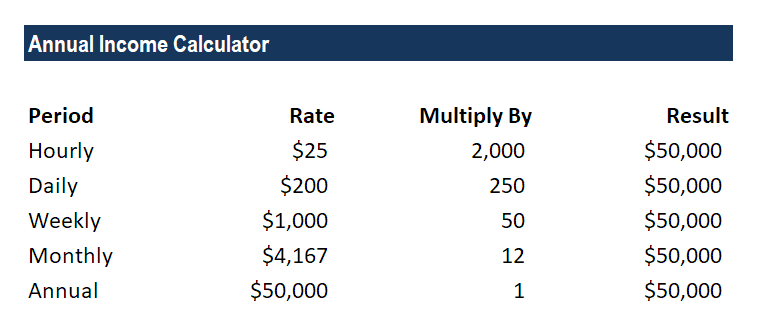
Let’s work through how to calculate the yearly figure by using a simple example. Assume that Sally earns $25.00 per hour at her job. What would her annual income be if she works 8 hours per day, 5 days per week, and 50 weeks per year?
Solution:
Hourly: Multiply $25 per hour by 2,000 working hours in a year (8 hours x 5 days per week x 50 weeks per year)
Daily: Multiply the $200 per day by 250 working days in a year (5 days per week x 50 weeks per year)
Weekly: Multiply the $1,000 per week by 50 working weeks per year
Monthly: Multiply the $4,167 per month by 12 months per year
Download the Free Template
Enter your name and email in the form below and download the free template now!
Get more templates in CFI Free Template Library.
Salary vs Wage
Employees who receive a salary are paid the same amount periodically, regardless of how many hours or days they work over the time period. Employees who earn a wage are paid based on a rate that is multiplied by the number of hours or days they worked during a period.
For example, an employee who earns an annual salarySalary CalculatorThis salary calculator can be used to estimate your annual salary equivalent based on the wage or rate you are paid per hour. Follow the instructions below to convert hourly to annual income and determine your salary on a yearly basis. Simply enter your information and this form will turn hourly to salary of $50,000 is paid the same amount every two weeks, regardless of how many hours they worked each day in those two weeks. The individual’s gross income every two weeks would be $1,923 (or $50,000 divided by 26 pay periods).
By contrast, an employee who is paid $25 per hour is paid $2,000 every two weeks only if they actually work 8 hours per day, 5 days per week ($25 x 8 x 5 x 2).
Total Annual Income
For an individual or business with multiple income streams or sources of earnings, their total annual income will be equal to the sum of all the income sources.
For example, Sarah works part-time at Online Co, earning $32,000 per year, and also works part-time at Offline Co, earning $21,000 per year. What is her total annual income?
$32,000 + $21,000 = $53,000 (Total gross annual income)
If Sarah is eligible for deductions of $5,000 for education and/or childcare expenses, she may be able to lower her taxable income in some jurisdictions. If this is the case, her net taxable income would be as follows:
$53,000 – $5,000 = $48,000 (Net taxable income)
Learn more in CFI’s Free Accounting & Finance Courses.
Income, Revenue, and Earnings
In accounting and finance, the terms income, revenue, and earnings can often be used interchangeably. If a company refers to their annual sales revenueSales RevenueSales revenue is the income received by a company from its sales of goods or the provision of services. In accounting, the terms "sales" and as being $20 million, they might also say that their gross income is $20 million.
After deducting all eligible operating expenses, they may say their pre-tax income or pre-tax earningsEarnings Before Tax (EBT)Earnings before tax, or pre-tax income, is the last subtotal found in the income statement before the net income line item. EBT is found is $5 million.
Additional Resources
Thank you for reading this guide to understanding hourly, daily, weekly, monthly, and annual income. To learn more, check out CFI’s financial modeling courses.
CFI is the official global provider of the Financial Modeling & Valuation Analyst (FMVA)®Become a Certified Financial Modeling & Valuation Analyst (FMVA)®CFI's Financial Modeling and Valuation Analyst (FMVA)® certification will help you gain the confidence you need in your finance career. Enroll today! certification program, designed to transform anyone into a world-class financial analyst. To continue advancing your career, these additional CFI resources will be useful:
- Cash Flow StatementCash Flow StatementA cash flow Statement contains information on how much cash a company generated and used during a given period.
- Balance SheetBalance SheetThe balance sheet is one of the three fundamental financial statements. The financial statements are key to both financial modeling and accounting.
- Projecting Income Statement Line ItemsProjecting Income Statement Line ItemsWe discuss the different methods of projecting income statement line items. Projecting income statement line items begins with sales revenue, then cost
- 3 Financial StatementsThree Financial StatementsThe three financial statements are the income statement, the balance sheet, and the statement of cash flows. These three core statements are
-

Understanding Income Properties: A Guide to Real Estate Investment
Income property is a property or piece of real estate that is bought and developed with the purpose of generating income by renting or leasing the property to others.Furthermore, income properties off
-

Understanding Income Tax: A Comprehensive Guide for Individuals & Businesses
Income tax is a tax that is imposed by governments on individuals and businesses with respect to income or profits earned by them. To determine the amount of income tax that should be paid by individu
Accounting
- Understanding Accounting Income: A Key Financial Metric
- Accrued Income Explained: Definition & Accounting
- Understanding Adjusted Gross Income (AGI): Definition & Calculation
- Gross Income Explained: Definition, Sources & Examples
- Gross vs. Net: Understanding the Difference - Definitions & Examples
- Income Smoothing: Definition, Methods & Implications
- Understanding Modified Adjusted Gross Income (MAGI) & Its Impact
- Total Annual Income: Definition, Calculation & Importance
- Gross Monthly Income: Definition & Calculation | [Your Company Name]
-
 EBITDA Explained: Understanding Earnings Before Interest, Taxes, Depreciation & Amortization
EBITDA stands for Earnings Before Interest, Taxes, Depreciation, and Amortization and is a metric used to evaluate a company’s operating performance. It can be seen as a proxy for cash flowCash ...
-
 Understanding Income: Definition, Types & Uses
Income refers to the money that is earned by an individual for providing a service or as an exchange for providing a product. The income earned by an individual is used to fund their day-to-day expend...