
Gross vs. Net: Understanding the Difference - Definitions & Examples
Gross means the total or whole amount of something, whereas net means what remains from the whole after certain deductions are made. For example, a company with revenuesSales RevenueSales revenue is the income received by a company from its sales of goods or the provision of services. In accounting, the terms "sales" and of $10 million and expensesFixed and Variable CostsCost is something that can be classified in several ways depending on its nature. One of the most popular methods is classification according of $8 million reports a gross income of $10 million (the whole) and net income of $2 million (the part that remains after deductions). This guide will compare gross vs. net in a business context.

Examples of Gross Items
In finance and accounting, there are many items in the financial statementsThree Financial StatementsThe three financial statements are the income statement, the balance sheet, and the statement of cash flows. These three core statements are that are referred to as gross.
Examples include:
- Gross Assets – The value of assets before any deductions
- Gross Revenue – All revenue before any items are netted out (e.g., refunds and returns)
- Gross Profit – Profit margin after only deducting cost of sales or cost of goods soldCost of Goods Sold (COGS)Cost of Goods Sold (COGS) measures the “direct cost” incurred in the production of any goods or services. It includes material cost, direct
- Gross Margin – Gross profit divided by revenue, showing gross profit as a percentage
Examples of Net Items
There are also many instances of net items that appear in financial statements.
Examples include:
- Net Assets – The value of assets after certain liabilities are deducted
- Net Revenue – Revenue after refunds, returns, or other items are deducted
- Net Earnings – The bottom line that remains after deducting all expenses from revenues
- Net IncomeNet IncomeNet Income is a key line item, not only in the income statement, but in all three core financial statements. While it is arrived at through – Same as net earnings
- Net MarginNet Profit MarginNet Profit Margin (also known as "Profit Margin" or "Net Profit Margin Ratio") is a financial ratio used to calculate the percentage of profit a company produces from its total revenue. It measures the amount of net profit a company obtains per dollar of revenue gained. – Net income divided by revenue, showing net income as a percentage of
Gross vs Net Calculator
Let’s work through two examples that were listed above and calculate the various gross vs net amounts.
Assets: A company owns land worth $5 million, a building worth $2 million, and has a $4 million mortgage. The gross asset value is $7 million ($5 million + $2 million) and the net asset value is $3 million ($5 million + $2 million – $4 million).
Income: The same company reports rental income of $1 million per year, interest payments of $200,000, salaries of $250,000, and taxes of $100,000. The gross income is $1 million. The net income is $450,000 ($1 million – $200,000 – $250,000 – $100,000).
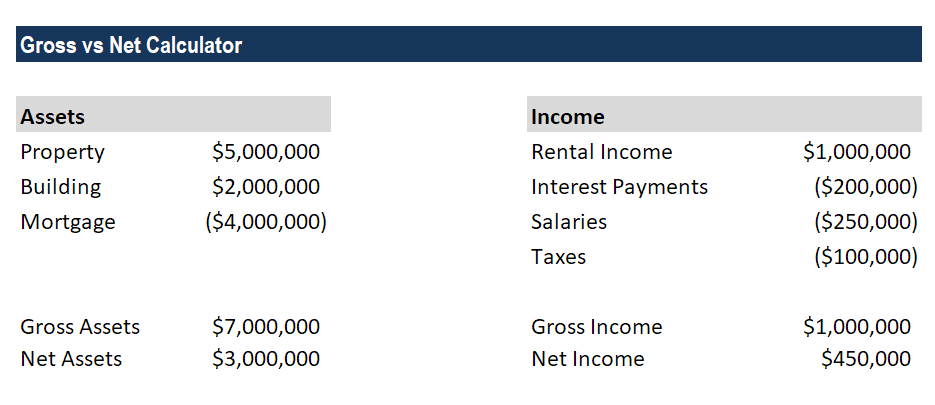
Download CFI’s Excel calculator to input your own numbers and calculate different values on your own. As you’ll see in the file, you can easily change the numbers or add/remove rows to change the items that are included in the calculation.
Gross vs Net in Conversations
The terms gross and net are used frequently in accounting and finance conversations. The easiest way to know what someone means is to think about what could naturally be deducted from something.
For example, if someone says, “Our company made $30 million last year in our online division.”, you may want to ask them, “Gross or net?”. If they say gross, they probably mean either revenue or gross profit (you may need to ask for further clarification). If they say net, you may assume it’s net income (after all expenses are deducted), but you may still need to ask for clarification, as they could be thinking only of operational expenses (which excludes interest and taxes), or they might be including all items.
Unfortunately, as you can see in the example above, it is sometimes ambiguous what someone means when they say “gross” or “net”, so further clarification may be required. The only way to know for sure what someone means is to ask them exactly what is included and/or what is deducted from the figure.
Additional Resources
Thank you for reading this guide to understanding what gross vs net means in a business financial context.
CFI is the official provider of the Financial Modeling & Valuation Analyst (FMVA)®Become a Certified Financial Modeling & Valuation Analyst (FMVA)®CFI's Financial Modeling and Valuation Analyst (FMVA)® certification will help you gain the confidence you need in your finance career. Enroll today! designation, created to help transform anyone into a world-class financial analyst. To continue learning and advancing your career, these additional CFI resources will be useful:
- Net IncomeNet IncomeNet Income is a key line item, not only in the income statement, but in all three core financial statements. While it is arrived at through
- Gross ProfitGross ProfitGross profit is the direct profit left over after deducting the cost of goods sold, or cost of sales, from sales revenue. It's used to calculate the gross profit margin.
- Balance SheetBalance SheetThe balance sheet is one of the three fundamental financial statements. The financial statements are key to both financial modeling and accounting.
- Financial Accounting TheoryFinancial Accounting TheoryFinancial Accounting Theory explains the why behind accounting - the reasons why transactions are reported in certain ways. This guide will
-

Understanding Net Exposure in Hedge Funds: A Comprehensive Guide
Net exposure underlines the difference between a hedge fund’s long positions and its short positions. Once calculated, the net exposure of a fund is presented in a percentage. It will display th
-

Net Volume Explained: Understanding Market Sentiment
Net volume is used to indicate the difference between a security’s uptick volume and downtick volume. Uptick volume is the volume of a company’s shares that are traded when the stock price
Accounting
- Net Settlement Explained: How Banks Settle Transactions
- Understanding Net Change: Definition & Calculation
- Gross Income Explained: Definition, Sources & Examples
- Gross Profit Explained: Definition, Calculation & Importance
- Understanding Net Income: A Comprehensive Guide
- Net Lease Explained: Understanding Landlord & Tenant Responsibilities
- Understanding Net Loss: Causes, Impact, and Accounting Principles
- Understanding Net Sales: Definition & Importance
- Net Income Explained: A Comprehensive Guide for Businesses & Individuals
-
 Understanding Net of Tax: Definition & Calculation
Net of tax is the amount obtained after the applicable tax is deducted from the gross incomeGross IncomeGross income refers to the total income earned by an individual on a paycheck before taxes and o...
-
 Net Profit Margin: Definition, Calculation & Importance
Net Profit Margin (also known as “Profit Margin” or “Net Profit Margin Ratio”) is a financial ratioFinancial RatiosFinancial ratios are created with the use of numerical values...