
Available-for-Sale Securities: Definition & Investment Strategy
Available for sale securities are the default categorization of securities that companies decide to invest in for the purposes of benefiting their financial position. Unlike trading securitiesTrading SecuritiesTrading securities are securities purchased by a company for the purpose of realizing a short-term profit. The securities are issued within the company's industry,, available for sale securities are not bought or sold for the sole purpose of realizing a short-term capital gain.
They may be purchased as tools to diversify away some of the risks that a company’s investment portfolio currently carries. For example, a company may choose to invest in two industries that exhibit negatively correlated returns or invest in lower betaBetaThe beta (β) of an investment security (i.e. a stock) is a measurement of its volatility of returns relative to the entire market. It is used as a measure of risk and is an integral part of the Capital Asset Pricing Model (CAPM). A company with a higher beta has greater risk and also greater expected returns. securities in order to hedge against investment risks.
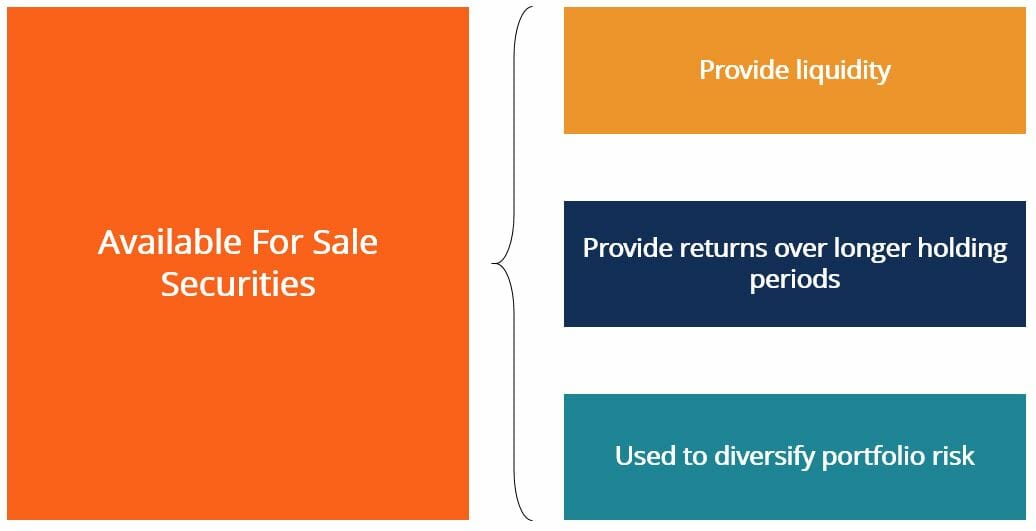
Available for sale securities can also be bought with the intent to be held for the long-term, rather than realizing a quick capital gainCapital Gains YieldCapital gains yield (CGY) is the price appreciation on an investment or a security expressed as a percentage. Because the calculation of Capital Gain Yield involves the market price of a security over time, it can be used to analyze the fluctuation in the market price of a security. See calculation and example. This investment strategy will rely upon finding undervalued securities that have a lot of upside potential. Available for sale securities can also be used to provide liquidity to a company in case cash is needed to finance its operations, repay its investors, or further develop its investment portfolio.
Types of Available for Sale Securities
Available for sale securities can broadly be categorized into the following two categories:
Financing Instruments
Financing instruments refer to securities that are issued by a company in the form of bonds for the purposes of financing the business’ operations. The securities are recorded as liabilities on the company’s balance sheetBalance SheetThe balance sheet is one of the three fundamental financial statements. The financial statements are key to both financial modeling and accounting. since the company is expected to provide a certain return to investors that purchase the securities.
For bond investors, the issuing company is legally obligated to make coupon payments and repay the bondholders the face value of the bond at maturity.
Investment Securities
Investment securities are securities purchased by a company for the purpose of making an eventual capital gain or to diversify away some of the risks of the company’s existing investment portfolio.
Companies that operate in a given industry may possess a knowledge advantage over external investors regarding factors that may affect stock prices, which is another reason why companies may choose to invest.
Accounting Treatment
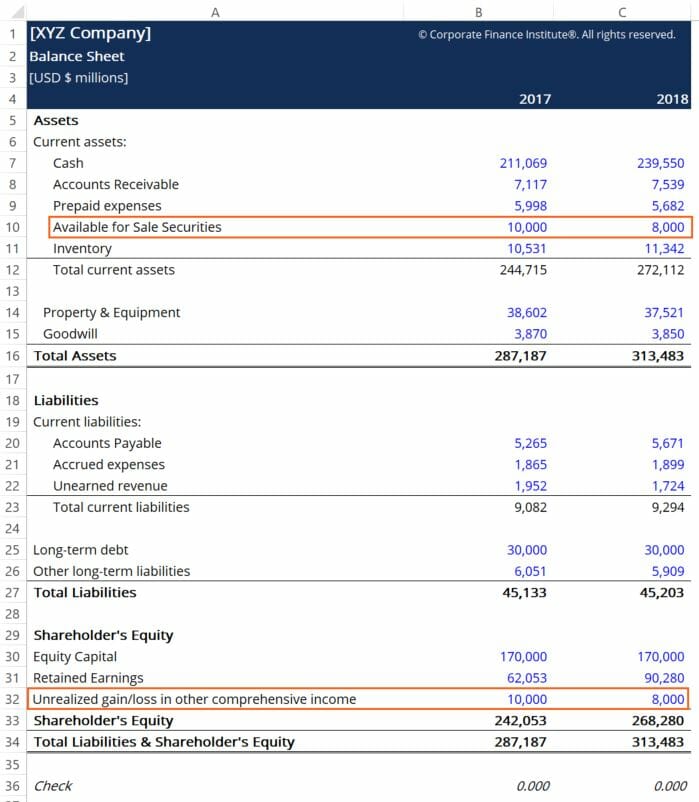
Available for sale securities are treated in the same way that trading securities are on the company’s financial statementsThree Financial StatementsThe three financial statements are the income statement, the balance sheet, and the statement of cash flows. These three core statements are, except for one difference. Changes in the fair value of the securities are recorded in an account titled “Unrealized gain/loss in other comprehensive income,” located in the shareholder’s equity section of the company’s balance sheet, as shown:
Journal entries to record changes in the fair value of the securities are also slightly different than with trading securities. The counter account to the “Unrealized Gain (Loss) on Available for Sale Securities” is the “Available for Sale Fair Market Adjustment” account, but both function in the same way as journal entry accounts for the trading securities function. An example is shown below:

Going with our example balance sheet above, we see that the available for sale securities lost $2 billion in value for the company over the course of the 2018 accounting period.
Additional Resources
CFI offers the Financial Modeling & Valuation Analyst (FMVA)®Become a Certified Financial Modeling & Valuation Analyst (FMVA)®CFI's Financial Modeling and Valuation Analyst (FMVA)® certification will help you gain the confidence you need in your finance career. Enroll today! certification program for those looking to take their careers to the next level. To learn more about related topics, check out the following CFI resources:
- Budgeting and Forecasting Course – CFI
- Accounting Fundamentals Course – CFI
- IFRS StandardsIFRS StandardsIFRS standards are International Financial Reporting Standards (IFRS) that consist of a set of accounting rules that determine how transactions and other accounting events are required to be reported in financial statements. They are designed to maintain credibility and transparency in the financial world
- Cash Flow Statement Cash Flow StatementA cash flow Statement contains information on how much cash a company generated and used during a given period.
-

Understanding Junior Securities: Risks and Implications
A junior security is a security that ranks lower in priority and seniority when contrasted against other securities. It typically comes with a lower priority claim against the assets and incomes of th
-
![Marketable Securities: Definition & Types | [Your Brand/Company Name]](https://www.etffin.com/article/uploadfiles/202110/2021100815155870_S.jpg)
Marketable Securities: Definition & Types | [Your Brand/Company Name]
Marketable securities are unrestricted short-term financial instruments that are issued either for equity securitiesStockWhat is a stock? An individual who owns stock in a company is ca
Accounting
- Understanding Company Bylaws: A Comprehensive Guide
- Understanding Earnings: A Guide to Financial Profitability
- Understanding Distressed Securities: Risks & Opportunities
- Non-Marginable Securities: Definition & Investing Implications
- Understanding Explicit Costs: Definition & Examples
- Held-to-Maturity Securities: Definition & Key Differences
- Understanding Normalized Earnings: A Guide for Investors
- Trading Securities: Definition, Types & Short-Term Investment Strategies
- Understanding Earnings Surprises: What Are They?
-
 Cash Reserves: Definition, Benefits & Short-Term Needs
Cash reserves are funds that companies set aside for use in emergency situations. The cash that is saved is used to cover costs or expenses that are unplanned or unexpected. In most cases, the reserve...
-
 Understanding Debt Covenants: A Comprehensive Guide
Debt covenants are restrictions that lendersLender of Last ResortA lender of last resort is the provider of liquidity to financial institutions that are experiencing financial difficulties. In most de...