
Understanding Distressed Securities: Risks & Opportunities
Distressed securities are securities of a company experiencing financial distress or bankruptcy, specifically, a company that sees its bond rating downgraded by rating agencies to a CCC bond rating or below. Distressed securities sell at a large discount to their intrinsic valueIntrinsic ValueThe intrinsic value of a business (or any investment security) is the present value of all expected future cash flows, discounted at the appropriate discount rate. Unlike relative forms of valuation that look at comparable companies, intrinsic valuation looks only at the inherent value of a business on its own. due to the significant risk involved in holding them.

Many investors choose to sell, as they are not prepared to bear the risk of the securities becoming worthless. Other investors may sell, as their portfolios are not permitted to hold the rating of below-investment-grade securities.
The selling may present an attractive opportunity for aggressive investors. Distressed security investing may earn a potentially large or beneficial return based on the risk-reward ratio for such investments. Distressed securities may include financial claims of a company, such as bank debt, bonds, trade claims, and shares.
Summary
- Distressed securities are securities of a company under financial distress – typically companies that are in or near bankruptcy.
- Distressed securities exist when a company sees its bond rating downgraded by rating agencies to a CCC bond rating or below.
- Attractive opportunities may arise for aggressive investors, as distressed securities sell at a steep discount due to the significant risk involved in holding them.
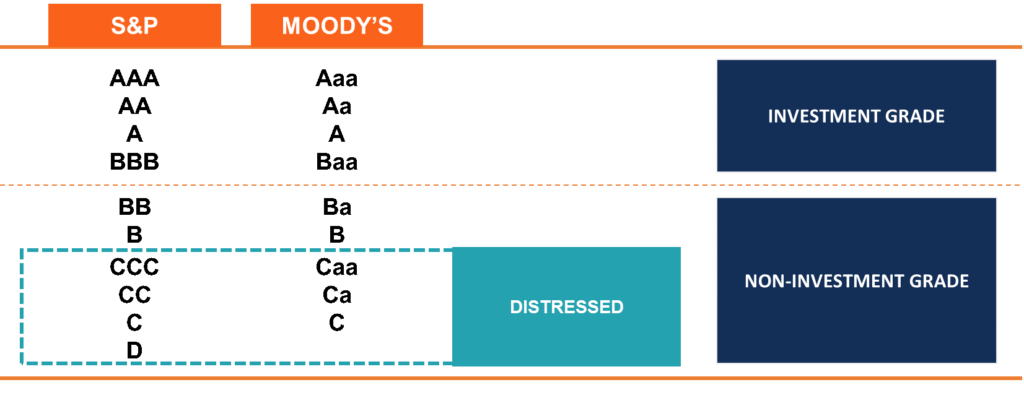
Bond Rating Scales and Agencies
Understanding Basic Distressed Securities Investment Strategy
Distressed securities investors may make a potential investment return based on their view of how an ongoing or upcoming restructuring process will go. Investing in distressed securities is a high-risk strategy. It involves the ability of the investor to analyze the organization’s upside and downside potential.
Large institutional investorsInstitutional InvestorAn institutional investor is a legal entity that accumulates the funds of numerous investors (which may be private investors or other legal entities) to, such as hedge funds, private equity firmsTop 10 Private Equity FirmsWho are the top 10 private equity firms in the world? Our list of the top ten largest PE firms, sorted by total capital raised. Common strategies within P.E. include leveraged buyouts (LBO), venture capital, growth capital, distressed investments and mezzanine capital., and investment banks, hold large portfolios and can diversify their investments to avoid concentration risk when investing in distressed securities.
In addition, as the distressed securities market is illiquid, the strategy is not suitable for the ordinary investor. In distressed securities investing, there are many players, and it is difficult to forecast each of their investment goals. On the surface, the distressed security investor can hold securities to profit through one of the following three scenarios:
1. Full recovery outside bankruptcy
The company may not enter bankruptcy at all. In purchasing at a large discount, distressed securities investors believe the company is not in a bad position. The investor’s opinion is different from the market’s opinion; therefore, investors may realize a return based on the view that the securities are undervalued compared with the true intrinsic value of the company post-recovery.
2. Chapter 11 bankruptcy restructuring
Chapter 11 bankruptcyChapter 11 BankruptcyChapter 11 is a legal process that involves reorganization of a debtor’s debts and assets. It is available to individuals, partnerships, corporations allows a company on the verge of bankruptcy to reorganize and restructure the business. The company, together with all the stakeholders and debtholders, will continue operations. They will find a way to meet their financial obligations and emerge from bankruptcy. The investor will realize a return if the security price approaches fair value once restructuring is complete.
3. Chapter 7 bankruptcy asset liquidation
Chapter 7 bankruptcy refers to the ceasing of a company’s business operations. The company will need to go through the process of liquidating its assets to repay its liabilities. The investor may realize a return based on the view that the assets received upon liquidation will cover the investment cost of the securities they’ve purchased.
Passive vs. Active Investment Approaches in Distressed Securities
A passive investor will buy distressed securities based primarily on market prices. An investor with a long-term investment approach will buy undervalued securities and wait for them to appreciate. An investor with a short-term investment approach will look to see if a restructuring process is positively received. If so, the investor may buy if the market value of the security has not yet reflected its true value.
An active investor of distressed securities will take a direct role in the restructuring process. The investor may get involved through participation in a creditor committee. The active investor ensures that the restructuring process is handled on a profitable basis, representing the interests of the distressed security investors.
Distressed Security Example
Based on the rating systems from rating agencies, such as Moody’s Investors Service (Moody’s) and Standard & Poor’s (S&P), firms use a rate ranging from AAA to D. Ratings above BBB are considered investment grade, while BB and below are considered non-investment grade. For distressed securities, anything rated CCC or below is often considered distressed.
Another accepted definition for distressed securities exists. Securities are classified as distressed when trading with a yield to maturity of greater than 1,000 basis points, or otherwise 10% above the risk-free rate of return. Yield to maturity is the anticipated rate of return of a bond if it is held to maturity.
Related Readings
CFI is the official provider of the global Commercial Banking & Credit Analyst (CBCA)™Program Page - CBCAGet CFI's CBCA™ certification and become a Commercial Banking & Credit Analyst. Enroll and advance your career with our certification programs and courses. certification program, designed to help anyone become a world-class financial analyst. To keep advancing your career, the additional resources below will be useful:
- Bond RatingsBond RatingsBond ratings are representations of the creditworthiness of corporate or government bonds. The ratings are published by credit rating agencies and provide evaluations of a bond issuer’s financial strength and capacity to repay the bond’s principal and interest according to the contract.
- Distressed DebtDistressed DebtDistressed debt refers to the securities of a government or company which has either defaulted, is under bankruptcy protection, or is in financial distress and moving toward the aforementioned situations in the near future. It includes all credit instruments that are trading at a significant discount
- Probability of DefaultProbability of DefaultProbability of Default (PD) is the probability of a borrower defaulting on loan repayments and is used to calculate the expected loss from an investment.
- Vulture FundsVulture FundsVulture funds are a subset of hedge funds that invest in distressed securities that have a high chance of default. The fund buys risky debt instruments at highly discounted prices in the secondary market and benefits by taking legal action against the issuers for debt recovery.
-

Accredited Investors: Definition & Requirements | SEC
An accredited investor refers to an individual or institutional investor who has met certain requirements set by the U.S. Securities and Exchange Commission (SEC)Securities and Exchange Commission (SE
-
Baby Bonds: A Comprehensive Guide to Investing in Children's Futures
As the name suggests, baby bonds are fixed-income securities with the size characteristics of babies in the sense that their par values are small. Baby bonds have a par valuePar ValuePar Value is the
invest
- Marketable Securities: Definition & Types | [Your Brand/Company Name]
- Asset-Backed Securities (ABS): Definition & How They Work
- Capital Markets Explained: Investing in Equity & Debt
- Commodity-Linked Securities: Explained | Investment Guide
- Hybrid Securities: A Comprehensive Guide to Balanced Investments
- Non-Marginable Securities: Definition & Investing Implications
- Held-to-Maturity Securities: Definition & Key Differences
- Trading Securities: Definition, Types & Short-Term Investment Strategies
- Securities Explained: A Beginner's Guide to Stocks, Bonds & More
-
 Understanding Depositories: Secure Storage for Financial Securities
A Depository refers to a place or entity that holds financial securities in a dematerialized form. A bank, organization, or any institution holding and assisting in security trading is referred to as ...
-
 Understanding Equity Issuance Fees: Costs of Raising Capital
“Equity issuance fees” is the accounting term used to reference the costs a company incurs when they introduce securities Marketable SecuritiesMarketable securities are unrestricted short-...