
Capital Lease vs. Operating Lease: Key Differences Explained
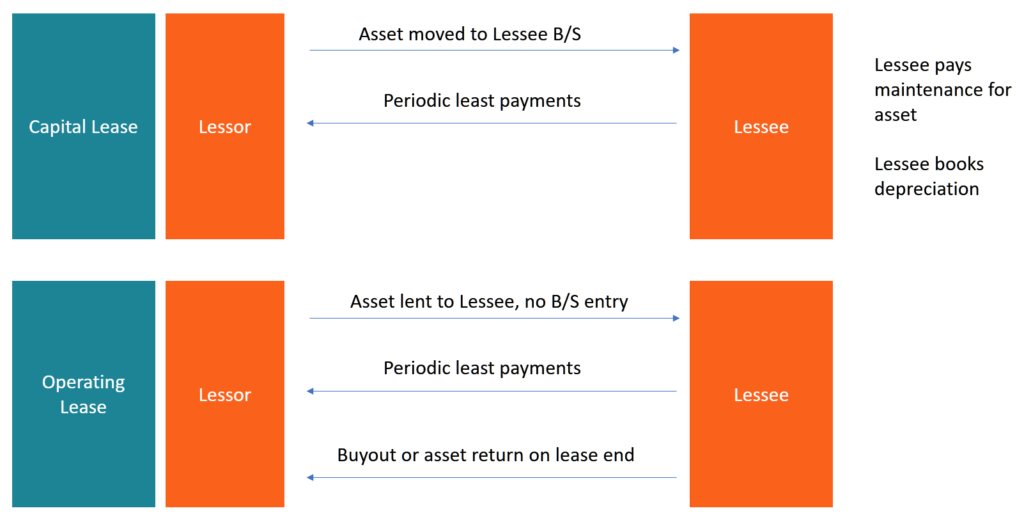
A capital lease (or finance lease) is treated like an asset on a company’s balance sheet, while an operating lease is an expense that remains off the balance sheet. Think of a capital lease as more like owning a piece of property, and think of an operating lease as more like renting a property. There are significant differences between a capital lease vs operating lease, and this guide will help you understand the difference between the two types of leases and their respective accounting treatmentIFRS StandardsIFRS standards are International Financial Reporting Standards (IFRS) that consist of a set of accounting rules that determine how transactions and other accounting events are required to be reported in financial statements. They are designed to maintain credibility and transparency in the financial world.

Capital leases are counted as debt. They depreciate over time and incur interest expenseInterest ExpenseInterest expense arises out of a company that finances through debt or capital leases. Interest is found in the income statement, but can also.
To be classified as a capital lease under U.S. GAAP, any one of four conditions must be met:
- A transfer of ownership of the asset at the end of the term
- An option to purchase the asset at a discounted price at the end of the term
- The term of the lease is greater than or equal to 75% of the useful life of the asset
- The present valueNet Present Value (NPV)Net Present Value (NPV) is the value of all future cash flows (positive and negative) over the entire life of an investment discounted to the present. of the lease payments is greater than or equal to 90% of the asset’s fair market value
Alternatively, if evaluated under IFRS, there is one more criterion that can be used to qualify a lease as a capital lease:
- The assets under the lease are specialized so that only the lessee is able to utilize them without major changes being made to the assets
Operating leases are used for short-term leasing of assets and are similar to renting, as they do not involve any transfer of ownership. Periodic lease payments are treated as operating expenses and are expensed on the income statementIncome StatementThe Income Statement is one of a company's core financial statements that shows their profit and loss over a period of time. The profit or, impacting both the operating and net income. In contrast, capital leases are used to lease longer-term assets and give the lessee ownership rights.
Accounting Treatment: Capital Lease vs Operating Lease
Capital and operating leases are subject to different accounting treatment for both the lessee and the lessor. For the purpose of entry-level finance interviews, it is enough to understand the accounting treatment for the lessee only.
Accounting for an operating lease is relatively straightforward. Lease payments are considered operating expenses and are expensed on the income statement. The firm does not own the asset and, therefore, it does not show up on the balance sheet, and the firm does not assess any depreciationDepreciation MethodsThe most common types of depreciation methods include straight-line, double declining balance, units of production, and sum of years digits. for the asset.
In contrast, a capital lease involves the transfer of ownership rights of the asset to the lessee. The lease is considered a loan (debt financing), and interest payments are expensed on the income statement.
The present market value of the asset is included in the balance sheet under the assets side, and depreciation is charged on the income statement. On the other side, the loan amount, which is the net present value of all future payments, is included under liabilities.
In general, capital leases recognize expenses sooner than equivalent operating leases.
Advantages of a Capital Lease
There are many advantages to a capital lease, including the following:
- Lessee is allowed to claim depreciation on the asset, which reduces taxable income
- Interest expense also reduces taxable income
Advantages of an Operating Lease
There are many advantages to an operating lease as well:
- Operating leases provide greater flexibility to companies as they can replace/update their equipment more often
- No risk of obsolescence, as there is no transfer of ownership
- Accounting for an operating lease is simpler
- Lease payments are tax-deductible
Conclusion
As both capital and operating leases are commonly used by companies, it is useful to gain an understanding of the accounting and commensurate tax treatment for each of these types of leases for both the lessor and the lessee. Each type of lease comes with its own advantages. Depending on the company’s requirement and tax situation, they may opt for one or the other, or possibly even a combination of both for different types of assets.
Other Resources
CFI is the global provider of the Financial Modeling & Valuation Analyst (FMVA)® designationBecome a Certified Financial Modeling & Valuation Analyst (FMVA)®CFI's Financial Modeling and Valuation Analyst (FMVA)® certification will help you gain the confidence you need in your finance career. Enroll today!, designed to help anyone become a world-class financial analyst. To continue learning more about other accounting issues, please see these additional free CFI resources:
- Lease AccountingLease AccountingLease accounting guide. Leases are contracts in which the property/asset owner allows another party to use the property/asset in exchange for money or other assets. The two most common types of leases in accounting are operating and financing (capital leases). Advantages, disadvantages, and examples
- Prepaid LeasePrepaid LeaseA prepaid lease (or operating lease) is a contract to acquire the use of tangible assets, which include plant, equipment, and real estate.
- Fixed and Variable CostsFixed and Variable CostsCost is something that can be classified in several ways depending on its nature. One of the most popular methods is classification according
- Projecting Balance Sheet ItemsProjecting Balance Sheet Line ItemsProjecting balance sheet line items involves analyzing working capital, PP&E, debt share capital and net income. This guide breaks down how to calculate
-

Understanding Operating Expenses (OPEX): A Comprehensive Guide
Operating expenses, operating expenditures, or “opex,” refers to the costs incurred by a business for its operational activities. In other words, operating expenses are the costs that a co
-
Operating Income (EBIT): Definition & Calculation
Operating income, also referred to as operating profit or Earnings Before Interest & Taxes (EBIT)EBIT GuideEBIT stands for Earnings Before Interest and Taxes and is one of the last
Accounting
- Capital Lease Payment Schedule: Calculation & Excel Template
- Capital Lease Explained: Accounting & Ownership
- Capital Funding: A Comprehensive Guide for Businesses
- Capital Outflow: Causes, Effects & What to Know
- Understanding Return of Capital (ROC): Definition & Tax Implications
- Understanding Tier 1 Capital: A Key Indicator of Bank Financial Health
- Capital Investment: Definition, Types & Examples | [Your Company Name]
- Operating Lease Explained: Benefits & How They Work
- Understanding Operating Leases: Definition & Benefits
-
 Understanding Operating Cash Flow (OCF): A Comprehensive Guide
Operating Cash Flow (OCF) is the amount of cash generated by the regular operating activities of a business within a specific time period. OCF begins with net incomeNet IncomeNet Income is a key line ...
-
 Understanding the Operating Cycle: Definition & Importance
An Operating Cycle (OC) refers to the days required for a business to receive inventoryInventoryInventory is a current asset account found on the balance sheet, consisting of all raw materials, w...