
Understanding Operating Expenses (OPEX): A Comprehensive Guide
Operating expenses, operating expenditures, or “opex,” refers to the costs incurred by a business for its operational activities. In other words, operating expenses are the costs that a company must make to perform its operational activities.

Operating expenses are essential for analyzing a company’s operational performance. It is therefore important for both internal and external analysts to identify a company’s opex, to understand its primary cost drivers, and assess management efficiency.
Summary
- Operating expenses reflect the operational activities, not the investing or financing activities of a company.
- Operational activities are a company’s key commercial activities in generating revenue.
- It is important to distinguish between operating expenses and capital expenditures as the two are treated differently for accounting purposes.
What are Operational Activities?
Before calculating a company’s operational expenses, it is essential to identify the operational activities or the primary revenue-producing activities of the business and other activities that are not financing or investing activities.
The operating activities primarily cover the commercial activities of the company. For example, the main operating activity for a manufacturing company is to produce the product from raw materials, while for a trading company, it is to buy products from the supplier and sell them to the end-users.
It is critical to note that operational activities differ greatly among industries. A business activity can be classified as operational in one industry, but financing or investing in another. For instance, buying a building is typically an investing activity in most industries. However, it is an operational activity for real-estate companies, given that the purchased building is intended for resale.
Example
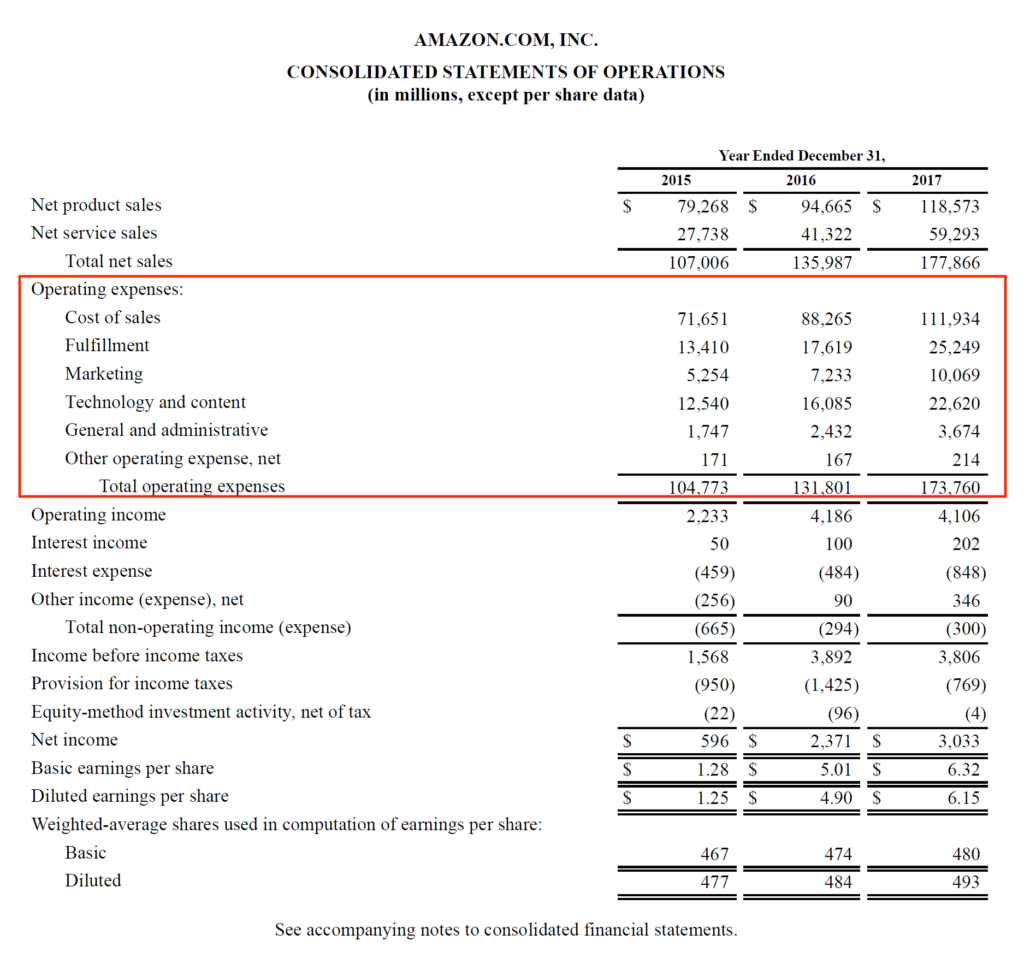
An example of Amazon.com‘s income statement is shown below. Encompassed by a red border, Amazon’s operating expenses include the cost of sales, fulfillment, marketing, general and administrative, technology and content, and other operating expenses.
Operating Expenses and Capital Expenditures
For businesses, operating expenses may typically include supplies, advertising expenses, administration feesSG&ASG&A includes all non-production expenses incurred by a company in any given period. It includes expenses such as rent, advertising, marketing, wages, rent, and utility costs. When it comes to capital or physical asset-related costs, however, it is important to make a distinction between operating expenses and capital expenditures as the two are treated differently for accounting purposes.
Capital expenditures are assets that are purchased and have a multiyear life, and are used in the operations of the business.. Purchasing machinery, for example, is considered a capital expenditure, whereas, repair and maintenance of the machinery is considered an operating expense.
Fixed Costs and Variable Costs
When it comes to analyzing operating expenses, managers classify the expenses as either fixed or variableFixed and Variable CostsCost is something that can be classified in several ways depending on its nature. One of the most popular methods is classification according. In such a way, a manager can better understand the nature of the expense. A fixed cost remains the same no matter what the production level is, while variable cost does vary with the number of products or services that a company produces.
For example, fixed costs are things such as rent, lease payments and insurance expense, and labour, raw materials and sales commissions are variable costs.
It is noteworthy that the same category of an operating expense can be either a fixed cost or a variable cost, depending on the situation. For example, the wage for a full-time office employee is a fixed cost to the company, while the wage for an assembly line factory worker can be identified as a variable cost. Understanding the distinction can help managers to better control the operating expenses while considering the timeframe.
Importance of Operating Expenses
Operating expenses are important because they can help assess a company’s cost and stock management efficiency. It highlights the level of cost that a company needs to make to generate revenue, which is the main goal of a company.
If a company incurs relatively higher opex as a percentage of sales compared to its competitors, that may indicate they are less efficient at generating those sales.
The disadvantage of looking at a company’s opex is that it is an absolute number, not a ratio. Therefore it is unreasonable to be used as a metric to compare between firms even if they are in the same industry. However, they can be highly instrumental in the horizontal analysis since it can reflect the company’s current performance in the past.
Additional Resources
CFI is the official provider of the global Commercial Banking & Credit Analyst (CBCA)™Program Page - CBCAGet CFI's CBCA™ certification and become a Commercial Banking & Credit Analyst. Enroll and advance your career with our certification programs and courses. certification program, designed to help anyone become a world-class financial analyst. To keep advancing your career, the additional CFI resources below will be useful:
- Cost StructureCost StructureCost structure refers to the types of expenses that a business incurs, and is typically composed of fixed and variable costs. Fixed costs remain unchanged
- Days Inventory OutstandingDays Inventory OutstandingDays inventory outstanding (DIO) is the average number of days that a company holds its inventory before selling it. The days inventory
- Operating IncomeOperating IncomeOperating income is the amount of revenue left after deducting the operational direct and indirect costs from sales revenue.
- Multi-Step Income StatementMulti-Step Income StatementA multi-step income statement is an income statement that segregates total revenue and expenses into operating and non-operating heads. It
-
Understanding Business Expenses: A Comprehensive Guide
Businesses incur various types of expenses. An expense is a type of expenditure that flows through the income statementIncome StatementThe Income Statement is one of a companys core financial statemen
-

Understanding Financial Assets: Definitions & Types
Financial assets refer to assets that arise from contractual agreements on future cash flowsCash Flow StatementA cash flow Statement contains information on how much cash a company generated an
Accounting
- Understanding Operating Expenses (OpEx): A Comprehensive Guide
- Understanding Business Erosion: Causes, Risks & Prevention
- Understanding Non-Cash Expenses: A Comprehensive Guide
- Understanding Accounts Expenses: A Comprehensive Guide
- Understanding Accrued Expenses: A Comprehensive Guide
- Understanding Administrative Expenses: A Comprehensive Guide
- Understanding Maintenance Expenses: A Comprehensive Guide
- Operating Lease Explained: Benefits & How They Work
- Understanding Prepaid Expenses: Definition & Accounting
-
 Understanding Credit Sales: Definition & Benefits | CFI
Credit sales refer to a sale in which the amount owed will be paid at a later date. In other words, credit sales are purchases made by customers who do not render payment in full, in cash, at the...
-
 Discontinued Operations: Definition & Accounting Treatment
Discontinued operations is a term used in accounting to refer to parts of a company’s business that have been terminated and are no longer operational. In accounting, discontinued operations are...