
R&D Capitalization vs. Expensing: A GAAP Guide for Businesses
Under the United States Generally Accepted Accounting Principles (GAAPGAAPGAAP, Generally Accepted Accounting Principles, is a recognized set of rules and procedures that govern corporate accounting and financial), companies are obligated to expense Research and Development (R&D) expendituresExpenditureAn expenditure represents a payment with either cash or credit to purchase goods or services. An expenditure is recorded at a single point in in the same fiscal year they are spent. It often creates a lot of volatility in profits (or losses) for many companies, as well as difficulty in measuring their rates of return on assets and investments.
A lack of R&D capitalization could mean that their total assetsTypes of AssetsCommon types of assets include current, non-current, physical, intangible, operating, and non-operating. Correctly identifying and or their total invested capital do not properly reflect the amount that has been invested into them. As a result, there can be an impact on the company’s Return on Assets (ROAReturn on Assets & ROA FormulaROA Formula. Return on Assets (ROA) is a type of return on investment (ROI) metric that measures the profitability of a business in relation to its total assets.) and Return on Invested Capital (ROICROICROIC stands for Return on Invested Capital and is a profitability ratio that aims to measure the percentage return that a company earns on invested capital.). Below, we analyze the practice of capitalizing R&D expenses on the balance sheet, versus expensing them on the income statement.

Let us compare GAAP with the International Financial Reporting Standards (IFRSIFRS StandardsIFRS standards are International Financial Reporting Standards (IFRS) that consist of a set of accounting rules that determine how transactions and other accounting events are required to be reported in financial statements. They are designed to maintain credibility and transparency in the financial world). Under IFRS rules, research spending is treated as an expense each year, just as with GAAP. By contrast, though, development costs can be capitalized if the company can prove that the asset in development will become commercially viable (meaning the technology or product in development is likely to make it through the approval process and generate revenue).
The benefit of the IFRS approach is that at least some research and development costs can be capitalized (i.e., turned into an asset on the company’s balance sheetBalance SheetThe balance sheet is one of the three fundamental financial statements. The financial statements are key to both financial modeling and accounting.) instead of being incurred as an expense on the statement of Profit and Loss (P&LProfit and Loss Statement (P&L)A profit and loss statement (P&L), or income statement or statement of operations, is a financial report that provides a summary of a). The trade-off, however, is that IFRS requires judgment and subjectivity, which creates a risk that managers will be overly optimistic about how commercially viable a new technology is, which can cause inconsistencies in different companies’ financial statementsThree Financial StatementsThe three financial statements are the income statement, the balance sheet, and the statement of cash flows. These three core statements are.
R&D Expense and Earnings Volatility
R&D spending can vary widely from one year to another, which has a significant impact on a company’s profitability. Many businesses in the technology, healthcare, consumer discretionary, energy, and industrial sectors experience this problem.
If a company doesn’t capitalize research and development, its net income can be significantly higher or lower because of the timing of R&D spending. It’s important to note that net income doesn’t include the significant investments in R&D under its cash flow from investing activitiesCash Flow from Investing ActivitiesCash Flow from Investing Activities is the section of a company's cash flow statement that displays how much money has been used in (or. Additionally, this issue seems to contradict one of the main accounting principlesIB Manual – Accounting PrinciplesAccounting Principles for Investment Banking Analysts. A fundamental understanding of accounting principles is critical to creating any meaningful financial analysis. Analysis of mergers and acquisitions requires knowledge of accounting concepts. We build from the beginning and try to summarize and explain accounting, which is that expenses should be matched to the same period when the corresponding revenue is generated.
Research and development is a long-term investment for most companies resulting in many years of revenue, cash flow,Cash FlowCash Flow (CF) is the increase or decrease in the amount of money a business, institution, or individual has. In finance, the term is used to describe the amount of cash (currency) that is generated or consumed in a given time period. There are many types of CF and profit, and, thus, should theoretically be capitalized as an asset, not expensed. Without the capitalization of R&D spending, it is more challenging to compare companies in the same industry, as the timing of their research spending can have a big impact on their bottom line in a given year.
The Process of R&D Capitalization vs Expense
From an economic perspective, it seems reasonable that research and development costs should be capitalized, even though it’s unclear how much future benefit they will create. To capitalize and estimate the value of these assets, an analyst needs to estimate how many years a product or technology will generate benefit for (its economic life), and use that as an assumption for the amortization period.
The amortizable life will differ from asset to asset and reflects the economic life of the various products. For example, R&D products developed by a pharmaceutical company would likely last many years (and thus have a long amortization period), since it takes a long time for patents to be approved and there is also some patent protection they can enjoy monopolistic sales for several years. R&D amortization for a mobile phone company, however, should be amortized much faster (a smaller number of years) since new phones tend to emerge much more quickly and, thus, come with shorter shelf lives.
After estimating the economic life of an asset with a life of seven years, a company would then amortize the capitalized R&D expenses equally over the seven-year life. In the example below, we will assume the amortization of the asset uses the straight-line approachStraight Line DepreciationStraight line depreciation is the most commonly used and easiest method for allocating depreciation of an asset. With the straight line.
R&D Capitalization Example
Below is an example of the R&D capitalization and amortization calculations in an Excel spreadsheet. The key assumptions are that a total of $100,000 has been spent on research and development, there is a $20,000 residual value, the product developed has a commercial life of 5 years, and the amortization expense uses the straight-line method.
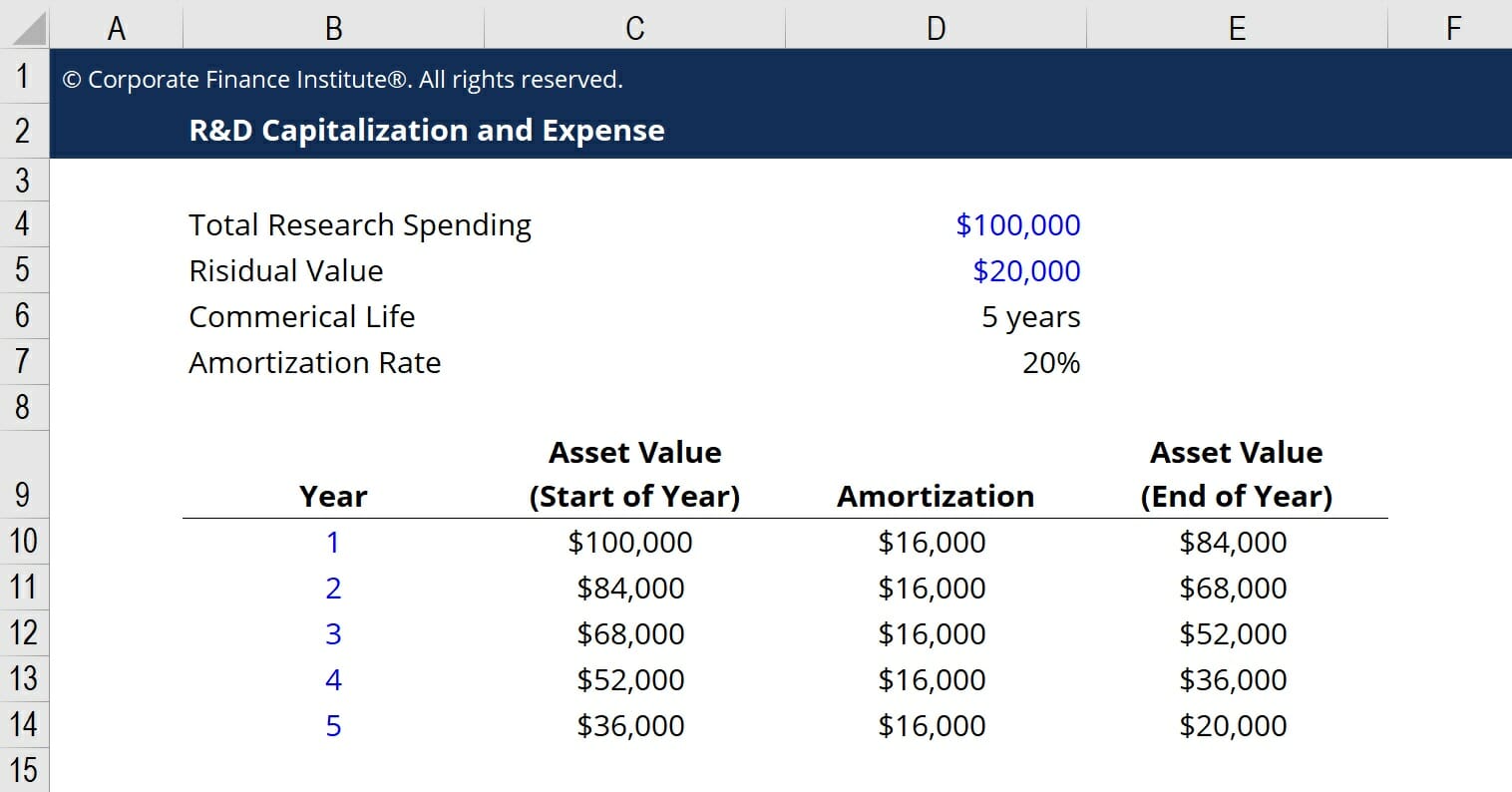
Based on these assumptions, the company would have a $16,000 amortization expense each year, for five years, until it reaches the residual value of $20,000. By amortizing the cost over five years, the net income of the business is smoothed out and expenses are more closely matched to revenues.
Download the Free Template
Enter your name and email in the form below and download the free template now!
Related Resources
Thank you for reading this guide to capitalizing R&D expenses. CFI is the official global provider of the Financial Modeling & Valuation Analyst (FMVA)®Become a Certified Financial Modeling & Valuation Analyst (FMVA)®CFI's Financial Modeling and Valuation Analyst (FMVA)® certification will help you gain the confidence you need in your finance career. Enroll today! program for analyst certification. To advance your career, these additional CFI resources will help:
- Accounting CycleAccounting CycleThe accounting cycle is the holistic process of recording and processing all financial transactions of a company, from when the transaction
- Accrued ExpensesAccrued ExpensesAccrued expenses are expenses that are recognized even though cash has not been paid. They are usually paired up against revenue via the matching principle
- Revenue Recognition PrincipleRevenue Recognition PrincipleThe revenue recognition principle dictates the process and timing by which revenue is recorded and recognized as an item in a company's
- Projecting Income Statement ItemsProjecting Income Statement Line ItemsWe discuss the different methods of projecting income statement line items. Projecting income statement line items begins with sales revenue, then cost
-

The Critical Role of Audits in Legal Compliance
The legal importance of an audit is to uphold the reliability of financial statements for all external users. AuditorsAuditorAn auditor is a person or a firm assigned to perform an audit on
-

Understanding Accounting Types: A Comprehensive Guide
If you’re just getting through accounting
Accounting
- Understanding Accounting: Its Role in Business Strategy
- Accounting Explained: Understanding Financial Records & Reporting
- Accounting Conservatism: Definition, Examples & Importance
- Accrued Expenses: Definition, Examples & Accounting Explained
- Forensic Accounting: Investigating Fraud & Financial Crime | [Your Company Name]
- Understanding Fraud in Audits: Risks and Consequences
- Understanding Utilities Expense: Definition & Accounting
- Bookkeeping: Definition, Importance & Benefits for Businesses
- Financial Accounting: A Comprehensive Guide for Beginners
-
 FASB: Understanding Financial Accounting Standards & GAAP
The Financial Accounting Standards Board (FASB) is an independent organization that exists in the private sector. It is responsible for establishing accounting standards for financial reporting within...
-
 Ecommerce Accounting: Simplify Your Financials & Grow Your Business
When you ask an ecommerce business owner, what’s the least favorite part of their job — most will say ‘accounting.’ (If you are that rare gem who loves accounting, virtual high-five to you!) And...