
The Critical Role of Audits in Legal Compliance
The legal importance of an audit is to uphold the reliability of financial statements for all external users.

AuditorsAuditorAn auditor is a person or a firm assigned to perform an audit on an organization. An audit is a structured, methodical process that includes an examination face civil and criminal liability in performing their duties and ensuring they uphold the transparency, usability, and reliability of financial information provided by reporting entities.
Audit Explained
Auditing refers to the examination of financial transactions and records of an entity to ensure that the financial information provided reflects the entity’s economic position and operations.
Audits are performed by internal, external, and governmental parties, and are used for a variety of reasons. Audits performed by external and governmental parties are important in establishing the validity of financial statements since they are not subject to conflicts of interest.
Importance of Auditing
Audits are needed to determine whether transactions shown by an entity fairly represent that entity’s economic state and operations.
Financial records are created internally and are subject to manipulation or fraudulent behavior from insiders. Internal parties may have personal incentives to manipulate these records, and auditing is important to ensure that the records are not misstated due to error or fraudFraudFraud refers to any deceptive activity engaged in by an individual with the aim of gaining something through means that violate the law. One keyword in.
Accounting Fraud
Accounting fraud refers to when an entity, such as a company, deliberately falsifies its financial records. Fraudulent behavior is difficult to define within accounting since most representations of financials are based on estimates.
For example, if a company decides to make an estimate that ends up being revised at a later date, this is not considered fraudulent behavior, as long as the company made the estimation in good faith by using all relevant information at the time of estimation.
However, if a company deliberately misstates its revenues to make itself appear more profitable or overstating assets to make itself seem more financially healthy, that is considered accounting fraud.
Punishment of Accounting Fraud
Accounting fraud is illegal and punishable, both in civil and criminal courts. In the United States, the Securities and Exchange Commission (SEC)Securities and Exchange Commission (SEC)The US Securities and Exchange Commission, or SEC, is an independent agency of the US federal government that is responsible for implementing federal securities laws and proposing securities rules. It is also in charge of maintaining the securities industry and stock and options exchanges is an independent agency that is responsible for protecting investors and maintaining fair, orderly, and efficient markets. This is mainly to ensure the public trust that underlies the financial system.
Accounting fraud undermines the trust that is required for a market economy. If a user of financial statements, such as an investor, cannot trust the company’s reported financial statements, it is very unlikely that the investor will be willing to invest their capital with that company.
However, if there are legal protections in place that confirm the accuracy of financial statements, then the investor is more likely to invest their funds, even if they do not know anyone from that company personally.
Auditors are held to the same level of trust. Investors need to know that they can trust the opinion of auditors and that the auditors will provide an unbiased opinion. Otherwise, it will undermine the financial system.
Therefore, to have an efficient and transparent market economy, three elements need to be present:
- Rules (accounting standards)
- Verifiers (auditors)
- Enforcers (government agencies and laws)
Legal Liability of Auditors
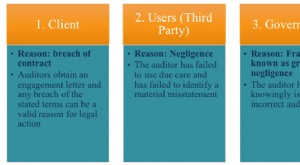
Auditors can face civil and criminal liabilities in the performance of their duties. They are held to a professional code of conduct that ensures that they take due care when performing their duties.
Due care implies four aspects:
- Possessing requisite skills to evaluate accountingPhilosophy of AccountingThe philosophy of accounting encompasses the general rules, concepts, and ideas surrounding the preparation and auditing of the accounts and records
- The duty to employ skills with reasonable care and due diligence
- Undertaking tasks with good faith and integrity
- Liability for negligence, bad faith, and dishonesty
Auditors are responsible to the users of financial statements, and the foreseeable users who may rely on the financial statements that they issue an opinion on. Users of financial statements include:
- Shareholders
- Creditors
- Suppliers
- Customers
- Management
- Regulating entities
Foreseeable users of financial statements are determined by personal judgment. For example, there are new investors and potential creditors that may arise in the future; however, they do not currently have a vested interest in the specific company.
Even though the auditor does not know the users yet, the auditor still has an obligation to them.
Related Readings
CFI offers the Commercial Banking & Credit Analyst (CBCA)™Program Page - CBCAGet CFI's CBCA™ certification and become a Commercial Banking & Credit Analyst. Enroll and advance your career with our certification programs and courses. certification program for those looking to take their careers to the next level. To keep learning and developing your knowledge base, please explore the additional relevant resources below:
- Legal Liability of AuditorsLegal Liability of AuditorsConcerns about the legal liability of auditors continue to grow every day. Auditors are highly important people because, ultimately, they are
- Accounting PoliciesAccounting PoliciesAccounting policies are rules and guidelines that are selected by a company for use in preparing and presenting its financial statements
- Audit Legal ImplicationsAccountingAccounting is a term that describes the process of consolidating financial information to make it clear and understandable for all
- Evidence in an AuditEvidence in an AuditEvidence in an audit is information that is collected and required in the review of an entity’s financial transactions, balances, and internal
-

Understanding Collateral: How It Impacts Loan Terms
If you default on your car loan, the lender will seize the car. When applying for a loan, you may notice that secured loans typically offer better terms than unsecured loans. Lenders of secur
-

Managerial Accounting vs. Financial Accounting: Key Differences Explained
If you’ve always thought that managerial accounti
Accounting
- Legal Guardian Financial Responsibilities: A Comprehensive Guide
- Accounting Explained: Understanding Financial Records & Reporting
- Accounting Conservatism: Definition, Examples & Importance
- Understanding the Accounting Equation: Assets = Liabilities + Equity
- Understanding Financial Audits: A Comprehensive Guide
- Understanding Audit Evidence: A Comprehensive Guide
- FASB: Understanding Financial Accounting Standards & GAAP
- Understanding the Philosophy of Accounting: Principles & Concepts
- Bookkeeping vs. Accounting: Key Differences Explained
-
 Auditor Legal Liability: Understanding Risks and Responsibilities
Concerns about the legal liability of auditors continue to grow every day. Auditors are highly important people because, ultimately, they are responsible for enhancing the reliability of fin...
-
 Understanding Materiality Thresholds in Audits: A Comprehensive Guide
The materiality threshold in audits refers to the benchmark used to obtain reasonable assurance that an audit does not detect any material misstatement that can significantly impact the usability of f...