
Understanding the De Minimis Tax Rule: A Comprehensive Guide
The de minimis tax rule is a law that governs the treatment and accounting of small market discounts. Translated “about minimal things,” the de minimis amount determines whether the market discount on a bond is taxed as capital gainCapital GainA capital gain is an increase in the value of an asset or investment resulting from the price appreciation of the asset or investment. In other words, the gain occurs when the current or sale price of an asset or investment exceeds its purchase price. or ordinary income.

The de minimis tax rule states that if a discount is less than 0.25% per year between the time purchased and maturity, the discount is considered too small and tax-exempt.
Capital Gain Tax vs. Ordinary Income Tax
Capital Gains Tax (CGT): The capital gains tax is a form of tax applied when profit is gained from the sale of non-inventory assets such as bonds and property. In the U.S., short-term capital gains (assets purchased and sold within a year) are taxed the same as ordinary income tax and more heavily than long-term capital gains.
Ordinary Income Tax: The ordinary income tax is a form of tax applied to a variety of items, such as salaries, wages, commissions, etc. Apart from the basic forms of income, ordinary income tax can be applied to dividends, partnerships, royalties, and even gambling winnings.
How to Determine which Form of Tax is Paid
Below are the mathematical steps needed to be taken when determining if a bond is subject to capital gain tax or ordinary income tax regarding the de minimis rule.
1. Multiply the face value (bond price when issued) by 0.25%.
2. Take the result above and multiply it by the number of full years between the time you purchased the discounted bond and its maturity.
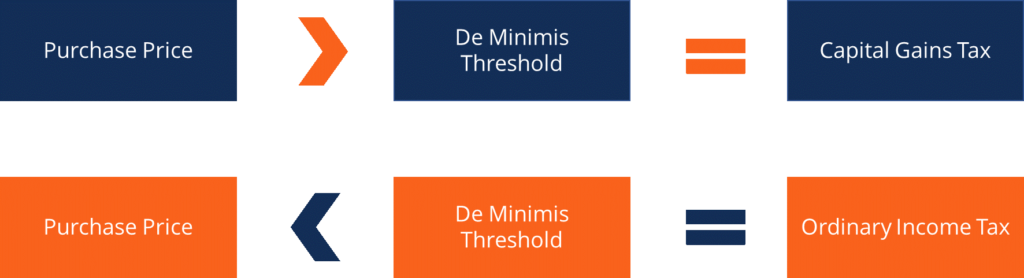
3. Subtract the result from face value. It will determine the minimis threshold. The diagram below depicts how purchase price and de minimis threshold correlate to taxation.
Example with Calculation
You are given a 15-year bond with a face value of $1,500, and it matures in six years. What form of tax will be applied once the bond is sold? The steps are shown below:
1. $1,500 x .0025 = $3.75
2. $3.75 * 6 years = 22.50
3. $1,5000 – $22.75 = $1,447.50 (de minimis threshold)
The calculation above that the de minimis threshold is $1,477.50. With the figure, we can determine which form of tax is applied based on the purchase price.
If the purchase price is above $1,477.50, it will be treated as capital gains tax. If the purchase price is below $1,477.50, it will be treated as ordinary income tax.
De Minimis Fringe Benefits
De minimis tax rule also applies to fringe benefits offered by employers. Since the de minimis benefits offered are so small, it will be unreasonable to account for them, and they are exempt from taxation. These are some of the main de minimis benefits:
- Snacks and coffee brought into the workplace to increase employee moraleEmployee MoraleEmployee morale is defined as the overall satisfaction, outlook, and feelings of well-being that an employee holds in the workplace. In other
- Holiday gifts offered by the firm for their employees
- Tickets for special work events or certain occasions
- Personal use of office equipment such as the photocopier
- Occasional meal allowance given to outstanding employees
- Transport expenses for employees who choose to work overtime
- Cocktail parties or special events organized to boost employee motivation
De minimis benefits cannot assume a tangible monetary value. In other words, money cannot be given as a gift to increase morale without it being taxed. Due to the frequency and small monetary value of the items listed above, de minimis benefits avoid taxation.
De Minimus Safe Harbor
De minimis safe harbor refers to an annual tax return election that allows taxpayers to deduct various purchases that are usually affected by taxation.
It allows businesses that prepare financial statements to deduct up to $2,500. The figure can reach $5,000 if a company uses an applicable financial statement (AFS). An AFS is any type of financial statement registered by the Securities and Exchange Commission (SEC) or audited by a CPA firm.
Why Expense Rather Than Capitalize?
During the process of creating year-end financial statements, accountants are faced with the decision to allocate cost as an expense or to capitalize it. As mentioned above, the de minimis safe harbor emphasizes allocating costs of assets as an expense. Here’s why:
- Capitalization: When a firm capitalizes a cost, it is directed towards capital expenditures. The cost will be accounted for as an asset on the balance sheet and subject to depreciation expense. In general, capitalization lowers the future net income of a firm.
- Expensing: When a cost is expensed, it is added to the company’s income statement and is subtracted from revenue, reducing profit. It may not seem beneficial, but the expensing of costs reduces the overall income tax burden. In general, expensing lowers total assets and shareholder’s equityEquityIn finance, equity is the market value of the assets owned by shareholders after all debts have been paid off. In accounting, equity refers to the book value of stockholders’ equity on the balance sheet, which is equal to assets minus liabilities. The term, "equity", in finance and accounting comes with the concept of fair and equal treatment of a firm.
Related Readings
CFI offers the Commercial Banking & Credit Analyst (CBCA)™Program Page - CBCAGet CFI's CBCA™ certification and become a Commercial Banking & Credit Analyst. Enroll and advance your career with our certification programs and courses. certification program for those looking to take their careers to the next level. To keep learning and developing your knowledge base, please explore the additional relevant resources below:
- Discount FactorDiscount FactorIn financial modeling, a discount factor is a decimal number multiplied by a cash flow value to discount it back to the present value.
- Securities and Exchange Commission (SEC)Securities and Exchange Commission (SEC)The US Securities and Exchange Commission, or SEC, is an independent agency of the US federal government that is responsible for implementing federal securities laws and proposing securities rules. It is also in charge of maintaining the securities industry and stock and options exchanges
- Capital Gains TaxCapital Gains TaxCapital gains tax is a tax imposed on capital gains or the profits that an individual makes from selling assets. The tax is only imposed once the asset has been converted into cash, and not when it’s still in the hands of an investor.
- Taxable IncomeTaxable IncomeTaxable income refers to any individual's or business’ compensation that is used to determine tax liability. The total income amount or gross income is used as the basis to calculate how much the individual or organization owes the government for the specific tax period.
-

Franchise Tax Explained: What It Is & Who Pays
A franchise tax, also known as a privilege tax, is a tax paid by certain companies that wish to conduct business in specific states. It gives businesses the ability to be chartered and to operate with
-

HM Revenue & Customs (HMRC): Your Guide to UK Taxes
The HM Revenue and Customs (HMRC) is a department of the United Kingdom responsible primarily for regulating taxes, wagesRemunerationRemuneration is any type of compensation or payment that an individ
Accounting
- Rule of 85 Retirement: Early Retirement Eligibility Explained
- The 80/20 Inventory Rule: Optimize Your Product Portfolio for Profitability
- Volcker Rule Explained: Understanding Banking Restrictions
- Rule of 72: Calculate Investment Doubling Time | [Your Brand Name]
- Progressive Tax Explained: How It Works & Examples
- Regressive Taxes: Definition, Examples & Impact on Income Inequality
- Tax Depreciation Explained: A Comprehensive Guide for Taxpayers
- Saver's Tax Credit: Eligibility, Contribution Limits & Benefits
- 5 Key Steps in Tax Planning for Businesses
-
 Understanding Estate Tax Caps: Federal & State Inheritance Limits
In discussions about death taxes, we sometimes use the terms "estate tax" and "inheritance tax" interchangeably, but they actually describe two distinct taxes. Estate tax is levied...
-
 Cayman Islands Dollar (KYD): Understanding the Currency of the Cayman Islands
The Cayman Islands Dollar (KYD) is the national currency in the Cayman Islands. Located just south of Cuba, the Caribbean country is composed of three major islands – Grand Cayman, Little Cayman...