
FFO Explained: Understanding Funds From Operations for Real Estate Investors
Funds from operations (FFO) is the actual amount of cash flowCash FlowCash Flow (CF) is the increase or decrease in the amount of money a business, institution, or individual has. In finance, the term is used to describe the amount of cash (currency) that is generated or consumed in a given time period. There are many types of CF generated from a company’s business operations.
To calculate the net FFO, one must add the non-cash expenses or losses that are not actually incurred from the operations, such as depreciation, amortization, and any losses on the sale of assets, to net income. Then subtract any gains on the sale of assets and interest income.
FFO is commonly used by companies that engage in Real Estate Investment Trusts (REITs)FinanceCFI's Finance Articles are designed as self-study guides to learn important finance concepts online at your own pace. Browse hundreds of articles!, a business that primarily operates on income-generating real estate transactions. REIT companies are involved in commercial real estate – selling, leasing, and financing office space and apartment buildings, warehouses, hospitals, shopping centers, hotels, and timberlands.
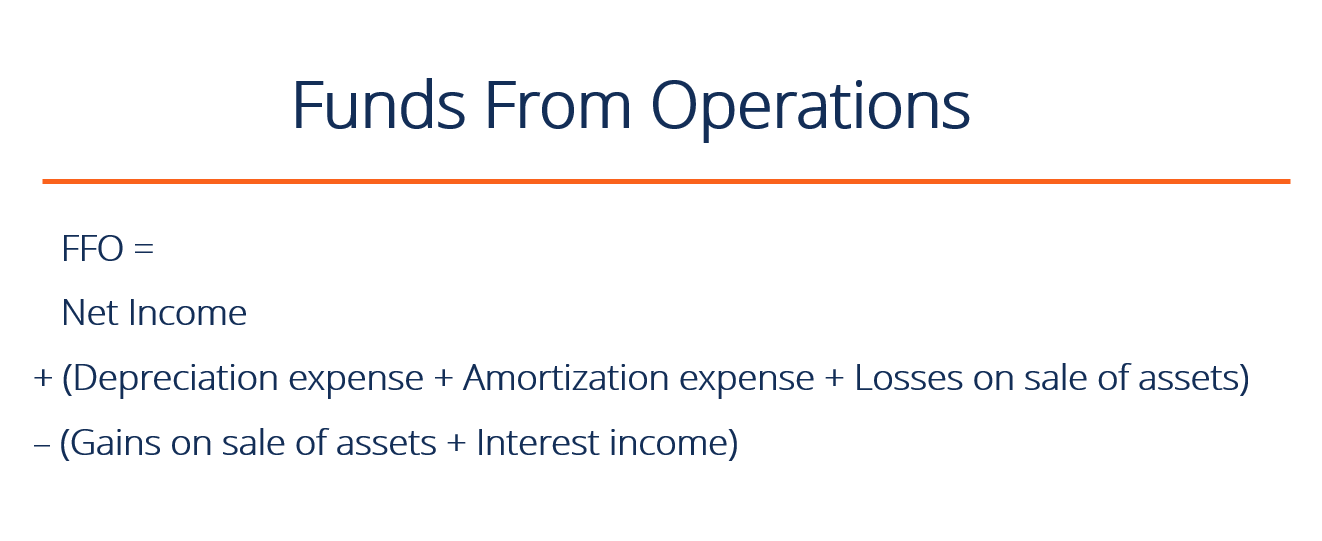
What is the FFO formula?
Here is the formula to calculate FFO:
FFO = Net Income + (Depreciation expense + Amortization expense + Losses on sale of assets) – (Gains on sale of assets + Interest income)
For example:
Big Time Real Estate Company declared a net income of $10M last year, a depreciation expense of $2M, an interest amortization expense of $1M, an interest income of $500,000, and a gain on the sale of various assets of $1M. The actual cash flow from business operations (FFO) for Big Time Real Estate Company comes out to $11.5M.
Download the Free Template
Enter your name and email in the form below and download the free template now!
What are Depreciation, Amortization, and Losses on Sale of Asset?
These finance terms are costs that need to be added back to net income to determine the actual earnings generated from the company’s core business operations. Non-operating expenses are excluded from the main business functions and, therefore, should be added back to net income.
Depreciation – DepreciationDepreciation ExpenseWhen a long-term asset is purchased, it should be capitalized instead of being expensed in the accounting period it is purchased in. is an expense allocated to cover capital expenditures (the acquisition of Property Plant and Equipment PP&EPP&E (Property, Plant and Equipment)PP&E (Property, Plant, and Equipment) is one of the core non-current assets found on the balance sheet. PP&E is impacted by Capex,, or any fixed assets). Depreciation is a non-cash expense because it is only created for accounting purposes and does not match the timing of when cash was used to buy the asset.
Amortization – Loan and capital expense payments spread out over a specific period of time.
Losses on the sale of assets – Loss is incurred when an asset is eliminated, and the selling price is lower than the net book value of the asset sold. This is another non-cash expense.
What are Gains on the Sale of Asset and Interest income?
Gains on the sale of an asset and interest income are deducted from net income to calculate the actual cash flow from operations. The earnings are not from the main operations of the business.
Gains on the sale of assets – Gain obtained when an asset is sold, and the selling price is higher than the net book value of the asset.
Interest income – Earnings from the interest of marketable securities, long-term investments, or cash maintained in interest-paying checking accounts.
Why is FFO so Important in Real Estate?
FFO measures the business’s operational efficiency or performance, especially for most REITFinanceCFI's Finance Articles are designed as self-study guides to learn important finance concepts online at your own pace. Browse hundreds of articles! companies. The reason for this is that real estate values are proven to rise and fall with macroeconomic conditions. Any operating results computed when using the cost accounting method do not usually serve as an accurate measurement of performance.
Real estate companies use FFO as a more accurate operating performance benchmark. Investors also use this metric to determine the financial performance of a real estate company.
More Resources
We hope this CFI guide to FFO has been helpful in your understanding of how investors look at the financial performance of REITs. To keep expanding your knowledge, we highly recommend these additional CFI resources:
- Free Cash FlowFree Cash Flow (FCF)Free Cash Flow (FCF) measures a company’s ability to produce what investors care most about: cash that's available be distributed in a discretionary way.
- Operating IncomeOperating IncomeOperating income is the amount of revenue left after deducting the operational direct and indirect costs from sales revenue.
- Prepaid LeasePrepaid LeaseA prepaid lease (or operating lease) is a contract to acquire the use of tangible assets, which include plant, equipment, and real estate.
- Commercial Real Estate BrokerCommercial Real Estate BrokerA commercial real estate broker is a middleman between sellers and buyers of commercial real estate, helping clients sell, lease, or purchase them.
-

Gross Income Explained: Definition, Sources & Examples
Gross income refers to the total income earned by an individual on a paycheck before taxes and other deductions. It comprises all incomes received by an individual from all sources – including w
-

Income Summary Account: Definition & Purpose
The income summary account is an account that receives all the temporary accounts of a business upon closing them at the end of every accounting periodFiscal Year (FY)A fiscal year (FY) is a 12-month
Accounting
- Understanding Target-Date Funds: Lessons for Investors
- Understanding Adjusted Funds From Operations (AFFO) for REITs
- Income Funds: A Comprehensive Guide to Current Income Investments
- Understanding Accounting Income: A Key Financial Metric
- Accrued Income Explained: Definition & Accounting
- Understanding Cash Flow from Operations: A Comprehensive Guide
- Income Smoothing: Definition, Methods & Implications
- Understanding Net Income: A Comprehensive Guide
- Non-Operating Income: Definition, Examples & Significance
-
 Understanding Due From Account: Definition & Usage
Due from account is a receivable account in the general ledger that records funds that are owed to the business. The account is normally used when amounts are owed between related companies. &nbs...
-
 Understanding Business Expenses: A Comprehensive Guide
Businesses incur various types of expenses. An expense is a type of expenditure that flows through the income statementIncome StatementThe Income Statement is one of a companys core financial statemen...